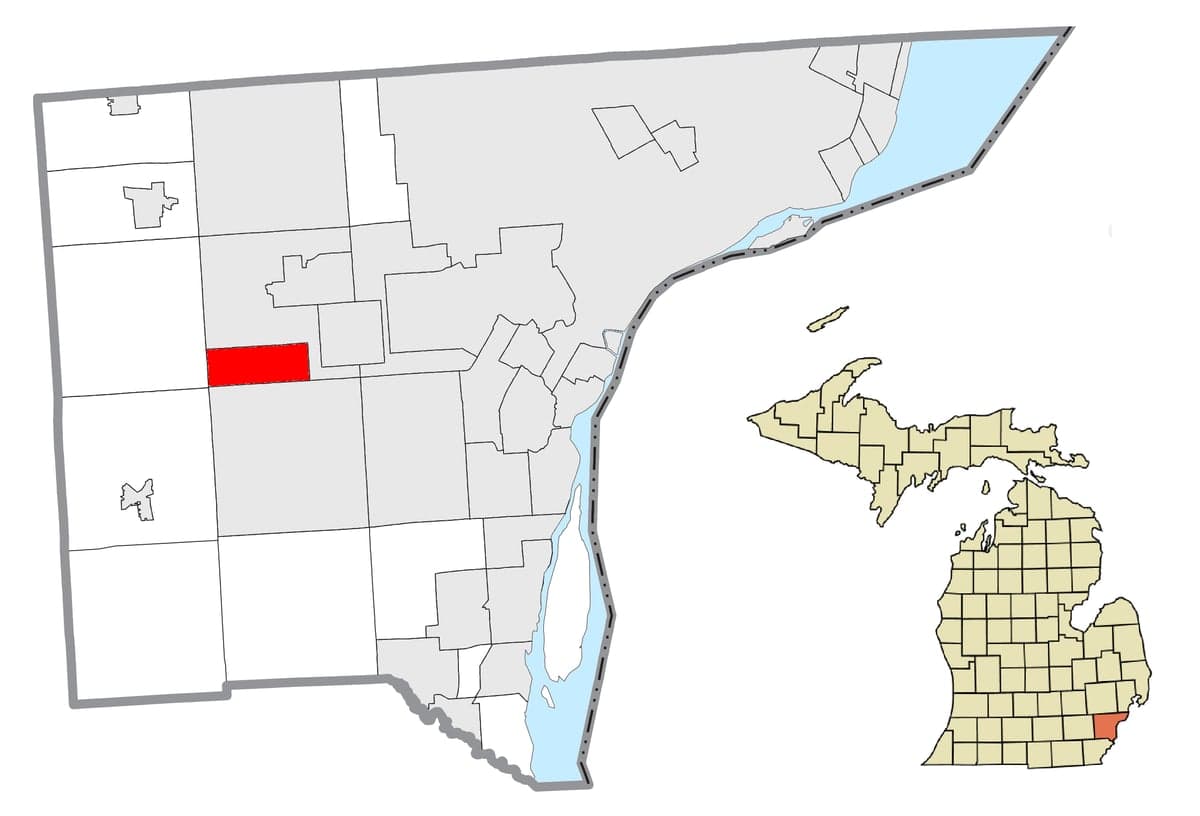
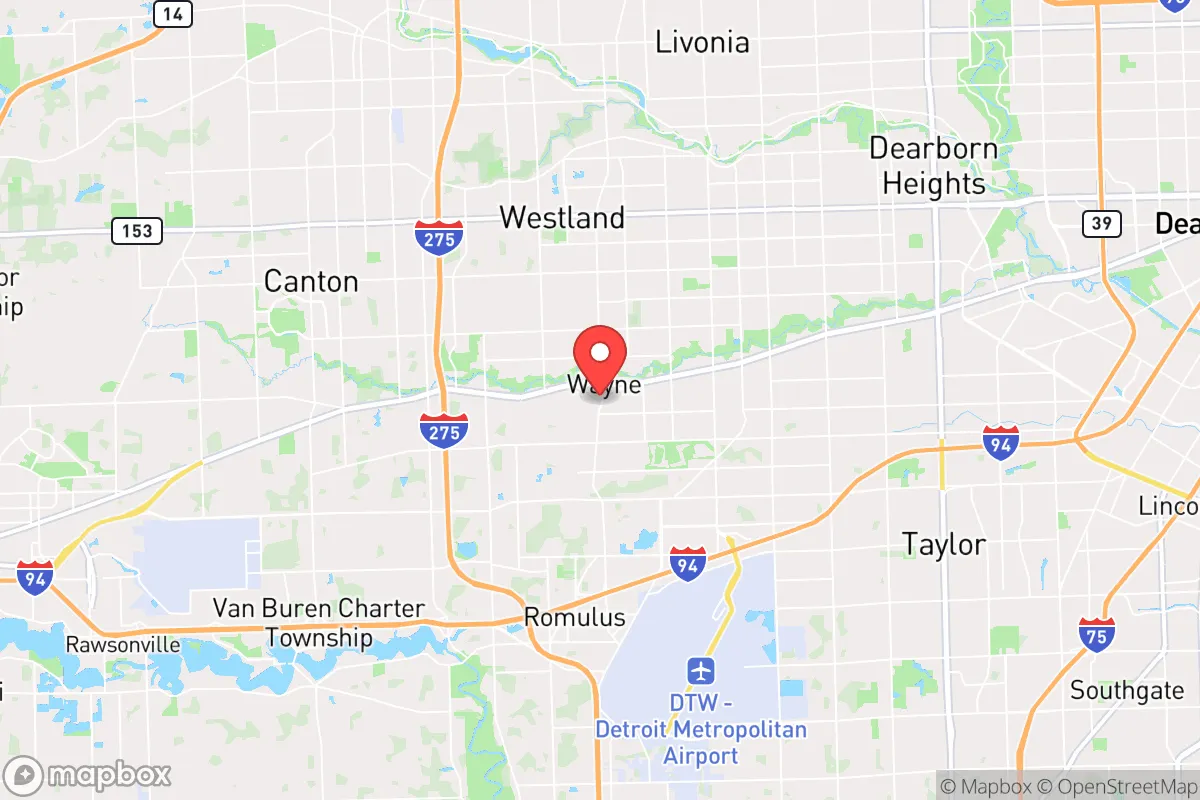
Photo: Wikipedia
Political ClimatePolitical Climate in Wayne, MI
District shown is the primary district for this city’s centroid. Cities may span multiple districts.
* Lean and PVI are calculated from Wayne, MI’s own 2020 presidential results (precinct returns summed to the city), with 2024 estimated from the surrounding county’s 2020–2024 shift, Cook-style. Sources: state election offices; VEST 2020 precinct results (CC BY 4.0).
Political rankings in Michigan
- Most Conservative Cities in Michigan
- Most Liberal Cities in Michigan
- Best Liberal-Leaning Towns in the Midwest
- Safest Liberal-Leaning Towns in the Midwest
- Safest Conservative-Leaning Towns in the Midwest
- Affordable Small Towns for Conservatives
- Most Affordable Liberal-Leaning Small Towns in the U.S.
- Safest Conservative-Leaning Cities in the U.S.
- Most Conservative Counties in Michigan
- Most Liberal Counties in Michigan
Local Political AnalysisPolitical Analysis of Wayne, MI
Wayne, Michigan, is a solidly Democratic stronghold with a Cook Partisan Voting Index (PVI) of D+22, meaning it votes about 22 points more Democratic than the national average. This isn't a recent shift; the city has been a reliable blue anchor in western Wayne County for decades, driven by a strong union tradition, a predominantly working-class population, and a significant African American community. While the surrounding state of Michigan as a whole is a pure toss-up with a Cook PVI of EVEN, Wayne itself has only gotten bluer in recent cycles, as the broader metro Detroit area has polarized along urban-suburban lines.
How it compares
The contrast between Wayne and the rest of Michigan is stark. While the state flipped from Obama to Trump in 2016 and back to Biden in 2020 by razor-thin margins, Wayne consistently delivers Democratic margins of 60-70% in presidential races. Drive 15 minutes west to Canton Township or 20 minutes north to Livonia, and you'll find suburbs that are much more competitive—Canton leans slightly Democratic, while Livonia has trended Republican in recent years. Head another 30 minutes west to communities like Northville or Plymouth, and you're in reliably Republican territory. Wayne's D+22 PVI places it in the same league as Detroit's core neighborhoods, not the swing suburbs that decide statewide elections. This means that while Michigan voters are evenly split and deeply contested, Wayne residents experience a political reality where Democratic candidates rarely have to fight for their votes.
What this means for residents
For liberal residents, Wayne's political climate means their values are reflected in local governance—the city council, school board, and county commissions are overwhelmingly Democratic. You'll see progressive policies on things like minimum wage ordinances, affordable housing initiatives, and support for public sector unions. For conservative residents, life is still perfectly manageable, but you'll be in a clear minority. You won't find many "Trump 2024" signs in front yards, and local political conversations lean left. That said, Wayne is a practical, blue-collar town—people are more focused on potholes, property taxes, and the local Ford plant than on national culture wars. The political lean doesn't translate into the kind of activist intensity you'd see in Ann Arbor or East Lansing; it's more of a quiet, institutional Democratic majority.
One cultural distinction worth noting: Wayne's politics are deeply tied to the United Auto Workers (UAW) and the legacy of the Big Three automakers. The local Democratic Party here is union-first, not necessarily progressive-first. That means you'll find support for things like trade protectionism and fossil fuel jobs that might put Wayne at odds with the national Democratic Party's environmental wing. For a conservative resident, this creates some common ground on economic nationalism, even if social issues remain a divide. Looking ahead, Wayne's political trajectory seems locked in—demographics and union loyalty suggest it will stay D+20 or higher for the foreseeable future, even as the rest of Michigan remains a battleground. The real action for both parties isn't in Wayne itself, but in the surrounding suburbs that will decide who controls the state legislature and the White House.

State Political ClimatePolitical Climate in Michigan
State Political AnalysisPolitical Environment in the State
Michigan is the ultimate swing state, with a Cook PVI of EVEN that perfectly captures its knife-edge political balance. Over the past 20 years, the state has lurched from reliably blue (voting for Democrats in every presidential election from 1992 to 2012) to a true battleground that flipped for Trump in 2016, then flipped back for Biden in 2020, and remains deeply contested heading into 2026. The dominant coalition is a three-way tug-of-war: the heavily unionized, diverse Detroit metro area pulls the state left; the reliably red western and northern Lower Peninsula and Upper Peninsula pull it right; and the fast-growing, politically mixed suburbs of Grand Rapids, Lansing, and Ann Arbor decide every close election. For a conservative-leaning relocator, Michigan offers a mix of blue-state policy constraints and red-state cultural and economic realities, depending on exactly where you land.
Urban vs. rural divide
The political map of Michigan is a textbook study in geographic polarization. Wayne County (Detroit) alone delivers roughly 30% of the statewide Democratic vote, with Detroit’s Black-majority population and strong union base making it one of the most reliably blue urban cores in the Midwest. The collar counties of Oakland and Macomb are the real battlegrounds: Oakland County, once a Republican stronghold, has trended sharply blue since 2016, while Macomb County—home to the famous "Reagan Democrats"—flipped for Trump in 2016 and 2020 and is now a key target for both parties. Meanwhile, the western side of the state tells a different story. Kent County (Grand Rapids) has been slowly trending purple as the city itself grows younger and more diverse, but the surrounding rural areas—like Ottawa County to the west and Allegan County to the south—remain deeply conservative. The northern Lower Peninsula (counties like Grand Traverse, Leelanau, and Emmet) is a mix: the tourist towns along Lake Michigan lean left, while the inland rural areas are solidly red. The Upper Peninsula, once a Democratic stronghold due to mining unions, has shifted rightward over the past decade, with many counties flipping from blue to red. For a conservative relocator, the safest bets are the rural counties west of US-131, the Thumb region, and most of the UP outside of Marquette.
Policy environment
Michigan’s policy environment is a patchwork that reflects its swing-state status. On taxes, the state has a flat income tax of 4.25% (reduced from 4.35% in 2023 via a trigger law) and a 6% sales tax. Property taxes are moderate but vary widely by county, with millage rates typically between 30 and 50 mills. The regulatory posture is mixed: Michigan is a right-to-work state in name only, as the Democratic trifecta repealed the right-to-work law in 2023, meaning private-sector unions can again require dues as a condition of employment. Education policy is a flashpoint: the state has a robust charter school sector (one of the strongest in the Midwest) and a school choice program that includes inter-district open enrollment, but the Detroit Public Schools Community District remains chronically underfunded and underperforming. Healthcare is dominated by the state’s Medicaid expansion under the Affordable Care Act, which covers roughly 1.2 million residents. Election laws are relatively moderate: Michigan has no-excuse absentee voting, same-day voter registration, and early voting (passed via a 2022 ballot initiative), but also requires a photo ID to vote in person (with a signed affidavit as an alternative). For a conservative, the policy environment is a mixed bag: low taxes and school choice are positives, but the repeal of right-to-work and the expansion of voting access are negatives.
Recent policy direction
The last three years under a Democratic trifecta (Governor Gretchen Whitmer, a Democratic House, and a Democratic Senate from 2023-2024) have produced a clear leftward shift on several fronts. On gun and self-defense law, Michigan passed universal background checks and safe storage requirements in 2023, and the state now has a "red flag" law allowing temporary seizure of firearms from individuals deemed a risk to themselves or others. Concealed carry remains shall-issue, but the new laws have drawn sharp opposition from rural counties. On parental and education rights, the state repealed the 2020 "Read by Grade Three" retention law and expanded LGBTQ+ anti-discrimination protections in schools, which has fueled a growing school board activism movement among conservative parents. On speech and privacy, Michigan has no broad shield law for journalists and has seen debates over library book challenges, but no major censorship legislation has passed. On medical and bodily autonomy, the state enshrined abortion rights in the state constitution via a 2022 ballot initiative (Proposal 3), and has since repealed a 1931 abortion ban and expanded access to reproductive healthcare. On property rights, the state has strong eminent domain protections but has seen controversy over renewable energy siting laws that allow wind and solar projects to override local zoning in some cases. On taxation, the 2023 budget included a temporary 0.25% income tax cut, but the overall trajectory is toward higher spending. On voting and ballot access, the 2022 Proposal 2 expanded early voting, absentee voting, and same-day registration, making Michigan one of the most accessible states to vote in the Midwest. For a conservative relocator, the recent direction is clearly leftward on guns, abortion, and union policy, but the state’s direct democracy process (ballot initiatives) means that voters can still push back on legislative overreach.
Civil unrest & political movements
Michigan has been a flashpoint for political activism on both sides. The most visible recent event was the 2020 armed protests at the Michigan State Capitol against COVID-19 lockdowns, which drew national attention and led to the "Wolverine Watchmen" kidnapping plot against Governor Whitmer. That event galvanized both the militia movement (which remains active in rural areas like Livingston County and the UP) and the progressive response, with groups like Michigan United and Indivisible chapters organizing counter-protests. Immigration politics are relatively low-key compared to border states, but the city of Detroit has a "Welcoming City" ordinance limiting cooperation with ICE, while rural counties like Ottawa and Macomb have passed resolutions opposing sanctuary policies. Election integrity remains a live issue: the 2020 election in Michigan saw intense scrutiny, with Republican-led audits in Antrim County (which initially showed a software error) and ongoing litigation over ballot drop boxes and absentee ballot processing. The state has also seen a rise in "county commission" activism, with conservative groups in counties like Ottawa and Livingston pushing for greater local control over election administration. For a new resident, the most visible sign of political tension is the proliferation of yard signs and flags—both "Let’s Go Brandon" and "In This House, We Believe" signs are common in the suburbs—and the occasional protest at the Capitol, which is a regular occurrence during legislative sessions.
Projection
Over the next 5-10 years, Michigan is likely to remain a swing state, but with a slight rightward drift driven by demographic shifts. The key trend is the continued exodus from Detroit and its inner suburbs to the outer exurbs and rural areas, which are overwhelmingly conservative. Macomb County is the bellwether to watch: if it continues trending red, the state could flip back to Trump in 2028. At the same time, the Grand Rapids area is becoming more diverse and younger, which could push Kent County further into the purple column. The Upper Peninsula is likely to continue its rightward shift as mining and manufacturing jobs decline and tourism and remote work bring in more conservative-leaning retirees. The wild card is the state’s growing Hispanic population, concentrated in southwest Michigan (around Holland and Grand Rapids) and the Detroit suburbs, which could become a swing vote. For a conservative relocator, the projection is cautiously optimistic: the state is not going to become Texas or Florida, but the rural and exurban areas will likely become more conservative over time, while the urban cores will remain blue. The policy environment will continue to seesaw depending on which party controls the legislature and governor’s office, which is likely to flip at least once in the next decade.
For a new resident, the bottom line is that Michigan offers a genuine choice. If you land in a rural county like Livingston, Ottawa, or Lapeer, you’ll find a conservative community with low taxes, good schools, and strong property rights—but you’ll also be subject to state-level policies on guns, abortion, and unions that you may disagree with. If you land in a suburb like Macomb Township or Grand Haven, you’ll be in a politically mixed area where every election is a fight. The key practical takeaway is to choose your county carefully: local government in Michigan has significant power over zoning, schools, and law enforcement, so a conservative-friendly county can buffer many of the state-level policies you might dislike. And remember: Michigan’s ballot initiative process means that if the legislature goes too far in either direction, voters can push back directly—as they did with abortion rights in 2022 and voting access in 2022. It’s a state where your vote truly counts, every single cycle.
* Values derived from national, state, county, city and local statistics and may differ in a specific area. Last updated: 2026-11-10T16:30:59.000Z
Narrative content on this page is AI-generated and may contain mistakes. Verify any details that matter before acting on them.
ReloMaps may earn a commission from affiliate links at no extra cost to you.

