

Photo: Wikipedia
Political ClimatePolitical Climate in Waterford, CT
District shown is the primary district for this city’s centroid. Cities may span multiple districts.
Local Political AnalysisPolitical Analysis of Waterford, CT
Waterford, Connecticut, leans Democratic but in a more tempered way than the state as a whole, carrying a Cook PVI of D+4 compared to Connecticut’s D+8. That four-point gap is the key to understanding the town’s political character: it’s a place where Democrats hold a consistent edge, but Republicans remain competitive enough to keep local elections from being foregone conclusions. Over the past decade, the town has shifted slightly leftward, mirroring the broader suburban trend in southeastern Connecticut, but it hasn’t swung as hard as places like New London or Hartford. If you’ve been around since the 1990s, you’d notice that Waterford used to be a true swing town—often splitting its tickets between Republican governors and Democratic legislators—but now it reliably votes blue in presidential races, even if the margins are narrower than in the state’s urban cores.
How it compares
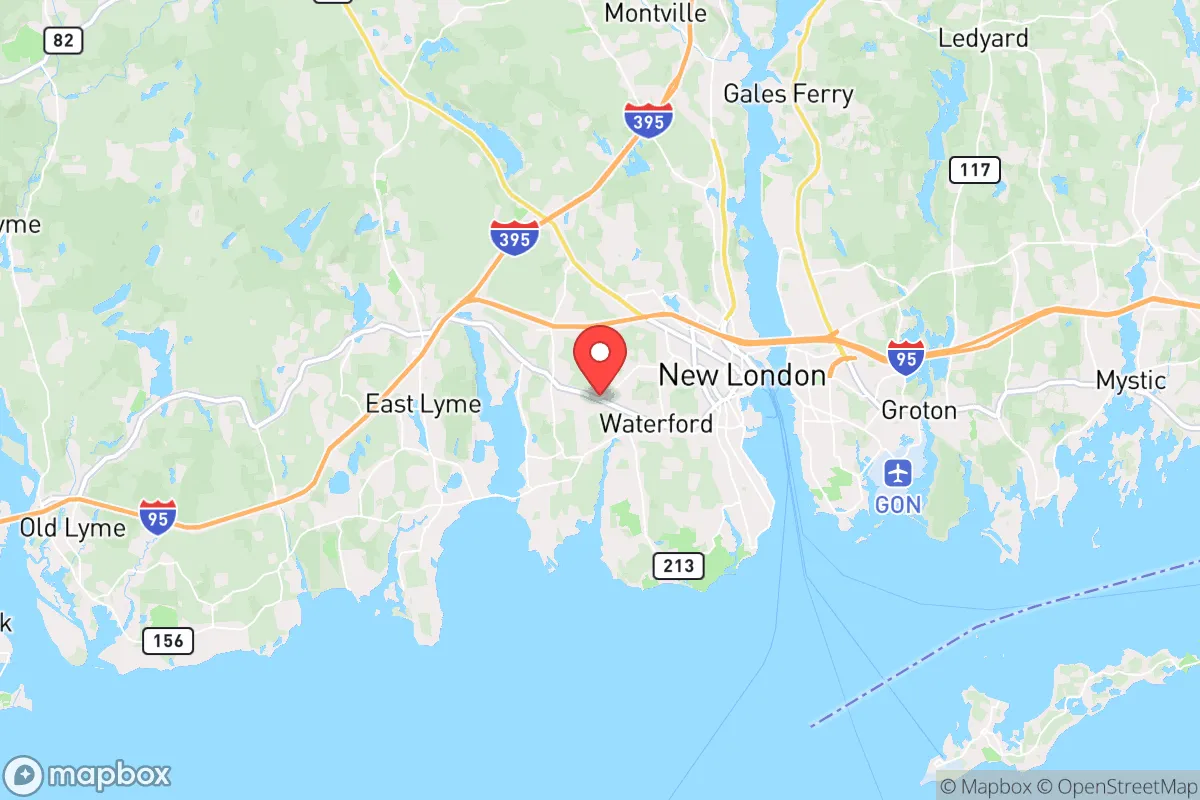
Compared to Connecticut’s D+8 overall, Waterford’s D+4 makes it a relative moderate in a blue state. Drive ten minutes west to New London, and you’ll find a D+18 environment where Democratic dominance is near-total. Head east to Groton, and the PVI is D+6, a bit more Democratic than Waterford but still in the same ballpark. The real contrast is with towns like Ledyard or Montville to the north, which lean Republican (R+4 to R+6) and vote more like the rural parts of eastern Connecticut. Waterford sits right in the middle of this spectrum: it’s not a deep-blue enclave, but it’s not a redoubt either. In state-level races, Waterford often votes for Democratic candidates for governor and U.S. Senate by margins of 8-12 points, while the same candidates win the state by 15-20 points. That means a Republican candidate who can appeal to moderates—like former Governor M. Jodi Rell—can still carry Waterford, even as the state moves left.
What this means for residents
For liberal residents, Waterford offers a comfortable environment where Democratic policies on education, environmental protection, and social services generally have majority support. You won’t feel out of place putting up a yard sign for a presidential candidate, and town government tends to lean progressive on issues like coastal resilience and public school funding. For conservative residents, the picture is more nuanced: you’re not in a deep-blue city where your vote feels meaningless, but you’re also not in a place where conservative candidates win often. Local elections—for the Board of Education, Planning and Zoning, and the Representative Town Meeting—are where Republicans can still make a real impact, often winning 40-45% of the vote and occasionally taking seats. The practical reality is that Waterford’s politics are shaped more by local concerns—like the future of the Millstone Nuclear Power Plant, the town’s largest taxpayer—than by national culture wars. Both sides tend to find common ground on keeping property taxes reasonable and preserving the town’s coastal character.
Culturally, Waterford stands out for its pragmatic, problem-solving approach to governance, a legacy of its history as a shipbuilding and manufacturing hub. You won’t see the kind of performative political theater that dominates in more polarized corners of the state. The town’s political trajectory is likely to stay on its current course: slowly drifting left, but never as fast or as far as Connecticut’s urban centers. For anyone moving here, the takeaway is simple: Waterford is a place where your vote matters more than it would in a deep-blue city, but where the overall political culture is one of moderation and compromise. It’s a town that votes blue but thinks purple.

State Political ClimatePolitical Climate in Connecticut
State Political AnalysisPolitical Environment in the State
Connecticut is a solidly blue state with a Cook PVI of D+8, meaning it typically votes about eight points more Democratic than the national average. Over the last 10-20 years, the state has shifted further left, driven by the growing political dominance of its affluent, educated suburbs and the hollowing out of its once-competitive industrial cities. While it hasn’t flipped in a presidential race since 1988, the margin has widened: Barack Obama won by 17 points in 2012, Joe Biden by 20 in 2020, and Kamala Harris by roughly 14 in 2024. For a conservative relocator, this means you’re moving into a state where Democratic control of the governorship and both legislative chambers is the norm, but the flavor of that control is often more moderate and fiscally cautious than in neighboring New York or Massachusetts.
Urban vs. rural divide
The political map breaks into three distinct zones. The southwestern corner — Fairfield County, anchored by Stamford, Greenwich, and Norwalk — is the engine of Democratic dominance. These are wealthy, highly educated commuter towns where voters reliably deliver 60-70% Democratic margins. The old industrial cities — Hartford, New Haven, Bridgeport — are deep blue strongholds, often voting 80%+ Democratic, but their populations have shrunk, reducing their statewide clout. The rural east and northwest — places like Litchfield County and the Quiet Corner around Windham — are the reddest parts of the state, but they’re small. A town like Litchfield itself might vote 55% Republican, but it’s surrounded by blue-leaning exurbs. The real story is the suburbs: towns like Glastonbury and Simsbury outside Hartford have moved from swing to solidly blue over the past two decades, driven by college-educated professionals who prioritize education spending and social liberalism. If you’re a conservative, you’ll find your strongest communities in the rural northwest (e.g., Torrington, Winsted) and some eastern towns like Killingly, but you’ll be a distinct minority in most of the state.
Policy environment
Connecticut’s policy environment is a mix of high-tax, high-service liberalism tempered by a pragmatic, business-friendly streak. The state has a progressive income tax with rates from 3% to 6.99%, and property taxes are among the highest in the nation — expect to pay 2-3% of assessed value annually. Sales tax is 6.35%, but groceries and prescription drugs are exempt. The regulatory posture is generally pro-labor and pro-environment: the state has a $15.69 minimum wage (indexed to inflation), paid family leave, and aggressive renewable energy mandates. Education is a top priority — Connecticut consistently ranks in the top five nationally for K-12 outcomes, but that comes with per-pupil spending over $20,000, funded largely by local property taxes. Election laws are among the most accessible in the country: no-excuse absentee voting, early voting (passed in 2023), and automatic voter registration at the DMV. For a conservative, the tax burden is the biggest shock — there’s no way around it, and the state has a history of retroactive tax increases (like the 2015 “millionaire’s tax” hike) that erode trust in fiscal predictability.
Recent policy direction
Over the past five years, Connecticut has moved decisively left on several fronts. In 2023, the legislature passed a comprehensive gun safety package that banned open carry, raised the purchasing age to 21, and expanded the state’s assault weapons ban — making it one of the strictest regimes in the country. Self-defense law is narrow: there is no “stand your ground” statute, and Castle Doctrine is limited. On education, the state passed a law in 2022 requiring all public schools to offer universal free meals, and in 2023 it expanded paid family leave to 12 weeks. Parental rights have been a flashpoint: a 2023 bill that would have required schools to notify parents of a child’s gender identity changes failed, but the debate remains heated. On medical autonomy, Connecticut is a strong abortion-rights state, with a 2022 law protecting providers and patients from out-of-state lawsuits. Property rights are constrained by strict zoning laws — the state has fought for years to force towns to allow more multi-family housing, with limited success. Voting access expanded in 2023 with early voting, and a 2024 law made it easier to register on Election Day. For a conservative, the direction is clear: the state is tightening gun laws, expanding social welfare, and limiting local control over education and zoning. There’s no sign of a pivot.
Civil unrest & political movements
Connecticut is not a hotbed of civil unrest, but it has its flashpoints. The Black Lives Matter protests in 2020 were large and sustained in Hartford, New Haven, and Bridgeport, but they were mostly peaceful. On the right, the “CT 2A” movement (Second Amendment activism) is organized and vocal, holding regular rallies at the state capitol — the 2023 gun law passed despite a massive protest. Immigration politics are quieter than in border states: Connecticut is a sanctuary state (by executive order since 2013, codified in 2024), meaning local police don’t enforce federal immigration detainers. This has caused friction in towns like Danbury and Norwalk, where some residents feel the policy attracts undocumented immigrants. Election integrity controversies are minimal — the state uses paper ballots and has strong chain-of-custody rules, and there’s been no major fraud scandal. The most visible political movement is probably the “Fix CT” coalition, a bipartisan group pushing for fiscal reform, including a spending cap and pension reform. You won’t see daily protests, but you will hear constant grumbling about taxes and the cost of living, especially in the rural areas.
Projection
Over the next 5-10 years, Connecticut will likely stay blue, but the margin could narrow slightly. The state is losing population — it’s one of the few states that shrank in the 2020 Census — and the people leaving tend to be younger, less affluent, and more conservative, while the newcomers are often wealthy retirees or remote workers from New York City who lean left. This demographic shift reinforces the Democratic tilt. However, the state’s fiscal challenges — a $30+ billion unfunded pension liability and one of the highest debt-to-GDP ratios in the country — could force a reckoning. If the state is forced to cut services or raise taxes further, it could accelerate out-migration and create a more competitive environment in the suburbs. For now, expect the policy direction to continue: more gun control, more social spending, and more environmental regulation. A conservative moving in now should expect to be in the minority politically, but the state’s small size means your vote matters more in local races — a few thousand votes can flip a state House seat.
Bottom line: If you’re a conservative relocating to Connecticut, you’re coming for the schools, the jobs (especially in insurance, finance, and biotech), or family ties — not the politics. You’ll pay high taxes, live under strict gun laws, and find your values out of step with most of your neighbors in the suburbs and cities. But you’ll also find a state that’s safe, well-run, and politically stable, with a strong tradition of local governance. The rural towns and some eastern exurbs offer like-minded communities, but you’ll need to seek them out. It’s not a state that’s hostile to conservatives — it’s just one where they’re a clear minority, and the policy reflects that. If you can afford the taxes and accept the cultural lean, it’s a perfectly livable place. If those things are dealbreakers, look elsewhere.
* Values derived from national, state, county, city and local statistics and may differ in a specific area. Last updated: 2026-09-18T03:55:44.000Z
Narrative content on this page is AI-generated and may contain mistakes. Verify any details that matter before acting on them.
ReloMaps may earn a commission from affiliate links at no extra cost to you.

