
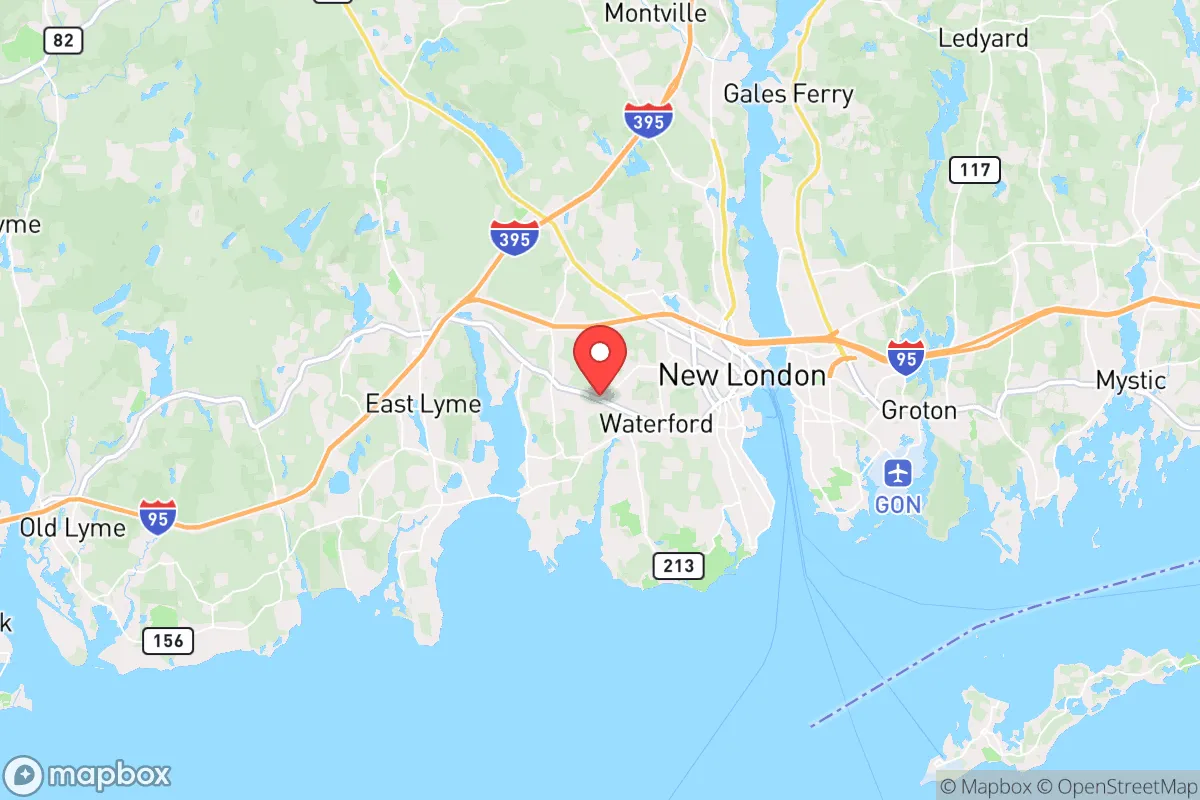
Photo: Wikipedia
Personal Sovereignty in Waterford, CT
Viable for self-reliance. Generally workable, though some barriers may limit total independence.
What does Personal Sovereignty tell us?
Personal Sovereignty measures your capacity for self-reliance and independence with minimal government friction. Higher scores mean fewer barriers between you and the way you want to live... but it assumes you have the space you need and good neighbors.
What does this tell us?
Personal Sovereignty measures your capacity for self-reliance and independence with minimal government friction. Higher scores mean fewer barriers between you and the way you want to live... but it assumes you have the space you need and good neighbors.
State Policy
Energy independence: Importer (5% of energy produced in-state)
Personal Liberty
Homesteading

Personal Liberty Analysis
Waterford, Connecticut, offers a nuanced personal sovereignty environment that balances New England’s traditional community structure with a moderate degree of individual autonomy, making it a viable option for those seeking a quieter, self-directed lifestyle without the extremes of either rural libertarianism or dense urban regulation. The town’s coastal location and suburban character mean that while state-level policies impose a notable regulatory and tax footprint, local governance in Waterford tends to be more pragmatic and less intrusive than in larger Connecticut cities. For a relocation reader prioritizing personal freedom, the key trade-off is between Connecticut’s higher baseline of state control and the tangible benefits of a stable, low-crime community with access to natural resources and a relatively engaged local citizenry.
Tax burden and regulatory posture: what you pay and what you can do
Connecticut carries a reputation for high taxes, and Waterford residents feel that reality directly. The state’s income tax is progressive, with rates from 3% to 6.99% for top earners, and the sales tax is 6.35% — one of the higher rates in New England. Property taxes in Waterford are the most significant local burden, with a mill rate around 24.5 mills (as of 2025), meaning a home assessed at $300,000 incurs roughly $7,350 annually in property tax. This is typical for southeastern Connecticut and funds well-regarded public schools and municipal services. On the regulatory side, Connecticut is a heavy-touch state: it has a strict state building code, environmental regulations that affect coastal construction and septic systems, and a complex permitting process for home businesses or major property alterations. However, Waterford’s local zoning is more permissive than in many inland towns, with larger lot sizes (typically 0.5 to 2 acres in residential zones) that reduce neighbor friction and allow for modest home-based enterprises. The regulatory posture is best described as structured but navigable — you will file more paperwork than in a Texas or Florida suburb, but the process is predictable and appeals are handled through a local planning and zoning commission that is generally responsive to residents.
Self-defense and gun law specifics: what Connecticut allows and restricts
For a reader prioritizing the right to self-defense, Connecticut presents a mixed picture. The state requires a permit to carry a handgun, either openly or concealed, and the process involves a background check, a firearms safety course, and a fee. As of 2025, Connecticut is a “may-issue” state in practice, though local authorities in Waterford (the town’s police department) process permits without the extreme delays seen in some urban jurisdictions. The state also bans certain “assault weapons” by feature and name, limits magazine capacity to 10 rounds, and requires universal background checks for all firearm transfers, including private sales. On the positive side, Connecticut recognizes permits from a limited number of other states, and Waterford’s rural-suburban character means that target shooting on private property is generally tolerated if done safely and with neighborly consideration. Stand-your-ground laws do not exist in Connecticut; the state imposes a duty to retreat in public spaces before using deadly force, though the Castle Doctrine applies within one’s home. For a self-defense-minded individual, Waterford offers a lawful path to firearm ownership but with more administrative hurdles and fewer legal protections than in states like New Hampshire or Maine. The practical reality is that most gun owners in Waterford comply with the permit system, and the town’s low violent crime rate (typically under 1 incident per 1,000 residents annually) means that defensive firearm use is rare.
Self-reliance and homesteading viability: lot sizes, zoning, and off-grid feasibility
Waterford’s residential zoning is a strong point for those interested in self-reliance. The town’s R-20 and R-40 zones require minimum lot sizes of 20,000 and 40,000 square feet respectively, which translates to roughly half-acre to one-acre parcels. Many older neighborhoods have even larger lots, with some properties exceeding two acres. This space allows for substantial vegetable gardens, small orchards, and even a few chickens or rabbits (subject to local animal ordinances, which permit up to six hens without a special permit, but no roosters). Off-grid living is effectively impossible within town limits due to Connecticut’s building code requiring connection to the electrical grid for new construction, and the state’s health code mandates septic systems or sewer connections for wastewater. Rainwater collection is legal but limited to non-potable uses, and solar panels are permitted but must comply with local setback and aesthetic rules. For a serious homesteader, the biggest constraint is the property tax burden, which makes large land holdings expensive to carry. A more viable path is to purchase a home on 1–2 acres, install a greenhouse, raise chickens, and supplement with local farmers’ markets and community-supported agriculture (CSA) shares from nearby farms in Ledyard or Stonington. Waterford’s coastal location also provides access to fishing and shellfishing, with a town-run shellfish program that allows residents to harvest clams and oysters from designated beds with a low-cost permit. The overall homesteading viability is moderate and suburban — you can achieve meaningful self-reliance, but full independence from municipal services is not realistic.
Personal liberties: parental rights, medical autonomy, speech, and property
Connecticut’s state-level policies lean progressive, which affects several dimensions of personal liberty. Parental rights are generally respected in Waterford’s public schools, with a school board that has historically been moderate and responsive to community input. The state mandates comprehensive sex education and has a vaccine requirement for school attendance (with medical and religious exemptions available, though the religious exemption has faced legal challenges). Medical autonomy is more restricted than in many states: Connecticut has a robust public health infrastructure, and during health emergencies, the state has shown willingness to mandate masking and vaccination. However, for routine medical decisions, adults have broad freedom to choose treatments, and the state does not impose restrictions on alternative medicine beyond standard licensing requirements. Free speech is fully protected under the First Amendment, and Waterford’s public spaces — including the town green and library — are used for political and community gatherings without significant friction. Property rights are constrained by Connecticut’s relatively strong eminent domain laws and by coastal regulations that limit development near Long Island Sound. The state also has a statewide property tax on motor vehicles (the “car tax”), which is assessed annually based on the vehicle’s value — a notable imposition on personal property that many residents find burdensome. Waterford’s local government is the key moderating factor: town meetings and elected boards provide a forum for residents to push back against overreach, and the community’s independent streak means that state mandates are sometimes implemented with local flexibility.
Overall, Waterford’s personal sovereignty profile is best described as structured freedom within a high-tax, moderate-regulation state. Compared to rural areas of New Hampshire or Maine, the regulatory and tax burden is heavier, and the path to self-reliance is more constrained by state codes and property costs. However, compared to Connecticut’s larger cities like Hartford or New Haven, Waterford offers more space, lower crime, and a local government that is more responsive to individual concerns. For a conservative-leaning reader who values community stability, access to nature, and a predictable legal environment, Waterford provides a viable middle ground — you will not enjoy the near-total autonomy of a rural Western county, but you will also avoid the chaos and overreach of a dense urban jurisdiction. The key is to enter with eyes open: budget for the tax burden, understand the gun laws, and accept that full off-grid independence is not on the table. For those willing to work within these parameters, Waterford offers a solid foundation for a self-directed life.

* Values derived from national, state, county, city and local statistics and may differ in a specific area. Last updated: 2026-09-18T03:55:44.000Z
Narrative content on this page is AI-generated and may contain mistakes. Verify any details that matter before acting on them.
ReloMaps may earn a commission from affiliate links at no extra cost to you.

