Photo: Wikipedia
Demographics of Yakima County
Affluence Level in Yakima County
A middle-class area roughly in line with national averages across income, home values, education, and employment.
People of Yakima County
Today, Yakima County is home to 256,605 residents, making it one of Washington’s most demographically distinctive counties. It is a majority-Hispanic county (51.6%) with a significant White non-Hispanic population (40.1%), a small but growing East/Southeast Asian community (1.0%), and a very small Black (0.7%) and Indian-subcontinent (0.1%) presence. The county’s identity is shaped by its agricultural economy, its deep-rooted Native American heritage, and a history of successive immigrant waves that have created a bilingual, bicultural region where Spanish is heard as commonly as English in many neighborhoods.
Settlement & growth (pre-1960)
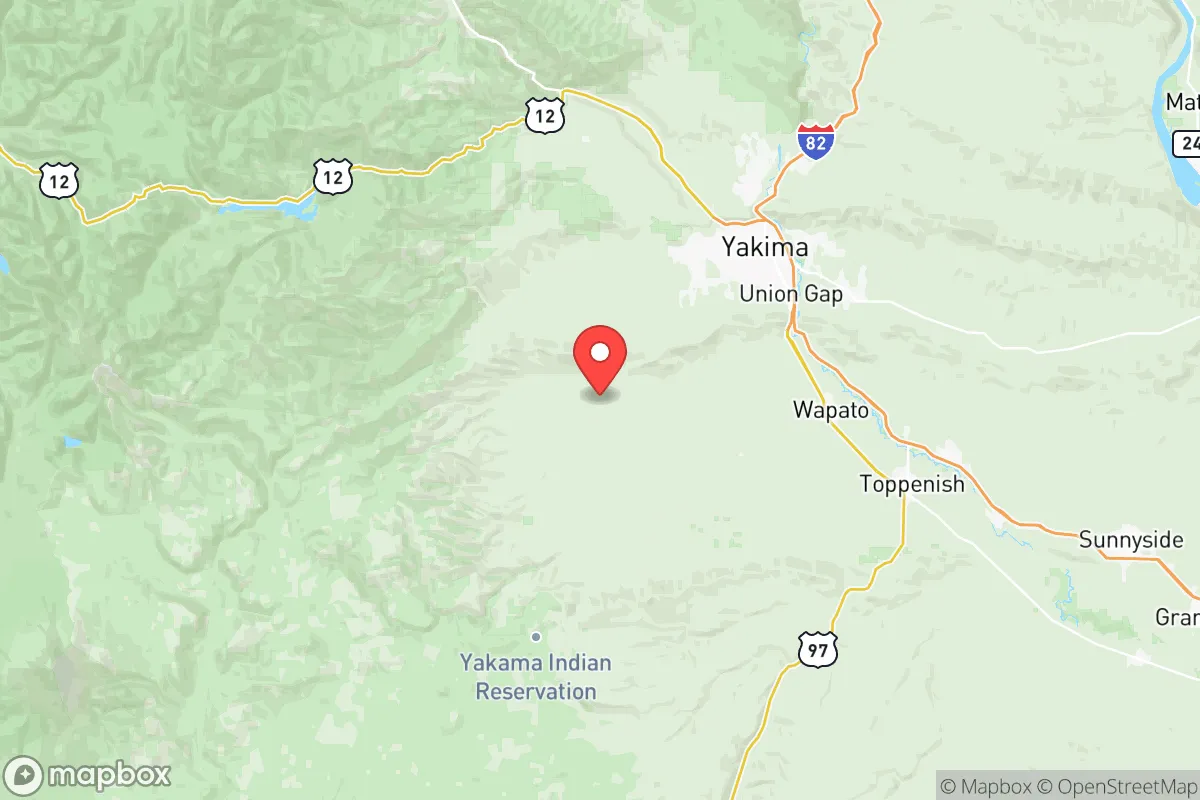
Long before European settlement, the Yakama Nation—a confederation of tribes speaking Sahaptin dialects—controlled the vast Columbia Plateau, including the entire area of modern Yakima County. The Yakama people lived in seasonal villages along the Yakima River and its tributaries, fishing for salmon, gathering roots, and hunting game. The 1855 Treaty of Yakima established the Yakama Indian Reservation, which today covers roughly 1.3 million acres in the county’s southeastern portion, including the communities of Toppenish, Wapato, and White Swan. The treaty ceded most of the tribe’s ancestral lands to the U.S. government, but the reservation remains the cultural and political heart of the Yakama Nation.
American settlement began in earnest after the Northern Pacific Railroad reached the area in the 1880s, transforming the arid sagebrush steppe into irrigated farmland. The first major wave of non-Native settlers were Anglo-American homesteaders from the Midwest and Great Plains, drawn by the promise of cheap land and the newly available irrigation water from the Yakima River. Towns like Yakima (founded 1885), Sunnyside (1902), and Grandview (1906) sprang up as agricultural service centers. By 1910, the county’s population had reached 41,709, overwhelmingly White and native-born.
The second major wave came during and after the Dust Bowl of the 1930s, when tens of thousands of displaced farmers from Oklahoma, Texas, and Arkansas—often called “Okies”—migrated west along U.S. Highway 97 and the Columbia River. Many settled in Yakima County’s agricultural towns, particularly Sunnyside, Grandview, and Prosser (the latter now in Benton County but historically tied to the same migration). These Dust Bowl migrants brought a distinct Southern Plains culture—country music, evangelical Protestantism, and a strong work ethic—that still echoes in the county’s rural communities today.
Simultaneously, the county’s agricultural boom created a demand for seasonal labor that drew Mexican immigrants and Mexican-American migrant workers. The Bracero Program (1942–1964) brought thousands of Mexican men to work in Yakima Valley orchards and hop fields. Many stayed, establishing permanent communities in Yakima, Toppenish, and Wapato. By 1960, the county’s population had grown to 113,101, with a Hispanic share of roughly 10–15%, concentrated in the lower Yakima Valley towns.
Modern era (post-1965)
The 1965 Hart-Cellar Act, which abolished national-origin quotas, fundamentally reshaped Yakima County’s demographics. While the county did not see the large-scale Asian or African immigration that transformed coastal cities, it experienced a sustained wave of Mexican and Central American immigration that accelerated through the 1970s and 1980s. Family reunification provisions allowed earlier bracero-era workers to sponsor relatives, creating chain migration that swelled the Hispanic population from about 15% in 1970 to over 40% by 2000.
Today, the Hispanic population stands at 51.6%, making Yakima County one of the few majority-Hispanic counties in the Pacific Northwest. The largest concentrations are in the lower valley towns: Toppenish (roughly 85% Hispanic), Wapato (80%), Sunnyside (75%), and Grandview (70%). In the city of Yakima, the Hispanic share is about 50%, with neighborhoods east of 16th Avenue and south of Yakima Avenue being predominantly Hispanic. The county’s agricultural economy—apples, cherries, hops, wine grapes, and dairy—remains the primary economic draw, though many second- and third-generation Hispanic residents now work in construction, healthcare, and retail.
The White non-Hispanic population, now 40.1%, has aged and declined in relative terms, though it remains the majority in the county’s more rural and higher-elevation areas, such as Naches, Tieton, and the upper Yakima Valley near Ellensburg (Kittitas County). Many White families have moved to newer subdivisions on Yakima’s west side or to bedroom communities like Terrace Heights and West Valley, creating a degree of residential separation by ethnicity and income.
The East/Southeast Asian community (1.0%) is small but notable, concentrated in Yakima and Sunnyside, with roots in Filipino and Vietnamese immigration that began after 1975. The Indian-subcontinent population (0.1%) is tiny, mostly professionals in healthcare and tech. The Black population (0.7%) is similarly small, with most living in Yakima and Toppenish, many descended from military families stationed at nearby Joint Base Lewis-McChord or from agricultural workers who arrived in the 1940s and 1950s.
The future
Yakima County is projected to become more Hispanic and more bilingual over the next two decades. The Hispanic population is younger (median age 26) than the White population (median age 42), and higher birth rates among Hispanic families will continue to drive the county’s demographic shift. By 2040, the Hispanic share could approach 60%, with the White non-Hispanic share falling to around 30%. The East/Southeast Asian and Black populations are expected to grow slowly, likely remaining below 2% each, as the county’s economy does not attract the same diversity as Seattle or the Puget Sound region.
New residential development is concentrating in Yakima’s west side and in unincorporated areas near Terrace Heights and West Valley, where newer subdivisions cater to middle-class families—both White and Hispanic. The lower valley towns like Toppenish and Wapato are likely to remain predominantly Hispanic and working-class, while the reservation communities of White Swan and Harrah will continue to be centers of Yakama Nation life. The county’s cultural identity is evolving from a historically Anglo-American agricultural society into a bilingual, bicultural region where Spanish-language media, Mexican-American festivals, and traditional rodeo culture coexist.
For someone moving in now, Yakima County offers a unique blend of small-town agricultural life, a strong sense of community, and a demographic reality that is increasingly Hispanic and younger than the rest of Washington. The county is not becoming more diverse in the broad sense—it is becoming more specifically Hispanic, with other ethnic groups remaining small. This means newcomers, whether White, Hispanic, or other, will find a place where the dominant cultural conversation is between English and Spanish, where agriculture still defines the economy and the calendar, and where the Yakama Nation remains a vital, sovereign presence in the county’s southeastern corner.

* Values derived from national, state, county, city and local statistics and may differ in a specific area. Last updated: 2026-06-22T19:01:04.000Z
Narrative content on this page is AI-generated and may contain mistakes. Verify any details that matter before acting on them.
ReloMaps may earn a commission from affiliate links at no extra cost to you.

