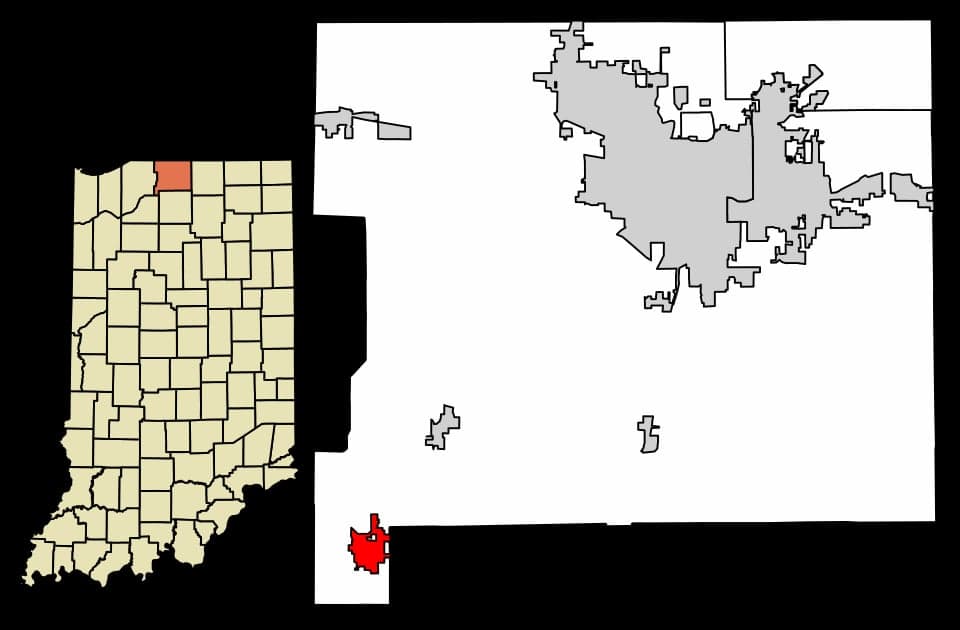
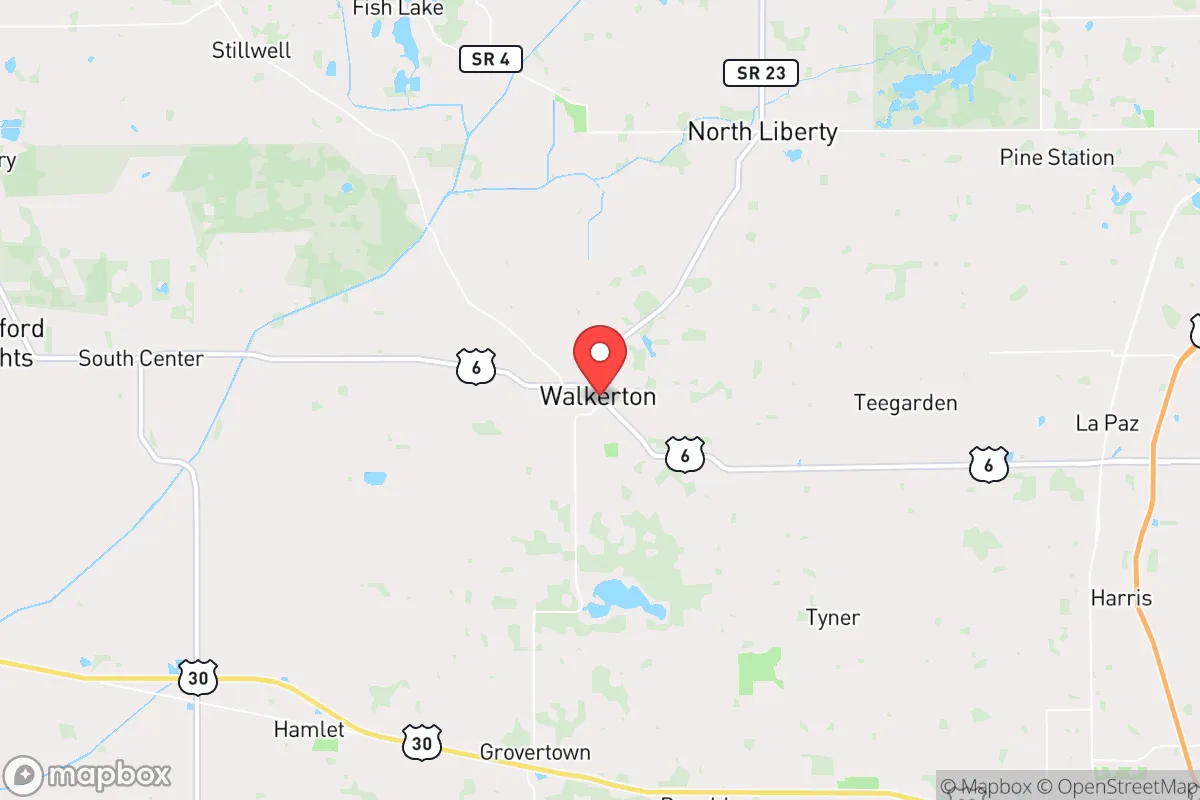
Photo: Wikipedia
Political ClimatePolitical Climate in Walkerton, IN
District shown is the primary district for this city’s centroid. Cities may span multiple districts.
Local Political AnalysisPolitical Analysis of Walkerton, IN
Walkerton sits in a county and congressional district that lean noticeably further right than Indiana as a whole — a Cook Partisan Voting Index of R+13 against the statewide R+9. In practice, that four-point gap means Walkerton-area voters back Republicans by margins you'd have to drive toward Indianapolis or Gary to find matched on the other side. The lean isn't new. Marshall and St. Joseph County farm country has voted reliably Republican for decades, and the town's politics have tracked the surrounding township more than they've tracked South Bend, twelve miles north.
How it compares to the rest of Indiana
Indiana's R+9 already makes it one of the more comfortably red states in the Midwest, but Walkerton's R+13 puts it in the deeper-red tier alongside places like Warsaw, Auburn, and the rural stretches of Elkhart County. The contrast sharpens as you move north: South Bend and Mishawaka anchor St. Joseph County's Democratic base, and Notre Dame's campus and the GM/Stellantis plants keep organized labor and university politics visible there. Walkerton residents commute into that economy but don't share its ballot. Meanwhile, Plymouth to the south and Knox to the west reinforce the conservative norm. The practical result is that Walkerton's state representative and state senator races are rarely competitive, and its congressional seat has been safely Republican through several redistricting cycles.
What this means for residents
For conservative residents, the lean is mostly invisible — it means primary elections decide more than general elections, so the real political action happens in May, not November. Local township trustee, school board, and county council races carry more weight than the federal ballot for daily life. For liberal residents, the reality is quieter: you can vote your conscience, but you'll rarely see a competitive local race, and your influence comes through showing up at school board meetings and township meetings rather than through party organizing. Both sides will tell you the same thing — Walkerton politics is personal and face-to-face, not partisan theater. Neighbors disagree about guns and school curriculum at the diner and then help each other pull a truck out of a ditch. That's not a cliché here; it's how a town of about 2,200 people actually functions.
Where it's heading
The trajectory looks stable rather than shifting. Walkerton's population is older and slower-growing than the South Bend metro, and the town hasn't attracted the kind of suburban influx that has nudged some exurban counties toward the middle. If anything, the R+13 margin may hold or widen slightly as rural Marshall County continues to consolidate around the Republican Party. The wildcard is South Bend's economic spillover — if commuter housing pressure pushes younger, more diverse families west into Walkerton, the town's politics could soften over a decade or two, the way it has in pockets of St. Joseph County. Nobody's betting on that happening soon.
The cultural distinction worth knowing: Walkerton's conservatism is more small-government and agricultural than the culture-war variety you see in some Indiana towns. The town's identity runs through the Tippecanoe River, the school corporation, and the grain elevators — not through national political fights. That localism shapes policy too: residents tend to care more about drainage districts, road maintenance, and school funding formulas than about the issues that dominate cable news. It's a place where the politics are red, but the governing is practical.

State Political ClimatePolitical Climate in Indiana
State Political AnalysisPolitical Environment in the State
Indiana is a solidly Republican state — Cook Political Report rates it R+9 — and it has only gotten redder over the past two decades. Republicans hold every statewide office, supermajorities in both legislative chambers, and have carried the state in every presidential election since 2008, with Donald Trump winning by roughly 17 points in 2020 and about 19 points in 2024. The coalition driving that is a familiar one: rural and small-town voters, evangelical and Catholic church networks, gun owners, business owners, and — increasingly — working-class families in the industrial north and the suburban donut counties around Indianapolis. Democrats retain a real but narrowing base in Indianapolis, Gary, South Bend, and Bloomington. If you're moving here from a blue state, the practical reality is that state policy will be set by Republicans for the foreseeable future regardless of how your particular county votes.
Urban vs. rural divide
The political map breaks cleanly along metro lines. Marion County (Indianapolis) votes heavily Democratic, as do Lake County (Gary, Hammond, East Chicago) in the northwest and St. Joseph County (South Bend) in the north. Monroe County, home to Bloomington and Indiana University, is the most reliably progressive county in the state. But the suburbs that once softened that advantage have flipped: Hamilton County — Carmel, Fishers, Noblesville — was a Republican bastion that has trended Democratic in recent cycles as affluent, college-educated voters moved in, even as the state overall moved right. Meanwhile the old Democratic strongholds of the Wabash Valley and the industrial towns around Terre Haute, Kokomo, and Muncie have drifted Republican, and the rural counties of southern Indiana — think Jasper, Crawford, and Washington — are now among the reddest places in the state. The net effect: Democrats win cities, Republicans win everything else, and the suburbs are the only genuinely contested ground.
Policy environment
Indiana is a low-tax, light-regulation state by design. The individual income tax sits at 3.0% (scheduled to keep ticking down under a 2023 law), the sales tax is 7%, and property taxes are capped by constitutional amendment at 1% for homesteads, 2% for other residential and farmland, and 3% for business — a structure that keeps homeowner bills predictable but starves local governments and schools of revenue. The state is a right-to-work state, has no state-level prevailing wage, and generally runs a business-friendly regulatory shop. On education, Indiana has one of the nation's most expansive school choice programs — the Choice Scholarship voucher program was dramatically expanded in 2021 and now reaches families well up the income scale — alongside a growing charter sector. Medicaid is administered through the Healthy Indiana Plan, a consumer-driven model with work requirements that has been a national template. Election law is middle-of-the-road: photo ID required, no-excuse absentee voting by mail, early voting available, and a Republican secretary of state overseeing it all.
Recent policy direction
The last several sessions have pushed the state in a distinctly conservative direction on social and cultural questions while staying pro-business on economics. On guns, Indiana eliminated its handgun carry permit requirement in 2022 (a "constitutional carry" law signed by Gov. Eric Holcomb), and the state has a strong self-defense statute. On education and parental rights, the 2023 and 2024 sessions advanced curriculum transparency, restrictions on instruction about gender identity in early grades, and a "parents' bill of rights" framework; the voucher expansion remains the signature achievement. On speech and privacy, Indiana has been less aggressive than some neighbors — no broad state-level speech codes, but the state does participate in the national trend of school and library book-challenge processes that have removed titles in some districts. On medical and bodily autonomy, Indiana enacted one of the nation's stricter abortion bans in 2022 (SB 1), with narrow exceptions, and it has been litigated and narrowed in the courts; a new resident should expect restricted access and a continuing legal fight. On property rights, the state has moved to limit local governments' ability to regulate short-term rentals and to preempt local ordinances in several areas. On voting, the 2021 and 2023 sessions tightened some absentee and third-party ballot-access rules while keeping the core ID-and-early-voting framework intact. The through-line: fewer mandates, more parental and property-owner control, and a legislature willing to override cities.
Civil unrest & political movements
Indiana has not been a national flashpoint for sustained unrest, but it has its moments. Indianapolis saw Black Lives Matter protests and some property damage in 2020, and the state has an organized conservative grassroots network — tea-party-descended groups, county Republican clubs, and church-based organizing — that turns out reliably. Immigration politics is live: Indiana has no sanctuary-city law, and some Republican legislators have repeatedly pushed to penalize localities that decline to cooperate with federal immigration enforcement, though Indianapolis and some college towns have resisted. Election integrity controversies have been modest compared with Arizona or Georgia — a few county-level disputes over voting machines and a 2020 push to expand mail voting that failed — but the secretary of state's office has faced scrutiny over vendor contracts. Secession or nullification rhetoric is essentially absent; this is a mainstream Republican state, not a fringe one. What a new resident would actually notice: yard signs, church-based political networks, and a state legislature that moves fast and doesn't much care what the cities think.
Projection
Over the next five to ten years, expect Indiana to stay Republican and probably get slightly more so at the state level, even as the Indianapolis suburbs and Bloomington pull the other way. The demographic story is mixed: in-migration from Illinois and California is real, especially into the Indianapolis metro and the lakefront, and those movers are not uniformly conservative — the Hamilton County shift is the leading indicator. But rural population loss and the consolidation of the Republican coalition among working-class and churchgoing voters likely outweighs it in statewide races. On policy, watch for further income-tax reductions, continued voucher expansion, more preemption of local ordinances, and a continuing legal battle over abortion access. The state's fiscal position is strong, which gives it room to cut taxes and invest in roads and broadband. The realistic expectation for a newcomer: a state that is comfortably conservative, business-friendly, and culturally traditional, with a few blue islands that will remain blue but will not set state policy.
Bottom line for someone choosing Indiana: if you want low taxes, strong gun rights, school choice, and a state government that reliably reflects traditional values, Indiana delivers and will keep delivering. If you're liberal, you can find a comfortable life in Indianapolis, Bloomington, or parts of South Bend and the near suburbs, but you should go in knowing that state-level policy — on abortion, education, guns, and taxes — will be set by the other side, and that local ordinances you care about can be preempted from the Statehouse. The practical advice: pick your county as carefully as your house, because in Indiana the county line often matters more than the state line.
* Values derived from national, state, county, city and local statistics and may differ in a specific area. Last updated: 2026-11-03T15:06:36.000Z
Narrative content on this page is AI-generated and may contain mistakes. Verify any details that matter before acting on them.
ReloMaps may earn a commission from affiliate links at no extra cost to you.

