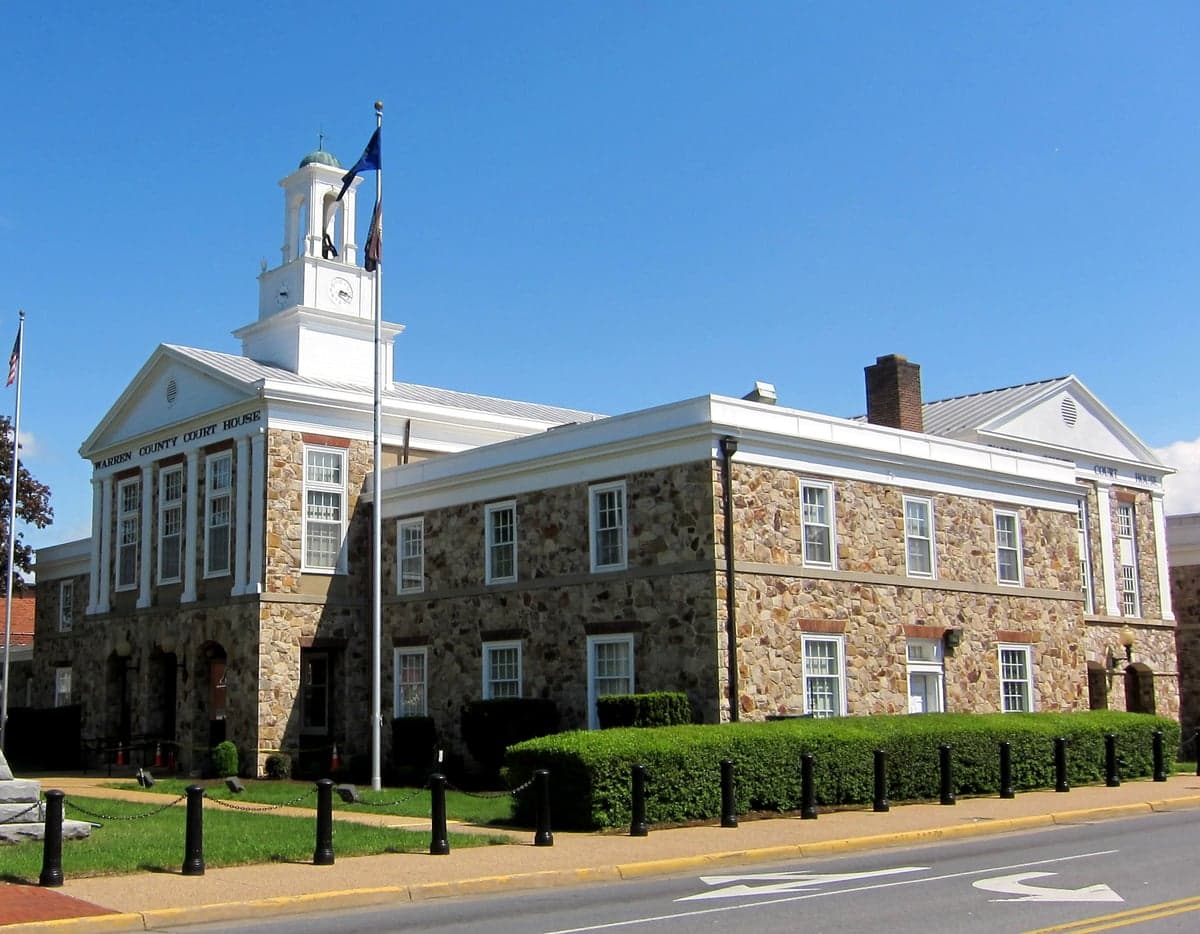
Photo: Wikipedia
Political ClimatePolitical Climate in Warren County
Showing state-level results — no local-only data available.
Local Political AnalysisPolitical Analysis of Warren County
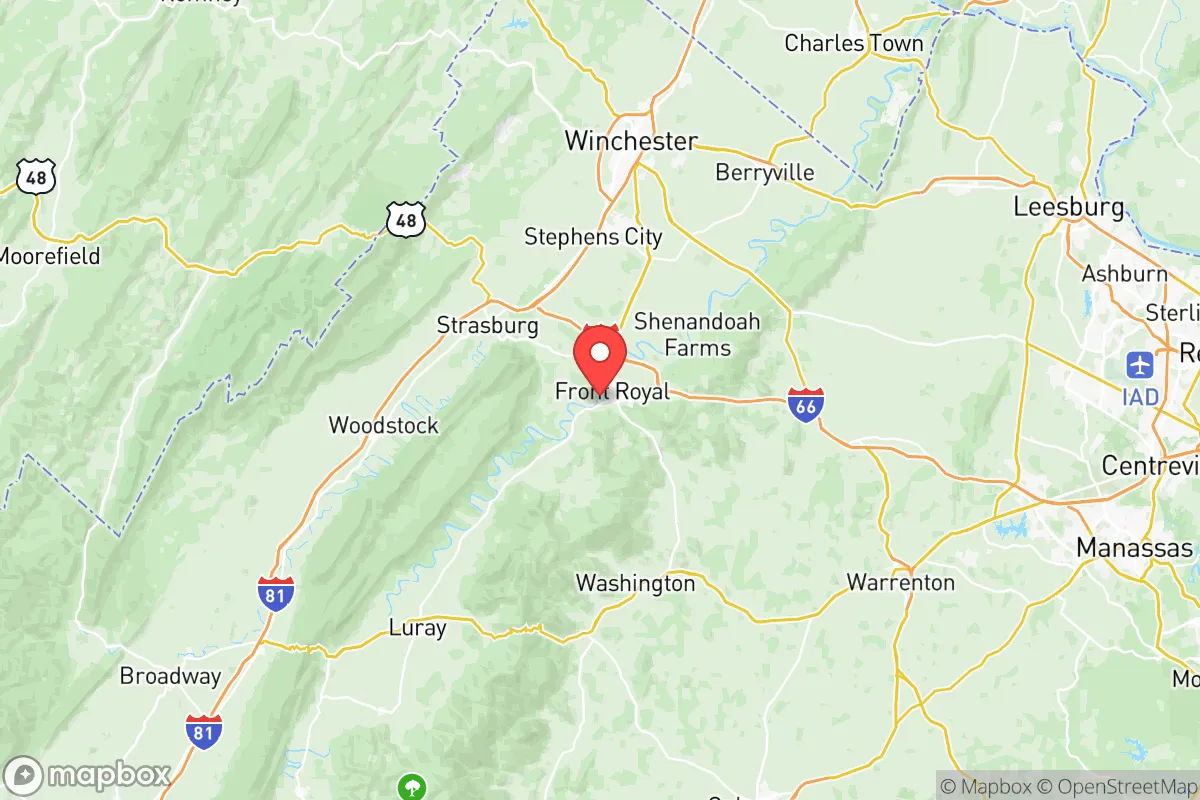
Warren County, Virginia, is a reliably conservative area that has only grown more Republican in recent cycles, carrying a Cook Partisan Voting Index of R+12. That puts it a full 16 points to the right of the state of Virginia as a whole, which sits at D+4. The county has voted for the GOP presidential candidate in every election since 2000, and in 2024, Donald Trump carried it by roughly 20 points. But don’t let the countywide number fool you—there’s real variation on the ground. The town of Front Royal, the county seat and largest population center, is the political bellwether: its downtown precincts, especially around the historic district, have trended bluer in recent years, while the rural stretches west of town toward Linden and north toward Riverton are deep red. The swing precincts are actually in the suburbanizing areas along Route 340 south of Front Royal, where new arrivals from Northern Virginia have made races for the Board of Supervisors tighter than they were a decade ago.
How it compares
Virginia’s statewide D+4 PVI reflects the dominance of the D.C. suburbs and the urban crescent from Northern Virginia down through Richmond and Hampton Roads. Warren County sits in the Shenandoah Valley, a region that has long been the state’s conservative counterweight. The contrast is stark: while Fairfax County votes D+30, Warren votes R+12. That gap has widened since 2016, as the state’s blue areas got bluer and Warren’s red areas got redder. In the 2023 state legislative elections, the county’s House of Delegates district (HD-31) went Republican by 18 points, while the state Senate district (SD-1) went Republican by 14 points—both well above the county’s baseline. The only place in the county where Democrats consistently compete is in the town of Front Royal itself, where the 2023 House race was decided by just 4 points in the town’s precincts. Outside town limits, Republican margins routinely hit 30 points or more.
What this means for residents
For conservative residents, Warren County feels like a stronghold. The local government—the Board of Supervisors, the School Board, and the constitutional officers—is uniformly Republican. Gun rights are widely respected, property taxes are low relative to Northern Virginia, and the county’s zoning code is deliberately rural. For liberal residents, the reality is more mixed. You’ll find like-minded neighbors in Front Royal’s historic district and among the growing number of remote workers who moved here from D.C. during the pandemic. But you won’t find a Democratic elected official above the town council level. The local Democratic committee is active but small, and its candidates typically run on a platform of fiscal restraint and land conservation rather than progressive social issues. The practical effect is that the county’s politics are stable and predictable—no sudden policy swings, but also little appetite for the kind of rapid change that Northern Virginia has seen.
Culturally, Warren County is distinct from the rest of Virginia in a few key ways. The county is one of the few in the state that still enforces a local ordinance requiring a permit for open carry of firearms in public spaces, a holdover from the 1990s that has survived multiple legal challenges. There’s also a strong independent streak: the county was one of the first in Virginia to pass a Second Amendment Sanctuary resolution in 2019, and it has consistently resisted state-level mandates on land use and education. At the same time, the influx of telecommuters from Northern Virginia has nudged the county’s politics slightly toward the center on issues like broadband expansion and environmental protection. The result is a place where the old guard and the newcomers are still figuring out how to share the same county—but so far, the old guard is still setting the pace.

State Political ClimatePolitical Climate in Virginia
State Political AnalysisPolitical Environment in the State
Virginia has shifted from a reliably purple swing state to a solidly Democratic-leaning one over the past two decades, with a Cook PVI of D+4. The transformation is driven by explosive growth in the Washington, D.C. suburbs, particularly in Northern Virginia, which now dominates statewide elections. While the state still elects Republican governors in off-years and maintains a competitive legislature, the underlying demographic and cultural trends point toward a continued leftward drift, especially on social and cultural issues.
Urban vs. rural divide
The political map of Virginia is a tale of two commonwealths. The urban crescent stretching from Northern Virginia through Richmond to Hampton Roads is overwhelmingly Democratic. Fairfax County alone, with over 1.1 million residents, votes about 65-70% Democratic in presidential elections. Loudoun County, once a Republican stronghold, flipped decisively blue after 2016 and now routinely votes D+15 or more. Meanwhile, rural and exurban areas like Roanoke, Lynchburg, and the Shenandoah Valley remain deeply Republican. The divide is stark: in 2024, Prince William County voted D+18 while Montgomery County (southwest Virginia) voted R+45. The Richmond suburbs, particularly Henrico County, have also trended blue, while Chesterfield County remains a competitive swing area. The result is a state where Democrats win statewide by piling up massive margins in the urban crescent while losing the rest of the state by wide margins.
Policy environment
Virginia's policy environment reflects its divided government and recent Democratic control. The state has a flat income tax rate of 5.75%, with no local income taxes, and a state sales tax of 4.3% (plus local add-ons). Property taxes are set locally and vary widely—Arlington County has rates around $1.01 per $100 of assessed value, while Roanoke County is about $0.75. Education policy is largely local, but the state has adopted the Virginia Standards of Learning (SOLs) and has seen recent battles over transgender student policies and critical race theory in schools. Healthcare is dominated by large systems like VCU Health and Inova, with Medicaid expansion enacted in 2019 under Governor Ralph Northam. Election laws are moderately restrictive: Virginia requires a photo ID to vote, offers no-excuse absentee voting, and has same-day voter registration. The state does not have a "stand your ground" law, but it does have a "castle doctrine" and a permitless concealed carry law that took effect in 2021.
Recent policy direction
Under Democratic control of the governorship and legislature from 2020-2022, Virginia enacted a wave of progressive legislation. The Virginia Clean Economy Act (2020) mandated a 100% carbon-free electricity grid by 2050. The state also abolished the death penalty (2021), legalized recreational marijuana (2021, with retail sales delayed), and expanded voting access with no-excuse absentee voting. On gun policy, Democrats passed a package of bills in 2020 including universal background checks, a red flag law, and a one-handgun-per-month limit. However, the 2021 election of Republican Governor Glenn Youngkin shifted the trajectory. Youngkin signed a bill to eliminate the state's grocery tax, pushed for parental rights in education (including a model policy on transgender students), and signed a two-year budget that cut income taxes. The state's abortion laws remain relatively permissive—abortion is legal up to 26 weeks, with a 24-hour waiting period—but Youngkin has proposed a 15-week ban, which has stalled in the Democratic-controlled Senate. On election integrity, Youngkin signed a bill requiring paper ballots and post-election audits, but the state has not adopted voter ID laws as strict as some other states.
Civil unrest & political movements
Virginia has been a flashpoint for political activism on both sides. The 2017 "Unite the Right" rally in Charlottesville brought national attention to white nationalist movements and led to a state of emergency. The event galvanized progressive activism and led to the removal of Confederate statues across the state. On the right, the "Parents Matter" movement has been particularly strong in Loudoun County, where school board meetings became battlegrounds over transgender policies and critical race theory. The 2021 gubernatorial election was heavily influenced by these cultural wars, with Youngkin running on a platform of parental rights. Immigration politics have been less volatile than in border states, but Prince William County has seen debates over sanctuary policies, with the county board voting in 2020 to limit cooperation with ICE. Election integrity controversies have been muted compared to other swing states, though some Republican activists have raised concerns about mail-in voting and ballot drop boxes. The state has not seen significant secession or nullification rhetoric, though some rural counties have discussed "seceding" to West Virginia, a largely symbolic gesture.
Projection
Over the next 5-10 years, Virginia will likely continue its leftward drift, but at a slower pace. The key driver is demographic change: Northern Virginia continues to grow rapidly, attracting young, college-educated professionals who lean Democratic. The Richmond and Hampton Roads areas are also diversifying and trending blue. However, the state's rural and exurban areas are not shrinking as fast as in some other states, and the Republican Party remains competitive in statewide races, especially when the national environment favors them. The 2025 gubernatorial election will be a key test: if a Democrat wins, it will signal that the state's blue shift is durable; if a Republican wins, it will show that Virginia remains a swing state in off-years. Expect continued battles over education, abortion, and gun policy, with the legislature likely to remain closely divided. A new resident moving in now should expect a state that is politically competitive but with a clear Democratic lean in presidential years, and a policy environment that will continue to shift left on social issues while remaining relatively moderate on taxes and business regulation.
Bottom line for a new resident: Virginia offers a mix of urban progressive energy and rural conservative tradition, with a policy environment that is generally moderate on taxes and business but increasingly progressive on social issues. If you're a conservative, you'll find plenty of like-minded communities in the Shenandoah Valley, Roanoke, and Lynchburg, but you'll need to accept that statewide politics will likely lean left. If you're a liberal, you'll feel at home in Arlington, Alexandria, and Richmond, but you'll encounter strong opposition in the legislature and in local school boards. The state's trajectory is clear, but the pace of change is still up for debate.
* Values derived from national, state, county, city and local statistics and may differ in a specific area. Last updated: 2026-06-27T23:26:15.000Z
Narrative content on this page is AI-generated and may contain mistakes. Verify any details that matter before acting on them.
ReloMaps may earn a commission from affiliate links at no extra cost to you.

