Political ClimatePolitical Climate in Radford City County
Showing district-level results — no local-only data available.
Local Political AnalysisPolitical Analysis of Radford City County
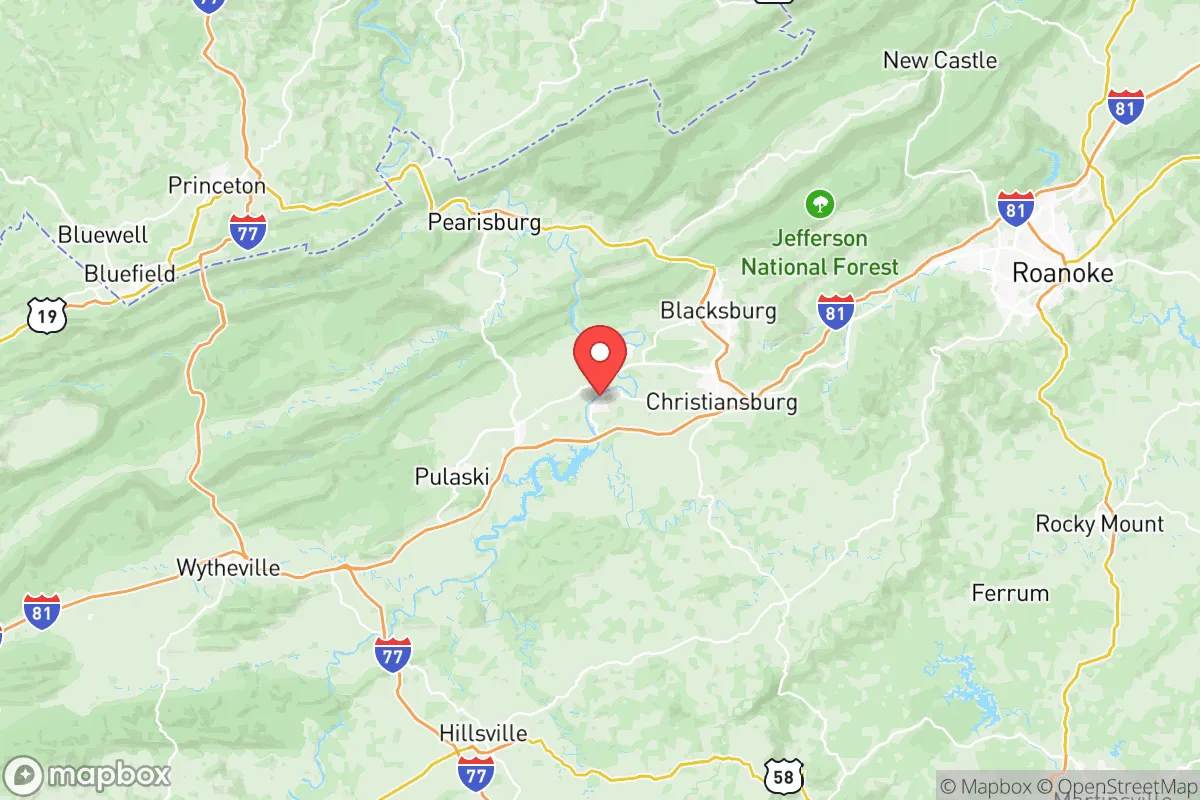
Radford City County is a solidly conservative pocket in an increasingly blue state, with a Cook PVI of R+22 that puts it far to the right of Virginia's statewide D+4 rating. The city itself has trended redder over the past decade, driven by a growing retiree population and a stable base of working-class voters in the surrounding unincorporated areas. While Radford University brings a small, transient liberal influence, the county's rural precincts—especially around the towns of Fairlawn and Belspring—consistently deliver 65-70% Republican margins in presidential elections. The only real blue dot is the university precinct near Main Street in Radford city proper, where student-heavy turnout can flip a local race but rarely shifts the countywide outcome.
How it compares
Virginia as a whole has moved leftward since 2008, driven by explosive growth in Northern Virginia and the Richmond suburbs. Radford City County has moved in the opposite direction. While the state's PVI shifted from R+1 in 2012 to D+4 by 2024, Radford's PVI tightened only slightly from R+24 to R+22. The county's voting patterns now resemble those of Southwest Virginia more than the New River Valley's other college towns like Blacksburg (Montgomery County, PVI D+8). In the 2024 presidential race, Radford County gave the Republican candidate 63% of the vote, compared to 48% statewide. The gap is even starker in local races: the county's Board of Supervisors has been all-Republican since 2019, and the last Democrat to represent the area in the Virginia House of Delegates lost in 2017. For context, a Democratic candidate would need to flip roughly 1,200 votes out of 8,000 cast to make the county competitive—a shift that hasn't happened in a presidential cycle since 2008.
What this means for residents
For conservative residents, the political climate is comfortable and affirming. Local government is reliably pro-business, with low property taxes (the county's rate is $0.54 per $100 of assessed value, well below the state median) and minimal zoning restrictions in rural areas. Gun rights are broadly supported, and the county sheriff's office has a strong relationship with the local Republican party. For liberal residents, the reality is more isolating. While Radford University provides a small progressive bubble, the surrounding county can feel unwelcoming—especially during election season when yard signs and bumper stickers overwhelmingly favor one side. There are no active Democratic Party committees in the county; the nearest one is in Christiansburg, 15 miles east. That said, the university precinct does elect a few Democrats to the city council, and the county's nonpartisan school board elections have seen some competitive races in recent years, suggesting the political monoculture is not absolute.
Culturally, Radford City County leans heavily into Appalachian traditions—hunting, fishing, and church attendance are common social anchors—and this shapes local policy. The county has resisted state-level pushes for renewable energy mandates and has maintained a "Second Amendment Sanctuary" designation since 2019. Alcohol sales are restricted in some precincts, and Sunday liquor sales are limited to a handful of stores. For newcomers, especially those from Northern Virginia or out of state, the political and cultural conservatism can be a shock. But for those who align with the county's values, it offers a stable, low-tax, low-regulation environment that feels increasingly rare in modern Virginia. The trajectory suggests Radford will remain a red island in a blue state for the foreseeable future, with the university's influence growing slowly but not enough to flip the county's partisan balance.

State Political ClimatePolitical Climate in Virginia
State Political AnalysisPolitical Environment in the State
Virginia is a classic swing state that has shifted decisively blue over the past two decades, now carrying a Cook PVI of D+4. The transformation is driven by explosive growth in the Washington, D.C. suburbs, particularly in Northern Virginia, which now dominates state elections. While the state voted Republican for president from 1968 through 2004 (except for 2008), it has voted Democratic in every presidential election since 2008, and Democrats have controlled the governorship and both legislative chambers for most of the last decade. However, the state is far from a monolith — the political geography is a sharp urban-rural split, with deep-red conservative strongholds in the southwest and south-central regions that still hold significant sway in local and state-level races.
Urban vs. rural divide
The political map of Virginia is essentially a tale of two Virginias. The blue anchor is Northern Virginia, encompassing Fairfax, Loudoun, Prince William, and Arlington counties, along with the cities of Alexandria and Falls Church. This region alone accounts for roughly one-third of the state's population and votes Democratic by margins of 60-70% in statewide races. The other major blue hub is the Richmond metro area, including the city itself and Henrico County, which has trended leftward as the capital has grown and diversified. Hampton Roads (Virginia Beach, Norfolk, Chesapeake) is more of a purple battleground, with the military-heavy population producing a mix of conservative and moderate voters. The rural and exurban areas — Southwest Virginia (Bristol, Abingdon, Wise), Southside (Danville, Martinsville), and the Shenandoah Valley (Harrisonburg, Staunton, Winchester) — are deeply Republican, often voting 70-80% for GOP candidates. The key swing counties are in the exurban ring around Richmond and the I-95 corridor, places like Chesterfield County and Spotsylvania County, which have been trending blue but still lean Republican in local races.
Policy environment
Virginia's policy environment is a mixed bag that reflects its purple-to-blue lean. The state has a flat income tax rate of 5.75%, which is moderate by national standards but high for the South. Sales tax is 5.3% (plus local add-ons), and property taxes are set at the local level, averaging around 0.8-1.0% of assessed value. The regulatory posture is generally business-friendly, with a right-to-work law on the books, but the state has moved left on labor issues — in 2020, Democrats passed a $12 minimum wage (rising to $15 by 2026) and repealed the state's ban on collective bargaining for public employees. Education policy is a flashpoint: the state has seen a push for expanded school choice, including charter schools and education savings accounts, but these efforts have been stymied by Democratic governors and legislatures. The state's election laws are among the most accessible in the South — no-excuse absentee voting, same-day registration, and 45 days of early voting were codified in 2020. Virginia also has a one-party consent law for recording conversations, which is relevant for privacy-conscious residents.
Recent policy direction
The last five years have seen a dramatic leftward shift in Virginia's policy landscape, driven by unified Democratic control from 2020-2021 and again after 2023. On gun and self-defense law, the state passed a package of restrictions in 2020: universal background checks, a red flag law, a one-handgun-per-month limit, and a ban on assault weapons (though the latter was later struck down by a court). The state also repealed its preemption law, allowing localities to pass their own gun ordinances. On parental and education rights, the state has become a battleground: Governor Glenn Youngkin (R) made parental notification policies a centerpiece of his 2021 campaign, and the state board of education adopted new model policies requiring schools to notify parents if a child requests a name or pronoun change. However, these policies have been challenged in court and are not uniformly implemented. On medical and bodily autonomy, Virginia has become a safe haven for abortion access in the South, with no gestational limits on abortion up to the third trimester (though a 24-hour waiting period and parental consent for minors remain). The state also expanded Medicaid under the ACA in 2018. On voting and ballot access, the state has moved aggressively toward convenience: no-excuse absentee voting, automatic voter registration, and same-day registration are all law. On property rights, Virginia has a strong right-to-farm law and relatively low property taxes, but localities have broad zoning authority, which has led to conflicts over data centers and solar farms in rural areas.
Civil unrest & political movements
Virginia has been a flashpoint for political movements on both sides. The 2017 Unite the Right rally in Charlottesville remains a defining moment, leading to a state of emergency and a national reckoning with white supremacist violence. The event also galvanized the state's progressive movement, leading to the removal of Confederate statues and a push for police reform. On the right, the 2020-2021 Second Amendment sanctuary movement saw over 100 counties and cities pass resolutions declaring themselves sanctuaries from new gun laws, though these were largely symbolic. The 2021 gubernatorial election was a major flashpoint, with Youngkin winning on a platform of parental rights and education reform, flipping the state back to Republican control after a decade of Democratic dominance. Immigration politics are less visible in Virginia than in border states, but the state has a sanctuary city debate: Alexandria and Richmond have declared themselves sanctuary cities, while the state legislature has considered bills to ban such policies. Election integrity controversies have been relatively muted compared to other swing states, though the 2020 election saw Trump's legal challenges in Virginia fail, and the state's bipartisan elections board has generally been seen as competent.
Projection
Over the next 5-10 years, Virginia is likely to continue its slow drift leftward, driven by the continued growth of Northern Virginia and the Richmond suburbs. The state's population is projected to grow by about 1 million people by 2035, with most of that growth in the D.C. exurbs and the I-95 corridor. This will further dilute the influence of rural conservative areas. However, the state's political trajectory is not a straight line — the 2023 legislative elections saw Democrats retake the House of Delegates and hold the Senate, but by narrow margins, and the state has a history of electing Republican governors (Youngkin in 2021, McDonnell in 2009) even as it votes blue for president. The key wildcard is the 2025 gubernatorial election, which will test whether the state's purple tendencies persist. For a new resident, the practical implication is that Virginia will remain a competitive state where your vote matters, but the overall policy environment will continue to shift left on social issues, gun rights, and labor law, while remaining relatively business-friendly on taxes and regulation.
For a conservative relocator, Virginia offers a mixed picture: you'll find strong communities in the rural and exurban areas, but you'll be living under a state government that is increasingly hostile to your views on guns, abortion, and education. For a liberal relocator, the state offers a progressive policy environment that is still tempered by a strong moderate and conservative presence, meaning you won't face the same level of ideological uniformity as in deep-blue states like California or New York. The bottom line: Virginia is a state where political engagement is not optional — your vote and your voice will matter, and the outcome of elections will have real, tangible consequences for your daily life. If you're looking for a place where your political views are the default, this isn't it. If you're looking for a place where you can make a difference, it's one of the best in the country.
* Values derived from national, state, county, city and local statistics and may differ in a specific area. Last updated: 2026-07-27T01:02:05.000Z
Narrative content on this page is AI-generated and may contain mistakes. Verify any details that matter before acting on them.
ReloMaps may earn a commission from affiliate links at no extra cost to you.

