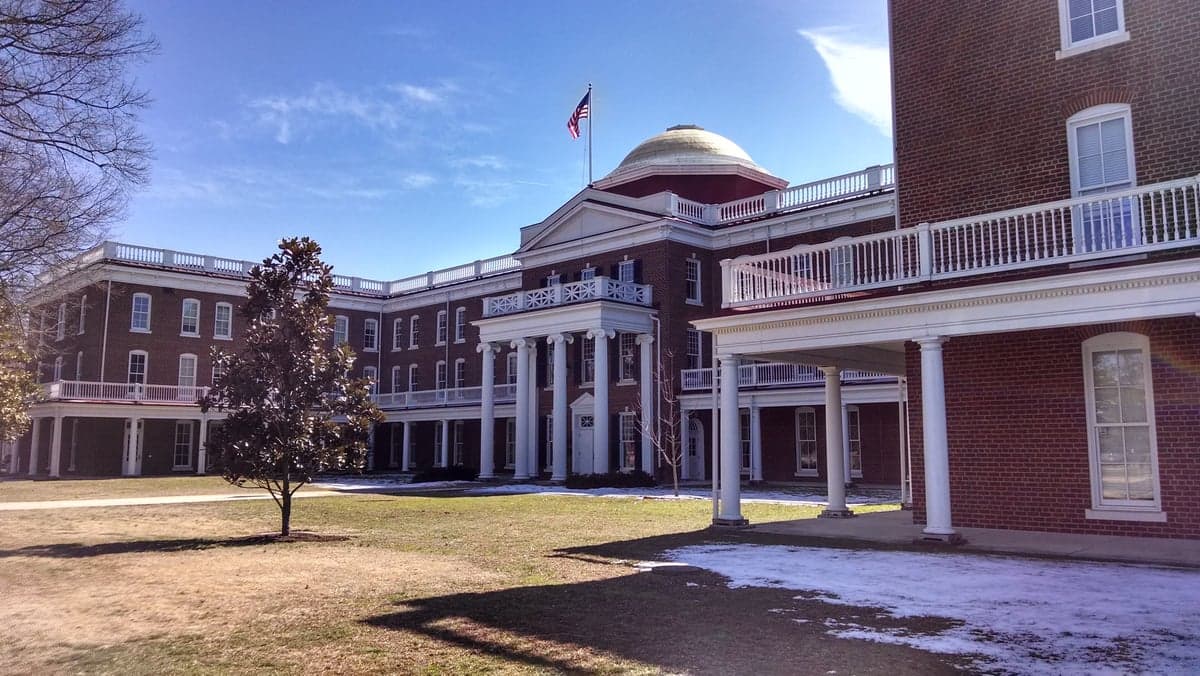
Photo: Wikipedia
Political ClimatePolitical Climate in Prince Edward County
Showing county-level results — no local-only data available.
Lean and PVI are calculated from this county’s 2020 and 2024 presidential results, Cook-style.
Political rankings in Virginia
- Most Conservative Cities in Virginia
- Most Liberal Cities in Virginia
- Best Liberal-Leaning Towns in the South
- Best Liberal-Leaning Towns in Appalachia
- Best Conservative-Leaning Towns in the Mid-Atlantic
- Safest Liberal-Leaning Towns in the South
- Safest Conservative-Leaning Towns in the South
- Safest Conservative-Leaning Towns on the East Coast
- Most Conservative Counties in Virginia
- Most Liberal Counties in Virginia
Local Political AnalysisPolitical Analysis of Prince Edward County
Prince Edward County, Virginia, is a reliably Republican area with a Cook PVI of R+6, meaning it votes about six points more conservative than the nation as a whole. This stands in stark contrast to Virginia state, which has shifted to a D+4 lean in recent years, reflecting the growing divide between rural Southside Virginia and the urban/suburban corridors of Northern Virginia and Richmond. The county’s politics are rooted in its agricultural history and the influence of local institutions like Longwood University and Hampden-Sydney College, which create a subtle but real political variation across its towns and precincts.
How it compares
Prince Edward County’s R+6 rating places it firmly in the conservative camp, while Virginia state’s D+4 rating shows a state that has trended blue over the past decade, driven by population growth in Northern Virginia and the Richmond metro area. Within the county, the political landscape is not monolithic. The town of Farmville, home to Longwood University, leans more moderate to liberal, especially in precincts near campus, where younger voters and faculty often vote Democratic. In contrast, Hampden-Sydney and the rural precincts around Rice and Meherrin are solidly red, with strong support for conservative candidates. The swing precincts are typically found in the more suburban edges of Farmville, where long-time residents and newer retirees mix, creating a toss-up dynamic in local races. This internal variation means that while the county overall is Republican, a Democratic candidate can win Farmville’s precincts by narrow margins, but the rural vote consistently tips the county red.
What this means for residents
For conservative residents, Prince Edward County offers a political environment where their views are the norm, with local offices and school board seats often held by Republicans. This can mean a focus on lower taxes, gun rights, and traditional values in local governance. For liberal residents, especially those in Farmville, the political climate can feel isolating, but the presence of Longwood University and a small but active Democratic party provides a community of like-minded individuals. The county’s R+6 lean means that statewide Democratic candidates, like those for governor or U.S. Senate, often struggle here, but local races can be competitive, especially in Farmville. The practical effect is that residents experience a mix of conservative county policies and more moderate influences from the university and the growing number of retirees moving into the area.
One notable cultural distinction is the county’s deep-rooted history, including the legacy of the 1959-1964 school closures during Massive Resistance, which still shapes local discourse on education and race. This history, combined with the county’s rural character and the presence of two colleges, creates a unique political culture that is more nuanced than a simple red-blue divide. The trajectory is toward a slow but steady increase in Democratic votes, driven by university growth and in-migration from more liberal areas, but the county is likely to remain Republican-leaning for the foreseeable future. For both conservatives and liberals, the key is understanding that Prince Edward County is not a monolith—it’s a place where the politics of a small Southern town meet the changing demographics of 21st-century Virginia.

State Political ClimatePolitical Climate in Virginia
State Political AnalysisPolitical Environment in the State
Virginia has shifted from a reliably purple swing state to a solidly Democratic-leaning one over the past two decades, with a Cook PVI of D+4. The transformation is driven almost entirely by the explosive growth of the Washington, D.C. suburbs in Northern Virginia, which now supply enough Democratic votes to outweigh the rest of the state. While Republicans still hold significant power in the state legislature and can win statewide races in favorable years (Glenn Youngkin’s 2021 gubernatorial victory being the prime example), the underlying demographic and electoral trends point toward a continued leftward drift, especially on cultural and social issues.
Urban vs. rural divide
The political map of Virginia is a textbook case of the urban-rural split. The Democratic stronghold is the crescent from Northern Virginia (Arlington, Alexandria, Fairfax County) down through Richmond and into Hampton Roads (Norfolk, Virginia Beach). These areas are dense, diverse, and highly educated, and they vote blue by margins of 30-40 points. In contrast, rural Southside and Southwest Virginia—places like Danville, Martinsville, and Bristol—vote Republican by equally lopsided margins. The key battlegrounds are the exurban and suburban counties that ring the D.C. metro: Loudoun, Prince William, and Stafford counties. Loudoun, once a Republican stronghold, flipped blue in the 2010s and now votes Democratic by double digits, driven by an influx of federal workers and tech professionals. The I-95 corridor south of D.C. is the state’s political fulcrum; whichever party wins those fast-growing suburbs usually wins the state.
Policy environment
Virginia’s policy environment is a mixed bag that reflects its divided government. The state has a relatively low flat income tax rate (5.75% as of 2025) and moderate property taxes, but it is not a low-tax state overall—sales tax is 5.3% (plus local add-ons), and the state’s gas tax is among the highest in the South. On regulation, Virginia is generally business-friendly, with a right-to-work law and a relatively low regulatory burden compared to Northeastern states. Education policy is a flashpoint: the state has seen fierce battles over school curriculum, transgender policies, and parental rights, with Governor Youngkin’s administration pushing for more school choice and transparency. Healthcare is dominated by a strong Medicaid expansion (passed in 2018 under a Democratic legislature) and a robust insurance market anchored by large systems like Inova and VCU. Election laws are moderately accessible: no-excuse absentee voting and early voting are available, but voter ID is required. The state does not have a strict “sanctuary” policy for undocumented immigrants, but some localities, like Fairfax County, have adopted non-cooperation policies with ICE.
Recent policy direction
The last five years have seen Virginia swing back and forth on key liberty issues. Under the 2020-2021 Democratic trifecta, the state passed a sweeping gun control package (universal background checks, red flag laws, a one-handgun-per-month limit) and abolished the death penalty. It also legalized marijuana possession (though retail sales remain stalled). The 2022-2024 Youngkin administration reversed some of that momentum: the governor signed a parental rights bill in education, banned “divisive concepts” in state contracts, and pushed for a 15-week abortion ban (which failed in the divided legislature). On property rights, Virginia has a strong tradition of local zoning control, but the state has recently preempted localities from banning certain housing types (like duplexes) in an effort to boost supply. On privacy and surveillance, the state passed a comprehensive data privacy law in 2021, but police still have broad access to license plate readers and facial recognition. The net effect is a state that is moderately conservative on fiscal and education issues but increasingly liberal on social and criminal justice matters—a tension that will likely persist.
Civil unrest & political movements
Virginia has been a stage for some of the most visible political flashpoints in the country. The 2017 Unite the Right rally in Charlottesville and the subsequent violence left a lasting scar and made the city a symbol of the national struggle over Confederate monuments and white nationalism. The 2020 racial justice protests in Richmond, which saw the toppling of Confederate statues on Monument Avenue, were among the largest and most sustained in the South. On the right, the “parents’ rights” movement has been particularly strong in Virginia, with groups like the Virginia Parents Association mobilizing thousands of voters in school board races, especially in Loudoun County and Virginia Beach. Immigration politics are less heated than in border states, but the debate over sanctuary policies in Northern Virginia remains a live issue. Election integrity controversies have been muted compared to other swing states, though the 2020 election saw Trump supporters protest outside the state capitol. A new resident would notice the political energy most in the form of yard signs, bumper stickers, and local news coverage of school board meetings—especially in the fast-growing suburbs where the cultural battle lines are sharpest.
Projection
Over the next five to ten years, Virginia will likely continue its slow drift leftward, but not as fast as some predict. The key demographic driver is the continued growth of Northern Virginia, which is adding tens of thousands of new residents annually, most of whom are younger, more diverse, and more liberal. The state’s rural areas are losing population, which further concentrates Democratic power. However, the state’s political geography is not a one-way ratchet: the exurban counties like Spotsylvania and Culpeper are growing fast and trending Republican, and the Hampton Roads area remains a swing region. The most likely scenario is that Virginia remains a D+4 to D+6 state, with Democrats able to win statewide races consistently but Republicans holding the governorship in favorable years. The state legislature will remain closely divided, with the House of Delegates flipping control every few cycles. For a new resident, this means that policy will continue to be a tug-of-war: expect incremental changes on gun laws, abortion access, and education, but no dramatic swings in either direction. The state’s tax and regulatory environment will remain moderate, and the biggest political fights will be over cultural issues in the schools and local zoning decisions.
For a conservative relocating to Virginia, the bottom line is that you will find a state where your vote matters in local and legislative races, but where statewide elections will be an uphill climb. The best places to settle if you want a like-minded community are the exurban counties west of I-95 (like Fauquier and Warren), the Shenandoah Valley (Harrisonburg area), or the Richmond suburbs. For a liberal relocator, the state offers a comfortable political home in the D.C. suburbs, Richmond, or Charlottesville, with a policy environment that is generally aligned with your values on social issues but not as aggressively progressive as Maryland or California. Either way, Virginia’s political climate is one of constant negotiation—a state where no single faction gets everything it wants, and where the outcome of any given election can shift the balance of power significantly.
* Values derived from national, state, county, city and local statistics and may differ in a specific area. Last updated: 2026-10-24T12:07:31.000Z
Narrative content on this page is AI-generated and may contain mistakes. Verify any details that matter before acting on them.
ReloMaps may earn a commission from affiliate links at no extra cost to you.

