Photo: Wikipedia
Demographics of Prince Edward County
Affluence Level in Prince Edward County
A below-average socioeconomic profile. Incomes, home values, and educational attainment trail the U.S., with higher poverty and unemployment.
People of Prince Edward County
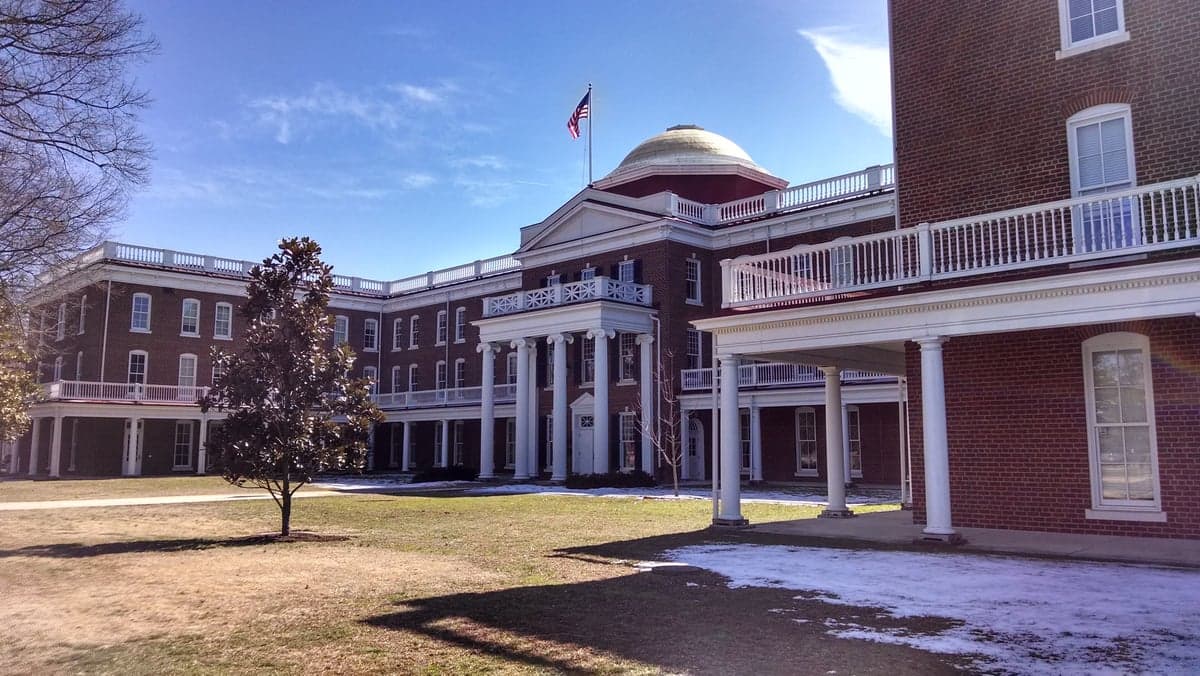
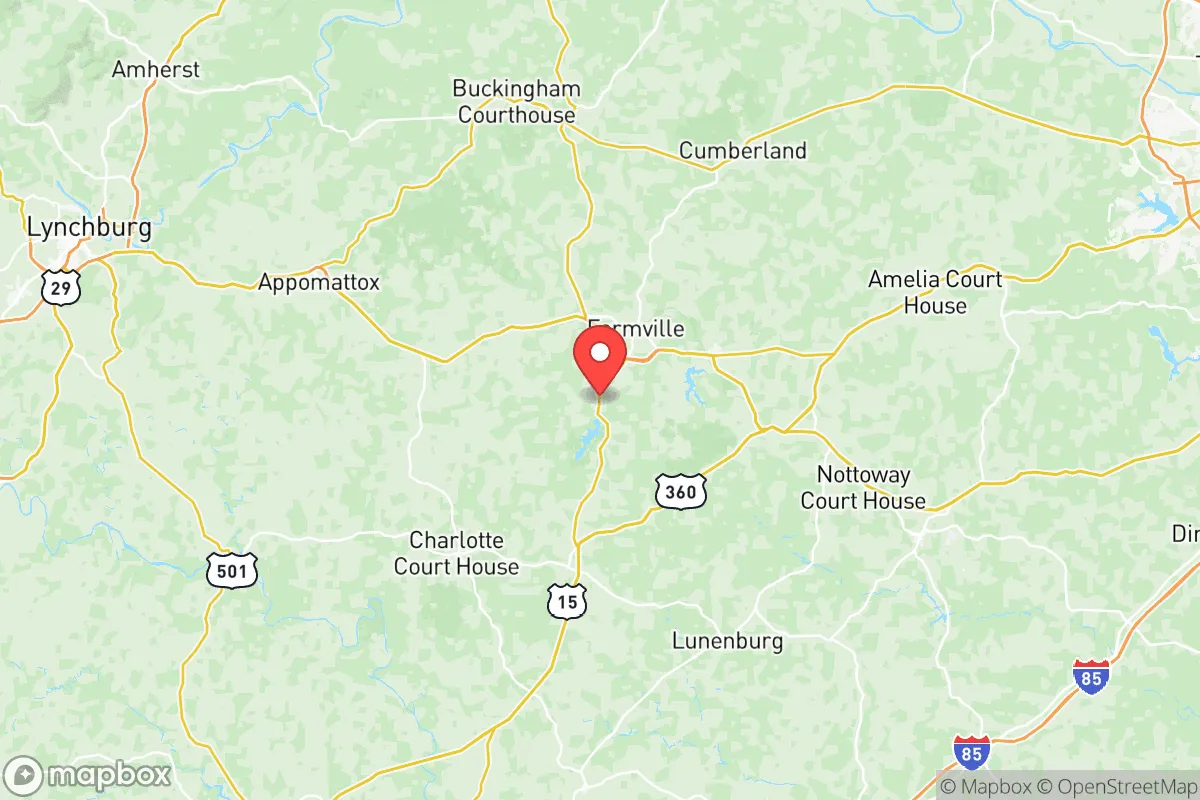
Prince Edward County, Virginia, is home to 21,932 residents, a population shaped by deep agricultural roots, the legacy of a historically Black land-grant university, and a demographic profile that remains predominantly Black and white with a small but growing Hispanic presence. The county's population density is low at roughly 50 people per square mile, and its distinctive identity is marked by the tension between a rural, conservative-leaning native population and the academic community centered around Longwood University and Hampden-Sydney College. The county seat of Farmville serves as the commercial and cultural hub, while smaller communities like Prospect, Meherrin, and Rice anchor the surrounding countryside.
Settlement & growth (pre-1960)
The land that became Prince Edward County was originally inhabited by the Siouan-speaking Monacan people, who lived in small villages along the Appomattox and James River watersheds. English colonists from the Tidewater region began pushing westward into the Piedmont in the early 1700s, and the Virginia General Assembly created Prince Edward County in 1754 from part of Amelia County. The earliest European settlers were primarily of English and Scots-Irish stock, drawn by the promise of fertile tobacco land granted through the headright system. These families established plantations along the Appomattox River and its tributaries, with the town of Worsham serving as the original county seat until 1848, when Farmville was incorporated and took over that role.
The institution of slavery was central to the county's antebellum economy, and by 1860, enslaved African Americans made up a majority of the population. After the Civil War, many freedmen remained in the area as sharecroppers and tenant farmers, and the founding of the State Normal School for Colored Students in 1882—later renamed Virginia State University—in nearby Ettrick provided a rare avenue for Black higher education. The early 20th century saw a gradual outmigration of Black residents during the Great Migration, as agricultural mechanization and Jim Crow restrictions pushed many to northern industrial cities. Meanwhile, white farmers continued to dominate the county's tobacco and livestock economy, and the construction of U.S. Route 360 and U.S. Route 460 in the 1930s improved access to Richmond and Lynchburg, though the county remained overwhelmingly rural.
The most defining event of the mid-20th century was the 1959 closure of all Prince Edward County public schools to avoid court-ordered desegregation following Brown v. Board of Education. For five years—from 1959 to 1964—white students attended a newly formed private academy, while Black students were left without formal education, a period known as the "Massive Resistance" crisis. This event caused a significant exodus of Black families to other counties and states, and the county's population dropped from 15,612 in 1950 to 14,159 in 1970. The scars of this era continue to shape the county's racial dynamics and trust in public institutions.
Modern era (post-1965)
The post-1965 era brought gradual demographic stabilization, driven primarily by the expansion of Longwood University (which became coeducational in 1976) and the growth of Hampden-Sydney College. These institutions attracted a steady stream of faculty, staff, and students from outside the region, many of whom settled in Farmville and its immediate surroundings. The county's population grew from 14,159 in 1970 to 19,720 in 2000, a 39% increase, largely due to this academic influx and the expansion of healthcare and retail services in Farmville.
Immigration to Prince Edward County has been minimal compared to urban Virginia. The foreign-born population stands at just 1.8%, well below the state average of 12.5%. The small Hispanic population—4.8% of the total—is concentrated in Farmville and the unincorporated community of Prospect, where many work in poultry processing at the Tyson Foods plant and in agricultural labor. East and Southeast Asian residents (0.8%) are primarily connected to Longwood University as international students or faculty, with no distinct ethnic enclave. The Indian-subcontinent population (0.3%) is similarly small and university-linked. The county's Black population, at 30.3%, remains concentrated in Farmville's historic Black neighborhoods and in rural communities like Meherrin and Rice, though many younger Black residents have left for urban job markets in Richmond and Northern Virginia.
Domestic migration has been modest. Some retirees from Northern Virginia and the Washington, D.C., area have moved to Farmville for its lower cost of living and slower pace, while a small number of remote workers have arrived since 2020. However, the county has not experienced the rapid Sun Belt growth seen in other parts of Virginia, such as Loudoun or Chesterfield counties. Suburbanization is limited to the immediate outskirts of Farmville, with new subdivisions like Briarwood and Woodland Hills attracting a mix of university employees and local professionals.
The future
Prince Edward County's population is projected to remain relatively stable, with modest growth of 5-10% over the next two decades. The county is becoming slightly more diverse, driven by the slow but steady increase in Hispanic residents, who are expected to reach 7-8% of the population by 2040, and by the continued presence of international students at Longwood University. The Black population share is likely to decline gradually as outmigration continues, while the white population will remain the majority but age in place, with a median age already above 40.
New communities are not forming distinct ethnic enclaves; instead, the small Hispanic and Asian populations are dispersing across Farmville and the surrounding county, integrated into existing neighborhoods. The county's cultural identity is evolving slowly, with the legacy of Massive Resistance still a sensitive topic but increasingly addressed through local initiatives like the Moton Museum, which preserves the history of the school closures. For newcomers, the county offers a low-cost, rural lifestyle with access to two colleges, but limited job diversity and a population that remains socially conservative and racially aware of its past.
For someone moving in now, Prince Edward County is a place where the past is never far from the present. The population is stable, aging, and slowly diversifying, but the core identity remains rooted in the agricultural and educational institutions that have defined it for generations. The county offers a quiet, affordable life for those who value history and community, but it is not a destination for rapid growth or cosmopolitan change.

* Values derived from national, state, county, city and local statistics and may differ in a specific area. Last updated: 2026-10-24T12:07:31.000Z
Narrative content on this page is AI-generated and may contain mistakes. Verify any details that matter before acting on them.
ReloMaps may earn a commission from affiliate links at no extra cost to you.

