Political ClimatePolitical Climate in Manassas Park City County
Showing district-level results — no local-only data available.
Local Political AnalysisPolitical Analysis of Manassas Park City County
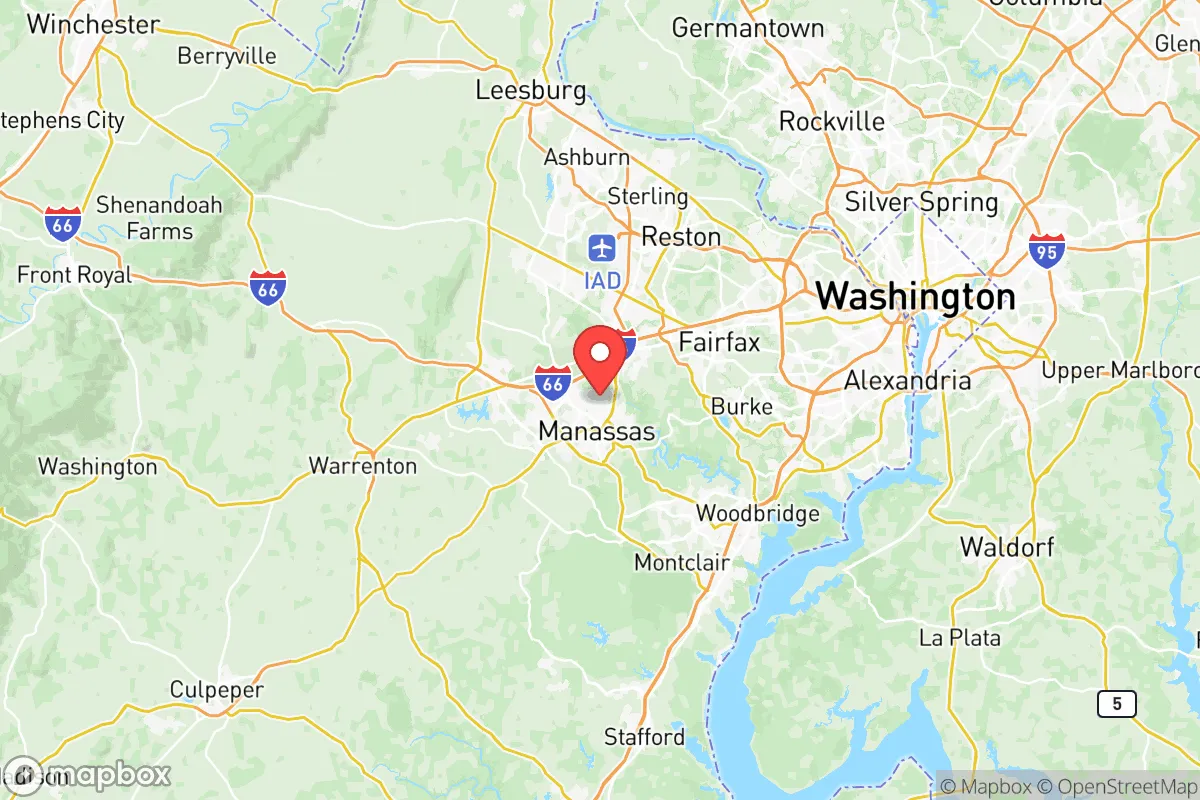
Manassas Park City County leans solidly Democratic, with a Cook PVI of D+6, making it more reliably blue than the surrounding Commonwealth of Virginia, which sits at D+4. This isn't a recent shift; the city has been trending left for over a decade, driven by a growing, diverse population of young families and professionals who commute into D.C. or work in the region's tech and defense sectors. In the 2024 presidential race, Manassas Park voted for the Democratic candidate by a margin closer to 12 points, while neighboring Manassas City was a tighter 8-point Democratic win, and more rural parts of Prince William County—like Gainesville and Haymarket—leaned Republican by 5-7 points. The city itself is small, just over 17,000 people, but its politics are a microcosm of the broader Northern Virginia shift: increasingly Democratic, with a strong progressive undercurrent among newer residents, balanced by a quieter, older conservative base that still turns out for local races.
How it compares
Compared to Virginia as a whole, Manassas Park is a Democratic stronghold in a state that's become a reliable blue anchor in the South, but with more internal variation. Virginia's D+4 PVI reflects the influence of the D.C. suburbs (like Fairfax and Loudoun counties) and the Hampton Roads area, but it also includes deep-red rural regions like Southwest Virginia and the Shenandoah Valley, which vote Republican by 30-40 points. Manassas Park, by contrast, has no such conservative counterweight within its borders—the city is uniformly suburban, with a high percentage of renters and immigrants (over 40% of residents are foreign-born), which correlates with Democratic voting. In the 2023 state legislative races, Manassas Park's precincts gave Democratic candidates 58-62% of the vote, while Virginia's statewide average for those races was closer to 52%. The city's politics mirror those of Arlington or Alexandria more than the rest of Prince William County, where swing precincts in areas like Woodbridge and Dale City can flip between parties depending on turnout.
What this means for residents
For liberal residents, Manassas Park feels like a safe bet—local elections are rarely competitive, and the city council has been Democratic-controlled for years, meaning policies around affordable housing, public transit expansion (like the VRE and OmniRide bus service), and immigrant-friendly initiatives move forward without much friction. Conservative residents, however, aren't entirely sidelined; they tend to organize around school board races and zoning issues, where a more moderate or fiscal-conservative voice can still win if turnout is low. The city's small size means personal relationships matter—you'll see the same faces at the Manassas Park Farmers Market or the city's summer concert series, and political disagreements rarely get as heated as they do in larger, more polarized suburbs like Centreville or Reston. In practice, the D+6 lean means Democratic candidates can take the city for granted, but it also means conservative residents often feel their votes don't matter in national races, leading to lower turnout in presidential years compared to the rest of Virginia.
Culturally, Manassas Park is distinct from the rest of Virginia in its density and diversity. The city has a higher percentage of Hispanic and Asian residents than the state average, and this shows in local policy: the city funds bilingual programs in schools, hosts a Dia de los Muertos celebration that draws crowds from across the region, and has a police department that emphasizes community policing over aggressive enforcement. Unlike more rural parts of Virginia, where gun rights and religious liberty are hot-button issues, Manassas Park's political debates center on school funding, traffic congestion on Route 28, and the balance between development and green space. The city's trajectory is clear—it will only get more Democratic as younger, more diverse families move in—but the pace is slow enough that longtime residents, both liberal and conservative, still feel heard in local decisions. For anyone moving here, the political climate is less about red vs. blue and more about how to make a small, growing city work for everyone, which is a refreshingly practical focus compared to the noise in the rest of Virginia.

State Political ClimatePolitical Climate in Virginia
State Political AnalysisPolitical Environment in the State
Virginia has shifted from a reliably conservative-leaning swing state to a solidly Democratic-leaning one over the past two decades, with a Cook PVI of D+4. The transformation is driven almost entirely by explosive growth in the Washington, D.C. suburbs—specifically in Northern Virginia—which now dominate statewide elections. While the state still elects a Republican governor (Glenn Youngkin in 2021) and has a competitive state legislature, the underlying demographic and electoral trends point toward a continued leftward drift, especially on cultural and social issues. For a conservative relocator, the reality is that Virginia is a purple state with a blue ceiling, where your experience will vary dramatically depending on whether you settle in Loudoun County or Lynchburg.
Urban vs. rural divide
The political map of Virginia is a tale of three regions. Northern Virginia—Fairfax, Loudoun, Prince William, and Arlington counties—is the engine of Democratic power, producing massive vote margins that swamp the rest of the state. Fairfax County alone delivered 63% of its vote to Joe Biden in 2020. Richmond and Norfolk/Virginia Beach are also reliably blue, with the latter’s military-heavy population showing more moderation but still trending Democratic. In contrast, rural Southside and Southwest Virginia—places like Danville, Martinsville, and Bristol—vote overwhelmingly Republican, often by 70-80% margins. The exurban and suburban counties that once were swing areas, like Chesterfield and Hanover near Richmond, have held steady for the GOP, but the population growth is overwhelmingly in the blue-leaning suburbs. The 2021 gubernatorial race saw Youngkin win by running up margins in rural areas while cutting the Democratic margin in Northern Virginia, but that strategy is becoming harder as the D.C. suburbs continue to densify and diversify.
Policy environment
Virginia’s tax structure is moderate: a flat 5.75% income tax and a statewide property tax rate that is low, though local rates vary widely. The state has a right-to-work law, which keeps union influence relatively weak. Education policy is a major flashpoint: Governor Youngkin pushed through a 2022 executive order banning "inherently divisive concepts" in public schools, but local school boards in blue areas largely ignored it. The state’s education funding formula favors wealthier counties, meaning rural schools often struggle. Healthcare policy is mixed: Virginia expanded Medicaid under the ACA in 2019, but the state also has some of the strictest abortion laws in the South after a 2024 law banned the procedure after 15 weeks with limited exceptions. Election laws are relatively accessible: no-excuse absentee voting, same-day registration, and early voting are all available, though voter ID is required. The state has no income tax on military pensions, a draw for retirees.
Recent policy direction
The last five years have seen a sharp pendulum swing on cultural issues. In 2020, the Democratic-controlled legislature passed a sweeping gun control package that included universal background checks, a red-flag law, and a one-handgun-per-month limit. In 2023, Republicans passed a parental rights bill requiring schools to notify parents of changes to a child’s health or well-being, including gender identity. On property rights, Virginia has a strong Dillon Rule, meaning localities only have powers explicitly granted by the state—this limits local zoning fights but also restricts local autonomy. Medical and bodily autonomy is a battleground: the 2024 15-week abortion ban is being challenged in court, and the state has no law protecting gender-affirming care for minors. On voting and ballot access, the state has moved toward convenience: no-excuse absentee voting was made permanent in 2021, and automatic voter registration is in place. Privacy and surveillance is a mixed bag: Virginia passed the Consumer Data Protection Act in 2021, one of the strongest state privacy laws, but police can still access license plate reader data without a warrant in many jurisdictions.
Civil unrest & political movements
Virginia has been a flashpoint for political activism on both sides. The 2017 Unite the Right rally in Charlottesville remains a defining image of far-right extremism, leading to a state ban on firearms at public demonstrations. The 2020-2021 period saw massive Black Lives Matter protests in Richmond, including the toppling of Confederate statues on Monument Avenue. On the right, the Virginia Citizens Defense League holds annual Lobby Day rallies at the state capitol, drawing thousands of gun-rights activists. Immigration politics are relatively quiet compared to border states, but Prince William County has seen tensions over sanctuary policies, with the county board voting in 2023 to limit cooperation with ICE. Election integrity controversies flared in 2020-2021, with Republican activists alleging irregularities in mail-in voting, though no widespread fraud was found. A new resident in Northern Virginia will see political yard signs and bumper stickers year-round, while in rural areas, the culture war is more visible in school board meetings and church bulletin boards.
Projection
Over the next 5-10 years, Virginia will continue its slow but steady leftward drift. The key driver is demographics: Northern Virginia’s population is growing faster than the rest of the state, and it is younger, more diverse, and more educated—all correlates of Democratic voting. The Hampton Roads area is aging and may become more competitive, but the military presence tends to moderate rather than flip it. Rural Virginia will continue to shrink and age, making its Republican votes less impactful. The state’s in-migration from other states is net positive, but most newcomers are coming for jobs in the D.C. metro area, reinforcing the blue trend. A conservative relocator moving to Loudoun County today will find a county that voted 60% for Biden in 2020; in 2030, that number could be 65-70%. However, the state’s gubernatorial elections (held in off-years) will remain competitive because they are less nationalized—Youngkin’s 2021 win showed that a moderate Republican can still win by focusing on education and the economy. The state legislature will likely remain closely divided, with the House of Delegates possibly flipping back and forth.
Bottom line for a new resident: If you are a conservative moving to Virginia, your political experience will depend heavily on your zip code. In Loudoun or Arlington, you will be a minority voice in local politics, with school boards and county boards dominated by progressives. In Chesterfield or Hanover, you will find a more balanced environment, with conservative values still holding sway in local offices. In Roanoke or Lynchburg, you will be in solidly conservative territory. The state’s tax burden is moderate, but its regulatory environment is increasingly blue-leaning on guns, abortion, and education. The best advice: visit the specific city or county you are considering, attend a local school board meeting, and talk to neighbors. Virginia is not a monolith, and your experience will be shaped more by your locality than by the state as a whole.
* Values derived from national, state, county, city and local statistics and may differ in a specific area. Last updated: 2026-06-30T05:52:02.000Z
Narrative content on this page is AI-generated and may contain mistakes. Verify any details that matter before acting on them.
ReloMaps may earn a commission from affiliate links at no extra cost to you.

