Demographics of Manassas Park City County
Affluence Level in Manassas Park City County
An upper-middle-class area. Household wealth, education levels, and homeownership run ahead of national benchmarks.
People of Manassas Park City County
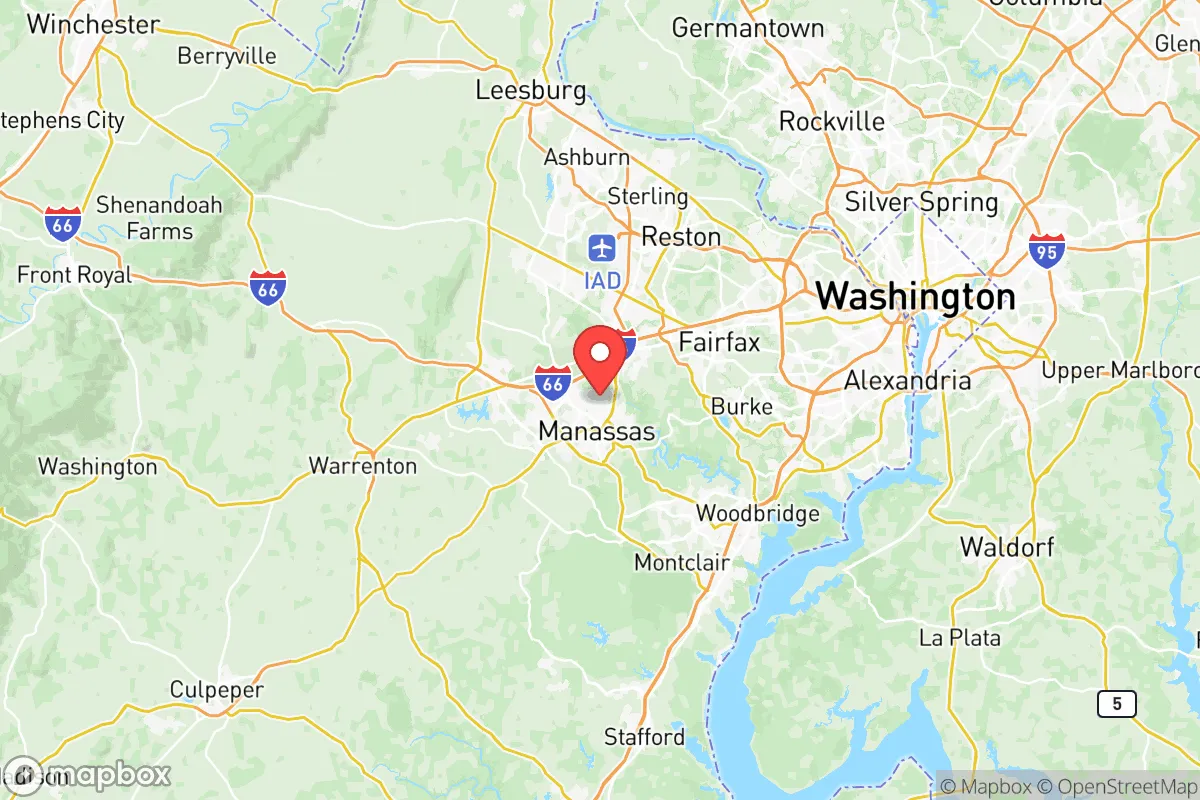
Manassas Park City County, Virginia, is a small, densely populated independent city of 16,923 residents, characterized by its remarkable ethnic diversity and youthful demographic profile. Unlike the surrounding Prince William County suburbs, Manassas Park has a distinctly Hispanic-majority population (45.9%), a significant Black community (10.9%), and growing East/Southeast Asian (6.4%) and Indian-subcontinent (4.1%) populations, all set against a White non-Hispanic share of just 27.4%. With 17.4% of residents foreign-born and a relatively low college attainment rate of 25.5%, the city is a working-class, immigrant gateway community that has transformed dramatically from its origins as a small railroad stop.
Settlement & growth (pre-1960)
Before European settlement, the area now comprising Manassas Park City County was part of the ancestral homeland of the Doeg and Manahoac Native nations, who lived along the Occoquan River and its tributaries. By the early 1700s, English colonists from the Tidewater region had pushed westward, establishing small tobacco plantations along the Bull Run and Broad Run watersheds. The land that would become Manassas Park was part of Prince William County, a rural expanse of farms and forests with no significant settlement until the arrival of the railroad.
The city's origin story begins in 1852, when the Manassas Gap Railroad built a junction at what is now Manassas, connecting the Shenandoah Valley to the Orange and Alexandria Railroad. The tiny hamlet of Manassas Junction was the site of two major Civil War battles (First and Second Manassas) in 1861 and 1862, which devastated the local economy and scattered the small population of farmers and merchants. After the war, the area slowly rebuilt as a railroad and agricultural center, but it remained sparsely populated through the 1880s.
The first real wave of settlement came in the 1890s, when the Manassas Park development company began selling small lots to working-class families, many of them German and Irish immigrants who worked on the railroad or in the nearby quarries and lumber mills. These early residents built modest homes along what are now Manassas Park Drive and Center Street, forming a tight-knit community of railroad laborers and their families. By 1900, the population had reached roughly 300, almost entirely White and native-born, with a small number of Black families living in segregated pockets near the tracks.
Through the first half of the 20th century, Manassas Park remained a small, sleepy railroad suburb of Washington, D.C., with a population that grew slowly from 500 in 1930 to just over 1,000 by 1950. The area was overwhelmingly White, Protestant, and rural in character, with most residents working in agriculture, the railroad, or commuting to the growing federal government in Washington. The city was formally incorporated as an independent city in 1957, separating from Prince William County, but its population was still under 2,000 and almost entirely White non-Hispanic.
Modern era (post-1965)
The 1965 Hart-Cellar Act fundamentally reshaped Manassas Park, as it did many Northern Virginia suburbs. The first major demographic shift came in the 1970s and 1980s, when the city began attracting Hispanic immigrants, primarily from El Salvador, Guatemala, and Mexico, who were drawn by construction jobs in the booming Washington exurbs and the area's relatively affordable housing stock. These early arrivals settled in the older neighborhoods near the railroad tracks and along Manassas Park Drive, establishing small tiendas, churches, and community organizations that made the city a regional hub for the growing Latino population.
By 1990, the Hispanic share of Manassas Park's population had risen to roughly 20%, and the White non-Hispanic share had fallen to about 70%. The 1990s and 2000s saw an acceleration of this trend, as continued immigration from Central America and Mexico, combined with White flight to farther exurbs like Haymarket and Gainesville, transformed the city into a majority-Hispanic community. The 2000 Census recorded a population of 10,290, with Hispanics making up 42% of residents and White non-Hispanics falling to 48%. The Black population remained small at 8%, and Asian and Indian communities were negligible.
The 2010s brought further diversification. The Hispanic share continued to grow, reaching 45.9% by 2020, while the White non-Hispanic share dropped to 27.4%. The Black population rose to 10.9%, driven by domestic migration from the Washington, D.C., core and from other parts of Prince William County. The East/Southeast Asian community, primarily Vietnamese and Korean families, grew to 6.4%, settling in newer apartment complexes near the Manassas Park VRE station and along Euclid Avenue. The Indian-subcontinent population reached 4.1%, concentrated in the newer subdivisions near Signal Hill Park and the city's southern edge, many of them professionals working in technology and government contracting in nearby Centreville and Chantilly.
Domestic migration also played a role: the 2008 housing crash and subsequent recovery brought a wave of younger, more diverse families from the Washington, D.C., core and from other parts of Northern Virginia, drawn by Manassas Park's relatively affordable housing (median home value around $350,000 in 2025, compared to $600,000+ in Fairfax County). The city's small size and walkable downtown, centered on the Manassas Park Community Center and the nearby VRE station, have made it attractive to commuters who work in D.C. but want a more diverse, less expensive community.
The future
Manassas Park City County is likely to become even more diverse and more immigrant-heavy over the next 10-20 years. The Hispanic share is projected to remain stable or grow slightly, as continued immigration from Central America and high birth rates among existing families offset any out-migration. The East/Southeast Asian and Indian-subcontinent populations are expected to grow, driven by the expansion of technology and government contracting jobs in the broader Northern Virginia region, though Manassas Park will likely remain a secondary destination compared to larger Asian enclaves in Annandale and Centreville.
The White non-Hispanic share is likely to continue declining, potentially falling below 20% by 2040, as older White residents age out and younger White families continue to choose farther exurbs or the D.C. core. The Black population may stabilize or grow modestly, as the city becomes more attractive to Black families priced out of Prince William County's more expensive neighborhoods. The city's low college attainment rate (25.5%) and high foreign-born share (17.4%) suggest that Manassas Park will remain a working-class, immigrant gateway community, with a cultural identity shaped by its Hispanic majority and its role as a first-stop for new arrivals to the region.
New development is likely to concentrate in the city's remaining vacant parcels near the VRE station and along the Manassas Park Drive corridor, where mixed-use projects and apartment complexes are being built to accommodate population growth. The city's small size (just over 2 square miles) means that future growth will be limited, but the population is projected to reach 18,000-19,000 by 2035, with the demographic profile becoming even more heavily Hispanic and foreign-born.
For someone moving in now, Manassas Park offers a genuinely diverse, working-class community with strong immigrant roots, affordable housing by Northern Virginia standards, and excellent commuter rail access to Washington, D.C. The city is not a wealthy suburb or a cultural destination, but a place where families from Central America, Vietnam, India, and across the United States are building new lives in a small, walkable city that feels more like a small town than a typical exurban bedroom community. The cultural identity is increasingly Hispanic and immigrant-driven, with Spanish widely spoken in stores and schools, and a community life centered on the Manassas Park Community Center, local parks, and the nearby historic district of Manassas. It is a place of transition and opportunity, not of established wealth or prestige, and it rewards residents who value diversity, affordability, and community over status and amenities.

* Values derived from national, state, county, city and local statistics and may differ in a specific area. Last updated: 2026-06-30T05:52:02.000Z
Narrative content on this page is AI-generated and may contain mistakes. Verify any details that matter before acting on them.
ReloMaps may earn a commission from affiliate links at no extra cost to you.

