
Photo: Wikipedia
Personal Sovereignty in Isle of Wight County
Viable for self-reliance. Generally workable, though some barriers may limit total independence.
What does Personal Sovereignty tell us?
Personal Sovereignty measures your capacity for self-reliance and independence with minimal government friction. Higher scores mean fewer barriers between you and the way you want to live... but it assumes you have the space you need and good neighbors.
What does this tell us?
Personal Sovereignty measures your capacity for self-reliance and independence with minimal government friction. Higher scores mean fewer barriers between you and the way you want to live... but it assumes you have the space you need and good neighbors.
State Policy
Energy independence: Importer (20% of energy produced in-state)
Personal Liberty
Homesteading

Personal Liberty Analysis
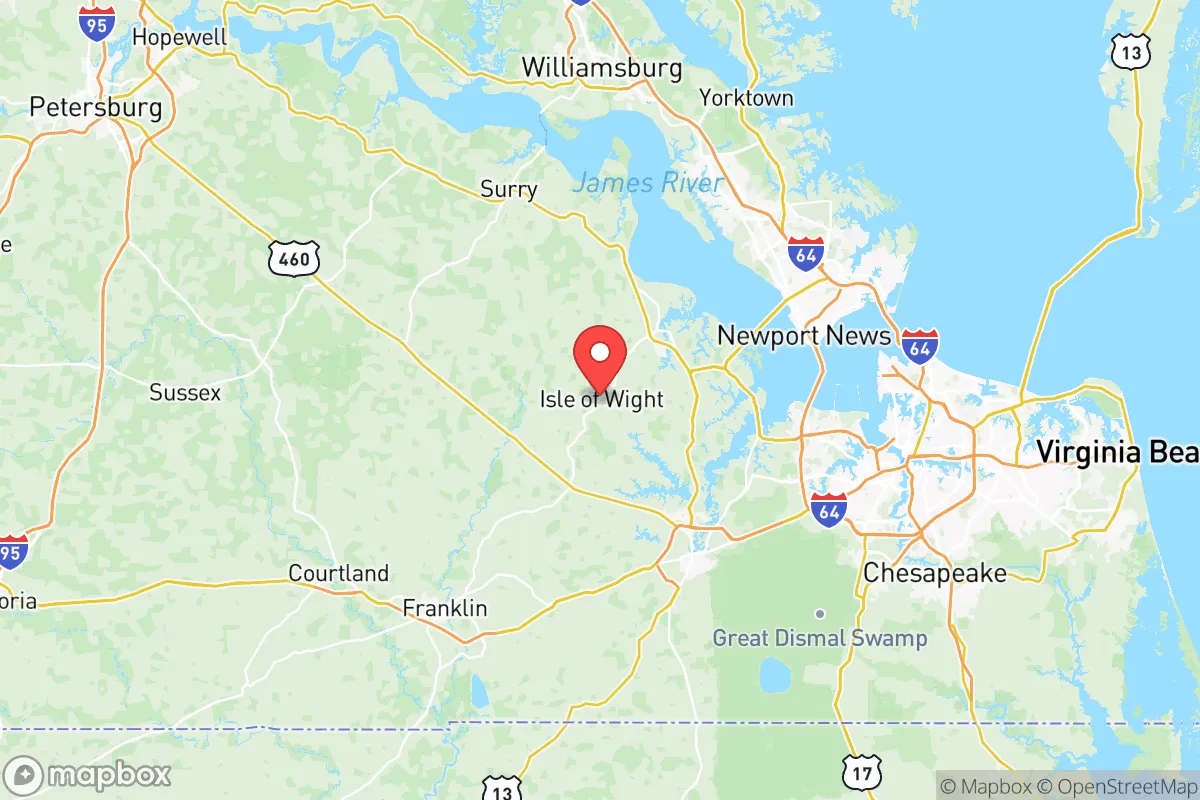
Isle of Wight County offers a notably lighter-touch environment for personal sovereignty than much of coastal Virginia, with the county seat of Isle of Wight and the town of Smithfield anchoring a regulatory culture that leans toward individual discretion rather than heavy-handed oversight. The county’s roughly 39,000 residents enjoy a blend of rural autonomy and suburban convenience, with the regulatory posture varying meaningfully between the more developed northern corridor near Carrollton and the expansive agricultural southern reaches around Windsor and Walters. For a relocation reader weighing personal freedom, the practical question is not whether Virginia’s state-level constraints apply — they do — but how the county chooses to exercise its discretion within that framework.
Tax burden and regulatory posture across the county
Isle of Wight County’s real estate tax rate sits at $0.72 per $100 of assessed value, among the lower rates in Hampton Roads and roughly half of what neighboring Suffolk or Norfolk property owners pay. The county has no local income tax, and Virginia’s state income tax is a flat 5.75% regardless of bracket, which keeps the marginal cost of additional earnings predictable. The regulatory environment is generally permissive: the county’s zoning ordinance allows agricultural uses by right in the A-1 district, which covers most of the land south of Route 460, and the permitting process for accessory structures like barns, workshops, and detached garages is straightforward compared to the urbanized cities to the north.
That said, the regulatory posture is not uniform. The Smithfield Historic District imposes design review for exterior changes to properties within its boundaries, and the Carrollton area — the county’s fastest-growing suburban corridor — has seen more active enforcement of subdivision and stormwater rules as development pressure has increased. Windsor, by contrast, operates with a lighter touch, and the unincorporated areas between Windsor and the Blackwater River see minimal county interference in day-to-day property use. The county’s comprehensive plan explicitly prioritizes preserving agricultural land and rural character, which translates into fewer use restrictions for landowners who keep their property in farming or forestry.
Self-defense and gun law specifics in Isle of Wight
Virginia is a shall-issue state for concealed handgun permits, and Isle of Wight County’s circuit court processes applications without the discretionary denials seen in some urban jurisdictions. The county sheriff’s office historically issues permits within the statutory 45-day window, and renewal is a straightforward administrative matter. Virginia law preempts local firearm ordinances, meaning Isle of Wight cannot impose its own restrictions on purchase, possession, or carry beyond state statute — a meaningful protection for gun owners that does not exist in states with home-rule authority.
Open carry is legal in Virginia for anyone 18 or older who can lawfully possess a firearm, and Isle of Wight sees routine open carry in rural areas without incident. The county has no local magazine capacity restrictions, no assault weapon ban, and no waiting period beyond the state’s universal background check requirement, which applies to all firearm transfers. The practical environment is gun-friendly: the Isle of Wight County Sheriff’s Office runs a concealed carry class several times a year, and the county’s rural culture treats firearms as ordinary tools for hunting and defense rather than objects of controversy. Smithfield’s police department and the county sheriff both maintain a visible but non-confrontational posture toward lawful gun owners.
Self-reliance and homesteading viability by area
Homesteading in Isle of Wight is genuinely viable, but the feasibility varies sharply by location. The A-1 Agricultural District, which covers most of the county south of Route 460 and west of Route 258, requires a minimum lot size of 3 acres for a new dwelling, with no maximum on livestock — chickens, cattle, pigs, and goats are all permitted by right. The area around Windsor and the unincorporated communities of Walters and Raynor offer the most practical off-grid potential, with well and septic approvals typically taking 30 to 60 days and the county’s building department applying the Virginia Residential Code without significant local embellishment.
Off-grid feasibility is real but not absolute. The county requires a connection to public water where available, which affects only the Carrollton and Smithfield town limits; rural properties rely on private wells by default. Solar panels are permitted as accessory structures without special use permits, and the county’s net metering policy follows Virginia’s statewide standard, allowing residential systems up to 25 kilowatts. The northern corridor near Carrollton is the least homestead-friendly — lot sizes shrink to a quarter-acre or less in the newer subdivisions, and homeowners associations in developments like Benn’s Grant and The Lakes impose architectural and use restrictions that effectively preclude livestock or substantial outbuildings. For the reader who wants actual self-reliance, the southern two-thirds of the county is where that becomes practical.
Personal liberties: parental rights, medical autonomy, speech, and property
Virginia’s parental rights framework gives Isle of Wight families substantial latitude. The state’s Parental Rights in Education law requires school boards to notify parents of any changes to a student’s health services or mental health support, and Isle of Wight County Schools has implemented a conservative interpretation of the statute, with the school board publicly affirming parental authority over curriculum and health decisions. The county’s school board elections are nonpartisan, but the current board has consistently voted to keep parental notification provisions robust and to limit third-party health providers from accessing students without written consent.
Medical autonomy in Isle of Wight is constrained by state law rather than local policy. Virginia mandates childhood immunizations for school attendance with only narrow exemptions, and the county health department enforces those requirements without local discretion. The county has no local mask mandates, no business closure orders currently in effect, and the board of supervisors has passed resolutions affirming that it will not impose pandemic-related restrictions beyond state requirements. Speech and property rights are protected under Virginia’s Dillon Rule, which limits local government authority to what the state legislature has expressly granted — a structural protection that keeps Isle of Wight’s supervisors from enacting the kind of overreach seen in charter cities like Richmond or Norfolk.
How Isle of Wight compares on the sovereignty spectrum
Relative to the broader region, Isle of Wight County ranks as a moderate-to-light regulatory environment — meaningfully freer than the cities of Hampton Roads, but not as libertarian as the rural Southside counties like Southampton or Brunswick, where zoning is nearly nonexistent and the tax rate is even lower. The county’s practical advantage is its balance: the southern agricultural district offers genuine homesteading viability at a fraction of the cost of comparable acreage in Loudoun or Fauquier counties, while the northern corridor provides access to employment centers in Newport News and Norfolk without surrendering the county’s rural character. For the reader who wants to own land, keep animals, carry a firearm, and raise children with minimal government interference, Isle of Wight delivers a workable middle path — not the wild west, but a place where personal sovereignty is a lived reality rather than a talking point.

* Values derived from national, state, county, city and local statistics and may differ in a specific area. Last updated: 2026-10-13T18:21:44.000Z
Narrative content on this page is AI-generated and may contain mistakes. Verify any details that matter before acting on them.
ReloMaps may earn a commission from affiliate links at no extra cost to you.

