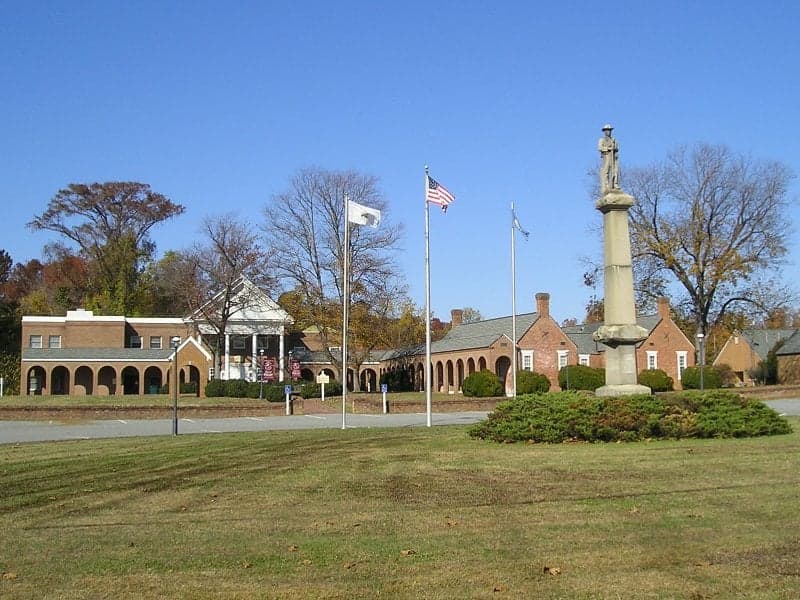
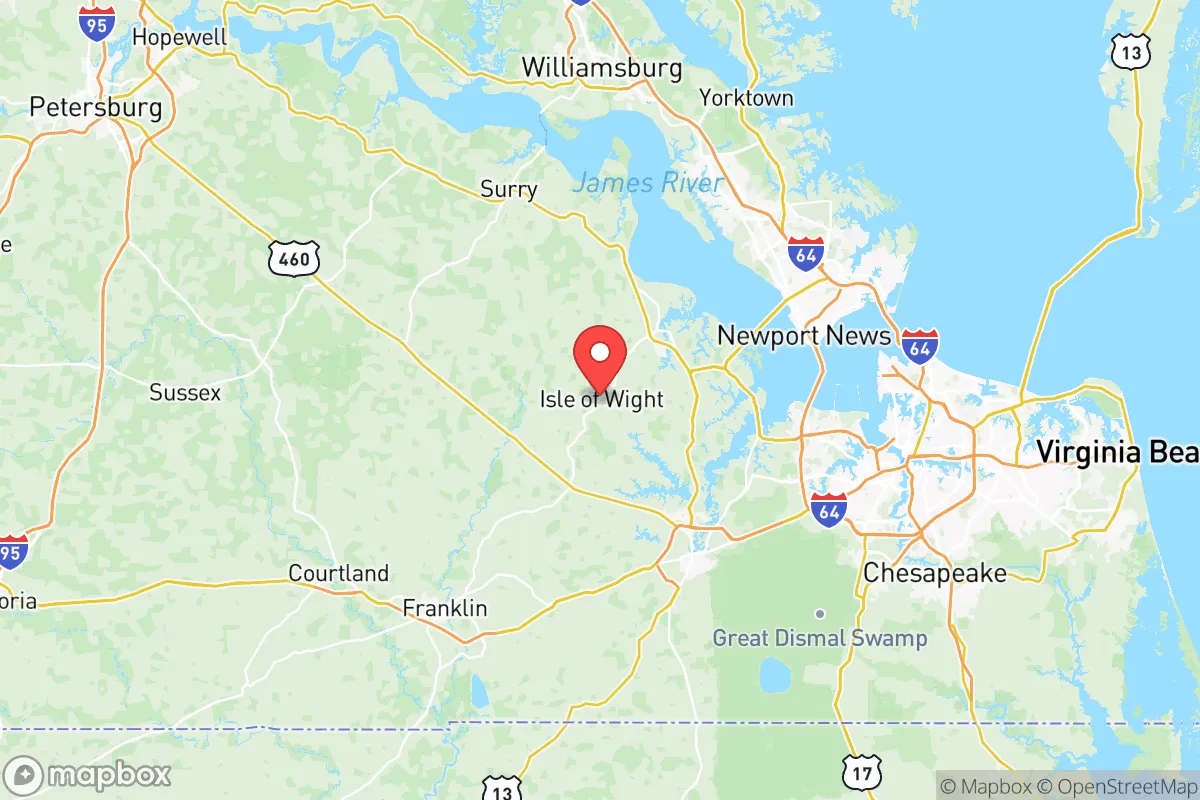
Photo: Wikipedia
Demographics of Isle of Wight County
Affluence Level in Isle of Wight County
A middle-class area roughly in line with national averages across income, home values, education, and employment.
People of Isle of Wight County
Isle of Wight County, Virginia, is a predominantly rural county of 39,444 residents where the population is roughly 69% White and 22% Black, with a very small Hispanic community at 3.9%. The county’s identity is rooted in its deep Tidewater history—it is one of the oldest English-settled jurisdictions in America—yet it is now experiencing the early stages of suburban spillover from the Hampton Roads metro area. With a foreign-born share of just 0.8% and a college-educated rate of 29.9%, the county remains a culturally traditional, family-oriented community that is slowly diversifying along its eastern edge.
Settlement & growth (pre-1960)
Long before English colonists arrived, the region was inhabited by the Warrosquoyacke, a Powhatan-aligned Algonquian people whose name survives in the county’s original 1634 designation as Warrosquoyacke County. The English established the first permanent settlements in the early 1600s, with the county formally renamed Isle of Wight in 1637 after the island off England’s south coast. The earliest European settlers were English Puritans and Anglican gentry who established tobacco plantations along the James River and its tributaries, including the Pagan River and Burwell Bay. The historic town of Smithfield, incorporated in 1752, became the county’s commercial and social hub, while the smaller settlement of Windsor grew as an inland agricultural crossroads.
Through the 18th and 19th centuries, the population remained overwhelmingly English-descended, with a substantial enslaved African population working the tobacco and peanut fields. After the Civil War and Emancipation, freed Black families formed tight-knit rural communities that persist today, particularly in the areas around Zuni, Rushmere, and Carrollton. The late 19th and early 20th centuries saw modest in-migration of Scots-Irish and German farmers drawn by cheap land, but the county’s population growth was slow compared to Virginia’s industrializing cities. The arrival of the Norfolk Southern Railway through Windsor in the early 1900s connected the county to regional markets, yet Isle of Wight remained a quiet, agrarian backwater through the 1950s, with a population that hovered around 15,000–20,000.
Modern era (post-1965)
The 1965 Hart-Cellar Act had little direct effect on Isle of Wight County, as the region never attracted the immigrant waves that reshaped urban Virginia. Instead, the county’s modern demographic story is one of domestic migration and suburbanization. Beginning in the 1980s and accelerating after 2000, the construction of the James River Bridge and the expansion of U.S. Route 17 made the county’s eastern townships—Carrollton and Smithfield—commuter-friendly for workers in Newport News, Hampton, and Norfolk. This triggered steady in-migration of White and Black families from Hampton Roads seeking larger lots, lower taxes, and better schools.
The racial composition has remained remarkably stable compared to national trends. The Black population, which made up roughly a third of the county in the mid-20th century, now stands at 21.8%, reflecting both out-migration of younger Black residents to urban centers and the arrival of predominantly White suburban families. The Hispanic share grew from under 1% in 2000 to 3.9% today, driven largely by agricultural labor and construction work, with families settling in the more affordable western half of the county around Windsor and Ivor. East and Southeast Asian residents make up just 1.0% of the population, concentrated almost entirely in the newer subdivisions near Carrollton, while the Indian-subcontinent population is effectively zero. The foreign-born share of 0.8% is among the lowest in Virginia, making Isle of Wight one of the least immigrant-diverse counties in the Hampton Roads region.
Suburbanization has been the defining force of the past two decades. The county’s population grew by roughly 15% between 2010 and 2020, almost entirely in the eastern corridor along Route 17, where new single-family subdivisions and townhome developments have replaced former farmland. The historic town of Smithfield has retained its character as a tourist destination—famous for the Smithfield ham industry—while Windsor has grown as a modest bedroom community. The western half of the county, including the villages of Burwell Bay and Rescue, remains sparsely populated with large agricultural tracts and waterfront properties.
The future
Isle of Wight County is poised for continued, moderate growth, but its demographic trajectory will likely remain far less diverse than the national average. The county’s comprehensive plan projects population reaching roughly 50,000 by 2040, with nearly all new development concentrated in the eastern Route 17 corridor and around the planned Windsor–Ivor industrial zone. The Hispanic population is expected to grow slowly, perhaps reaching 6–7% by 2040, as agricultural and logistics jobs expand. The Black population share is likely to hold steady or decline slightly as White suburban in-migration continues.
The county is becoming more suburban but not more cosmopolitan. New residents are overwhelmingly domestic migrants from Hampton Roads and, increasingly, from the Washington, D.C. metro area seeking affordable waterfront property. The cultural identity is evolving from a purely agricultural community to a hybrid of rural tradition and commuter suburbia, with tensions over land use, school funding, and the pace of development likely to define local politics. The county’s low foreign-born share means it will remain culturally homogeneous compared to neighboring cities like Newport News or Norfolk.
For someone moving to Isle of Wight County today, the bottom line is this: you are joining a community that is still overwhelmingly native-born, politically conservative, and rooted in Tidewater traditions, but which is gradually becoming a quieter, more spread-out extension of the Hampton Roads suburbs. The eastern townships offer new construction and commuter convenience, while the western half preserves the rural, agricultural character that has defined the county for nearly four centuries. Expect a place where neighbors know each other, schools are smaller than regional averages, and the pace of change is steady but slow.

* Values derived from national, state, county, city and local statistics and may differ in a specific area. Last updated: 2026-10-13T18:21:44.000Z
Narrative content on this page is AI-generated and may contain mistakes. Verify any details that matter before acting on them.
ReloMaps may earn a commission from affiliate links at no extra cost to you.

