Political ClimatePolitical Climate in Hampton City County
Showing district-level results — no local-only data available.
Local Political AnalysisPolitical Analysis of Hampton City County
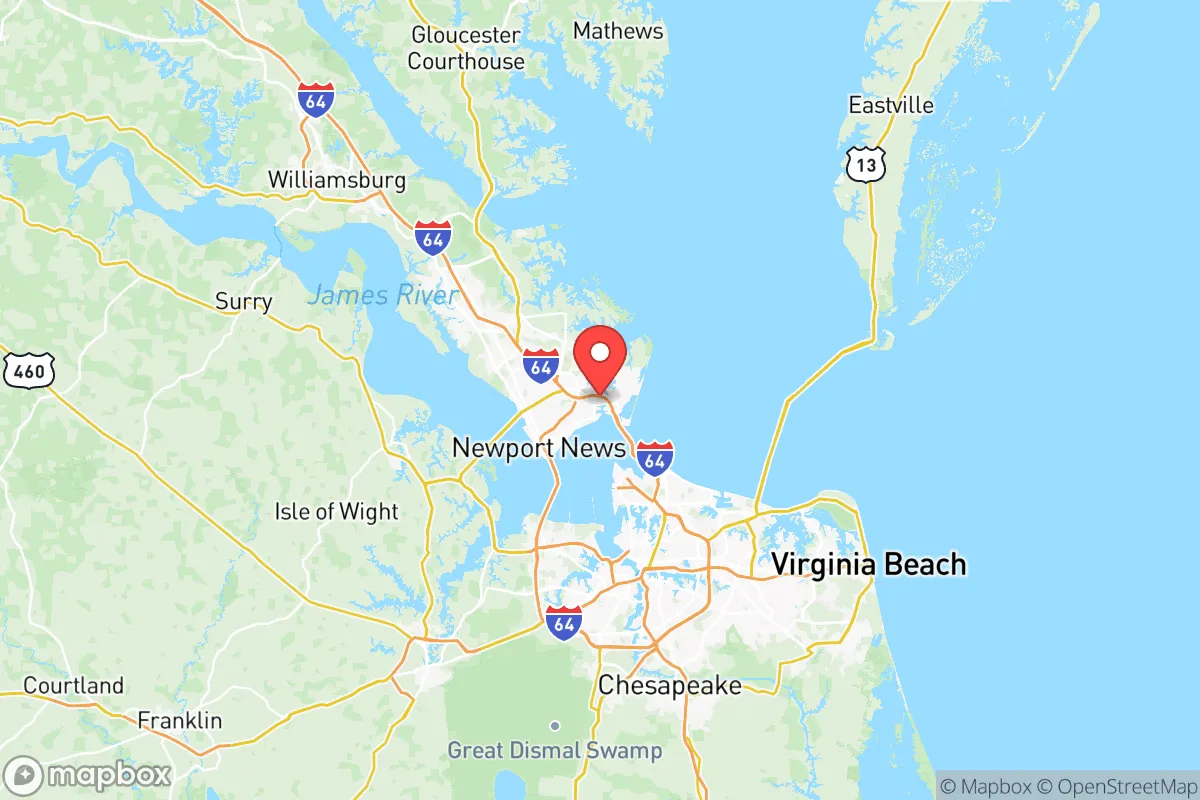
Hampton City County, VA is a solidly Democratic stronghold with a Cook PVI of D+18, making it one of the most reliably blue jurisdictions in the state. In the 2024 presidential election, the city delivered roughly 62% of its vote to the Democratic candidate, a margin that has held steady since the 2020 cycle. This isn't a recent shift — Hampton has been trending blue for decades, driven by its large African American population, a strong union presence tied to the shipbuilding and defense industries, and a growing base of younger professionals moving into the downtown and waterfront areas. The surrounding state of Virginia, VA, by contrast, has a Cook PVI of D+4, meaning Hampton is about 14 points more Democratic than the state as a whole, which itself has moved from a purple swing state to a lean-blue one over the past decade.
How it compares
Hampton's D+18 lean is significantly more liberal than the statewide D+4 average, placing it in the same political orbit as other Tidewater Democratic strongholds like Norfolk (D+16) and Portsmouth (D+19). Within Hampton itself, the political geography is fairly uniform, but there are subtle variations. The Buckroe Beach and Fox Hill neighborhoods in the southeast tend to be more moderate, with pockets of Republican-leaning voters, particularly among older, white, retired residents. The Downtown and Phoebus areas are the most reliably blue, driven by younger renters and a dense concentration of government and defense workers. The Langley Air Force Base area, while military-heavy, leans Democratic due to the high proportion of Black and Latino service members. In contrast, the state's D+4 PVI reflects a more balanced mix, with the rural and exurban counties of Southwest and Southside Virginia pulling the state rightward, while the urban crescent from Northern Virginia to Hampton Roads pushes it left. Hampton is essentially a microcosm of the state's urban Democratic base, but without the swing-voter dynamics seen in places like Chesterfield or Loudoun counties.
What this means for residents
For liberal residents, Hampton's deep blue lean means local policies align closely with their values — the city has a strong affordable housing initiative, a living wage ordinance for city employees, and a police oversight board established in 2021. Conservative residents, while a minority, are not without representation; the city council has two Republican-leaning members as of 2025, and the Fox Hill Civic League remains an active voice for fiscal conservatism and property rights. In practice, the political climate means that national issues like abortion rights and gun control are rarely debated locally because the city's stance is settled — Hampton is a "Second Amendment Sanctuary" city in name only, with local enforcement focused on state-level red flag laws. The biggest local political fights tend to be over development, school funding, and the pace of redevelopment in the downtown corridor, not culture war issues.
Culturally, Hampton's political identity is shaped by its deep ties to the military and the shipyard — Newport News Shipbuilding is the largest employer, and many residents work in defense or civil service, which fosters a pragmatic, pro-union, pro-veteran brand of liberalism. The city is also home to Hampton University, a historically Black university that anchors a politically engaged, civically active community. Unlike some parts of Virginia where the urban-rural divide is stark, Hampton's politics feel less polarized day-to-day; neighbors might disagree on presidential candidates but still show up for the same local Little League games or the Hampton Jazz Festival. The trajectory is clear: Hampton will remain a Democratic stronghold for the foreseeable future, but its brand of politics is more about service, community, and economic stability than ideological purity. For anyone moving here, the key takeaway is that the city's politics are predictable but not oppressive — you can be a conservative and live comfortably, you just won't win many local elections.

State Political ClimatePolitical Climate in Virginia
State Political AnalysisPolitical Environment in the State
Virginia is a classic swing state that has shifted decisively blue over the past two decades, now carrying a Cook PVI of D+4, but the reality on the ground is far more divided than that single number suggests. The state’s political identity is a tug-of-war between the densely populated, increasingly progressive suburbs of Northern Virginia and the reliably conservative rural and exurban regions stretching from the Shenandoah Valley down to the Southside and Southwest Virginia. Over the last 10-20 years, the key story has been the rapid growth and leftward march of the D.C. suburbs—places like Loudoun County, Prince William County, and Fairfax County—which have overwhelmed the GOP’s traditional strength in the rest of the state, flipping Virginia from a reliably red presidential state in the 2000s to a solidly blue one by the 2020s.
Urban vs. rural divide
The political map of Virginia is a study in stark contrasts. The entire engine of the Democratic majority is the I-95 corridor from Northern Virginia down through Richmond and into Hampton Roads. Northern Virginia alone—Fairfax, Loudoun, Prince William, and Arlington counties—generates a massive blue vote margin that often decides statewide elections before the rest of the state has fully reported. Richmond, the capital, is a reliably Democratic city, and the Hampton Roads area, anchored by Norfolk and Virginia Beach, leans blue but with more competitive pockets. Meanwhile, the rest of the state is deeply Republican. The Shenandoah Valley, places like Harrisonburg and Staunton, votes red, but the real GOP strongholds are the rural counties of Southside Virginia—Danville, Martinsville, and the counties along the North Carolina border—and the coal country of Southwest Virginia, including Bristol and Wise County. A key bellwether is Chesterfield County, just south of Richmond: once a solidly red suburban stronghold, it has been trending purple and even blue in recent cycles, reflecting the broader suburban shift that has reshaped Virginia politics.
Policy environment
Virginia’s policy environment is a hybrid that reflects its divided government and recent Democratic control. The state has a relatively moderate tax burden compared to its neighbors—no state income tax on the first few thousand dollars of income, but a marginal rate that tops out at 5.75% for high earners. Property taxes are set locally and vary widely, with Northern Virginia counties carrying some of the highest rates in the state. The regulatory posture is business-friendly in many respects, but the past few years have seen a push toward stricter environmental regulations and a higher minimum wage, which was raised to $12 per hour in 2023 with a path to $15. On education, Virginia has been a battleground: the state has seen fierce fights over school curriculum, parental rights, and transgender policies, with Governor Glenn Youngkin’s 2021 election largely driven by suburban parents frustrated with pandemic school closures and critical race theory debates. Election laws are moderately accessible—no-excuse absentee voting, same-day registration during early voting, and voter ID requirements that are less strict than in many Southern states. Healthcare policy has expanded under the Affordable Care Act, with Virginia adopting Medicaid expansion in 2018 under a bipartisan deal.
Recent policy direction
The last few years have seen Virginia swing back and forth on a range of liberty-related issues, creating a patchwork that relocators should weigh carefully. On gun and self-defense law, Virginia is a shall-issue state for concealed carry, but the Democratic-controlled legislature passed a series of gun control measures in 2020, including universal background checks, a red flag law, and a one-handgun-per-month limit. These remain in effect despite Republican efforts to roll them back. On parental and education rights, the Youngkin administration has pushed for more transparency in school curricula and expanded school choice through lab schools and charter school funding, but the legislature has blocked many of the more aggressive proposals. Speech and privacy issues have been relatively stable, though the state has not enacted the kind of broad social media or surveillance restrictions seen in some other states. Medical and bodily autonomy is a major flashpoint: Virginia has some of the most permissive abortion laws in the South, with no gestational limit on abortion before viability and a law protecting providers from out-of-state lawsuits, but this has made it a target for conservative backlash. Property rights are generally strong, though Northern Virginia’s growth has led to increasing land-use regulation and affordable housing mandates. On voting and ballot access, Virginia has moved toward greater convenience—no-excuse absentee voting, 45 days of early voting, and automatic voter registration—but this has also fueled election integrity concerns among conservatives, particularly after the 2020 election.
Civil unrest & political movements
Virginia has been a focal point for political activism and civil unrest on both sides. The 2017 Unite the Right rally in Charlottesville, which turned violent, remains a defining scar on the state’s political memory and galvanized both anti-racist organizing and right-wing backlash. The 2020 racial justice protests in Richmond, which included the toppling of Confederate statues on Monument Avenue, led to a statewide debate over historical memory and public symbols. On the right, the "parents’ rights" movement exploded in Loudoun County in 2021, driven by controversies over school policies on transgender students and sexual assault cases, and this energy directly fueled Youngkin’s gubernatorial win. Immigration politics are less heated than in border states, but Northern Virginia’s growing immigrant population has led to sanctuary city debates in places like Alexandria and Arlington, though no statewide sanctuary policy exists. Election integrity remains a live issue: the 2020 election saw Trump supporters protest outside state capitols, and the 2021 gubernatorial race was closely watched for fraud allegations, though none were substantiated. A new resident would notice the political polarization most acutely in the suburbs—yard signs, bumper stickers, and local Facebook groups are intensely partisan, especially in swing counties like Loudoun and Chesterfield.
Projection
Over the next 5-10 years, Virginia is likely to continue its slow drift leftward, driven by the relentless population growth of Northern Virginia and the in-migration of educated, moderate-to-liberal professionals from other states. The rural and exurban areas will remain deeply Republican, but their political weight will continue to shrink as a share of the state’s total vote. The key question is whether the suburbs of Richmond and Hampton Roads will follow the Northern Virginia model and shift blue permanently, or whether the GOP can hold them as a firewall. The 2025 gubernatorial election will be a critical test: if a Democrat wins, it will confirm the state’s blue trajectory; if a Republican wins, it will suggest the state remains competitive. For a new resident moving in now, expect to find a state where your local political experience depends heavily on where you live—a conservative in Loudoun County will feel increasingly isolated, while a liberal in Southwest Virginia will be in a clear minority. The state’s policy direction will likely continue to seesaw between Democratic-controlled legislatures and occasional Republican governors, meaning that major shifts on abortion, guns, and education will be fought out every few years.
For a relocator, the bottom line is that Virginia offers a genuinely mixed political environment: you can find a community that matches your values, but you will also live under state-level policies that may not align with them. Conservatives will appreciate the business climate and the strong gun rights framework that remains, but will need to accept that the state is trending blue on social issues and that their vote will be increasingly concentrated in rural areas. Liberals will find a state that protects abortion access, has expanded voting rights, and is investing in education and infrastructure, but will face high costs of living in the blue strongholds and a persistent conservative counterweight in the legislature. The best advice is to visit the specific region you’re considering—Northern Virginia, Richmond, the Shenandoah Valley, or Southside—and talk to locals, because the political reality of Virginia is not one state but several, and your experience will depend entirely on which one you choose to call home.
* Values derived from national, state, county, city and local statistics and may differ in a specific area. Last updated: 2026-07-04T01:41:37.000Z
Narrative content on this page is AI-generated and may contain mistakes. Verify any details that matter before acting on them.
ReloMaps may earn a commission from affiliate links at no extra cost to you.

