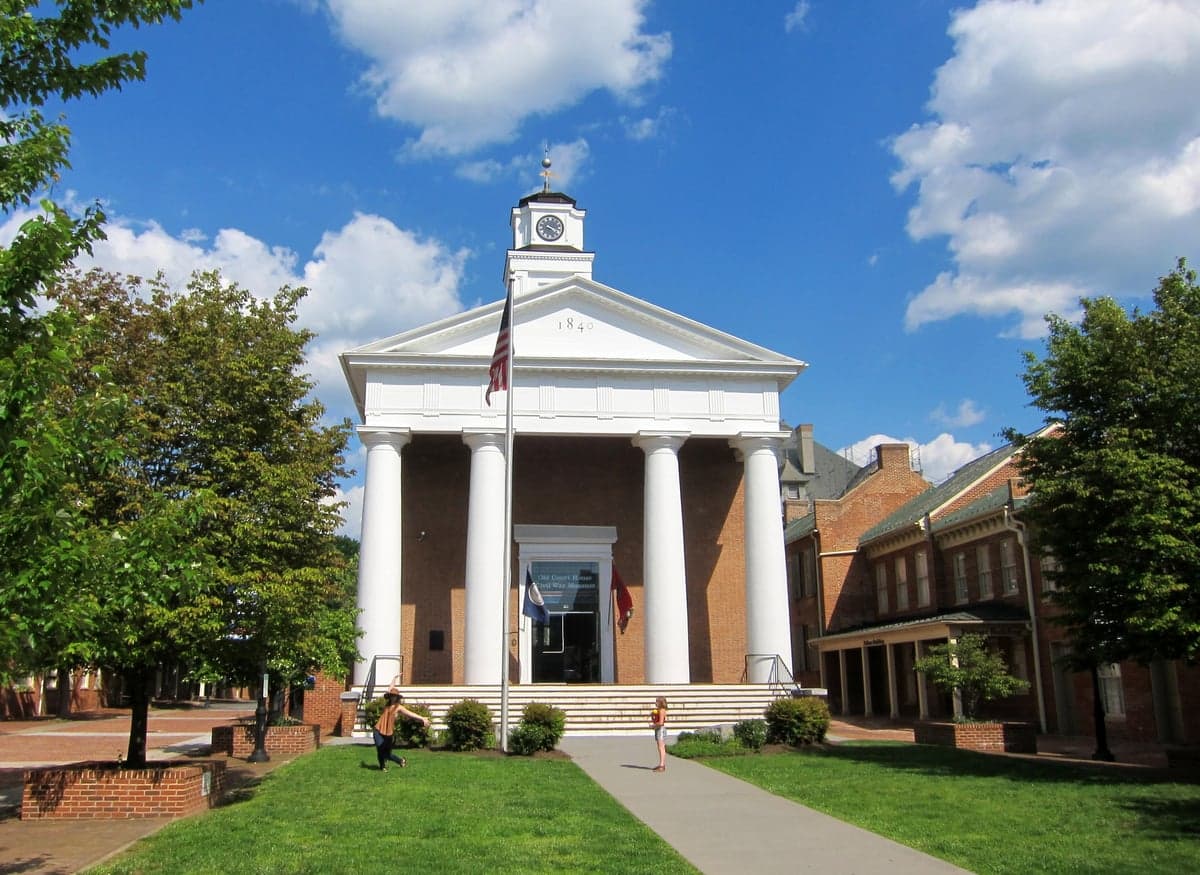
Photo: Wikipedia
Political ClimatePolitical Climate in Frederick County
Showing state-level results — no local-only data available.
Local Political AnalysisPolitical Analysis of Frederick County
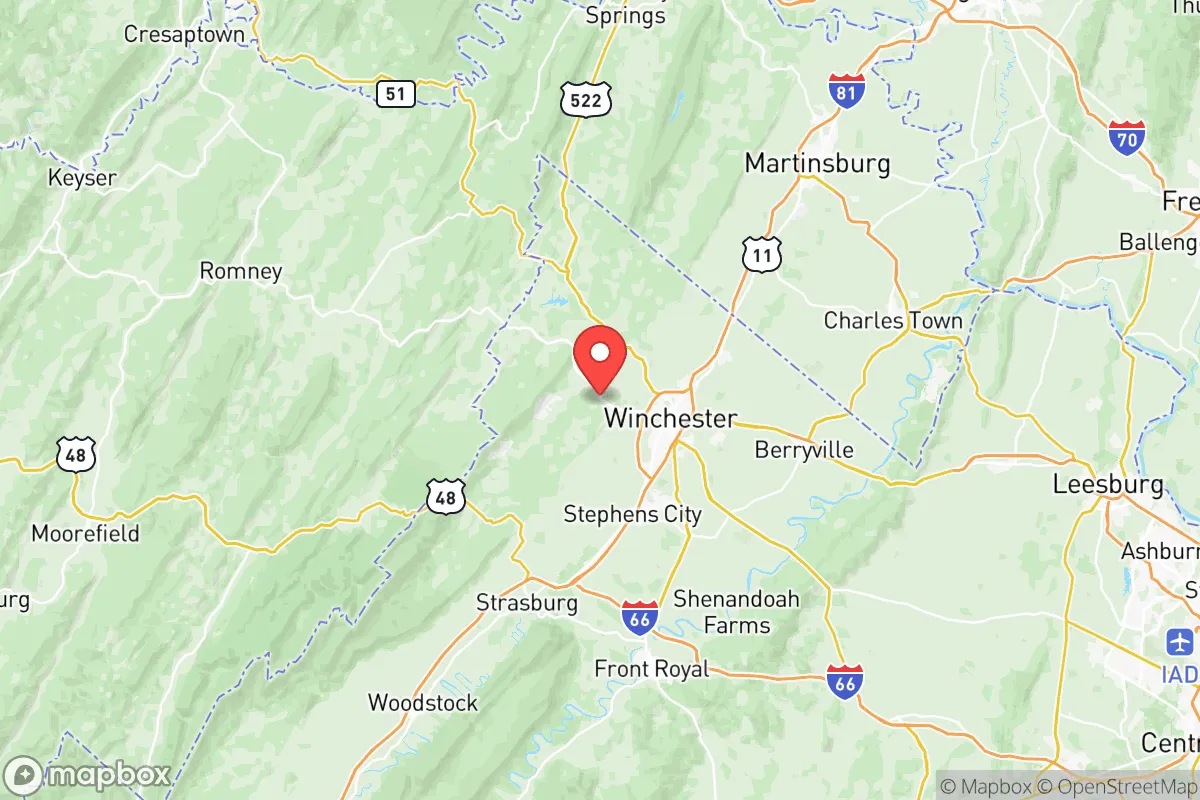
Frederick County, Virginia, has been a reliably conservative area for decades, with a Cook Partisan Voting Index of R+12 placing it roughly 16 points to the right of the Commonwealth as a whole, which now sits at D+4. While the county has moved rightward in recent presidential cycles, the county seat of Winchester (an independent city) creates a significant political island, voting reliably blue in state and national races. The real action, however, is in the unincorporated towns and suburbs—Stephens City, Middletown, and the sprawling subdivisions around Lake Frederick—where Republican candidates consistently rack up victories by 15-25 percentage points.
How it compares
The gap between Frederick County and the state of Virginia has widened noticeably since 2020. While the state shifted slightly left in the 2024 presidential election (driven by heavy turnout in Northern Virginia and Richmond), Frederick County voted for Donald Trump by a 58-40 margin, essentially holding its 2020 pattern. This puts the county in a shrinking cohort of rural and exurban jurisdictions that are moving opposite the statewide trend. For comparison, neighboring Loudoun County—just 30 miles east—voted D+15 in 2024, illustrating the sharp political border that runs along the county line. Within Frederick County itself, the most conservative precincts are in the far western rural areas around Wardensville and the Gore community, where GOP candidates often crack 70%. The swingiest area is the town of Middletown, where a mix of retirees, commuters, and locals produces margins closer to 55-45 Republican—still a safe win, but less lopsided than the rest.
What this means for residents
For conservative residents, Frederick County is largely a comfortable place politically. Local government, from the Board of Supervisors to the school board, is overwhelmingly Republican. Tax rates are among the lowest in the state, and gun rights are broadly supported. The county's resistance to expanding public transit or adopting high-density zoning reflects a local preference for slower growth and rural character. For liberal residents, the political reality is more complex. While you won't face hostility in day-to-day life, you will find that your state-level and national views are in the minority. That said, Winchester, just across the city line, offers a blue-leaning social and cultural scene—with a thriving arts district, independent bookstores, and a vocal activist community. Many Frederick County liberals effectively commute to Winchester for that social sphere, then return to the county for cheaper housing and good schools. The key distinction: Frederick County is not a place where political signs get vandalized, but it is also not a place where progressive candidates have any realistic chance of winning local office in the near term.
Culturally, Frederick County residents take pride in their independence from the state's urban centers. The county's official stance on immigration enforcement, its refusal to adopt Loudoun County's school policies, and its active pursuit of agricultural preservation easements all signal a community that self-consciously defines itself against the Northern Virginia juggernaut. Long-timers will note that this political identity has deepened since 2016, when the county began hosting large Trump rallies at the Frederick County Fairgrounds. Looking ahead, the trajectory suggests the county will remain R+12 or even drift slightly redder as adjacent Loudoun County becomes more expensive and pushes conservative retirees westward—a pattern that is already visible in the Lake Frederick development. In practical terms, this means the county's zoning debates, school funding decisions, and transportation priorities will continue to reflect a low-tax, low-regulation philosophy for the foreseeable future.

State Political ClimatePolitical Climate in Virginia
State Political AnalysisPolitical Environment in the State
Virginia has shifted from a reliably swing state to a solidly Democratic-leaning one over the past two decades, carrying a Cook PVI of D+4. This blue tint is driven primarily by explosive growth in the Washington, D.C. suburbs in Northern Virginia, which now dominate state elections. The state’s political trajectory has been a steady leftward march since 2008, when Barack Obama became the first Democrat to win Virginia since 1964, and it has only accelerated since, with Democrats now controlling the governorship and both legislative chambers. For a conservative-leaning relocator, this means the state government in Richmond is generally not aligned with their political values, even as many individual localities remain deeply conservative.
Urban vs. rural divide
The political map of Virginia is a classic urban vs. rural story, with a few critical suburban battlegrounds. The engine of Democratic power is Northern Virginia, a sprawling collection of cities and counties inside the D.C. beltway—places like Arlington, Alexandria, Fairfax County, and Loudoun County. These areas vote 65-35 or more Democratic and provide the lion’s share of Democratic votes statewide. The other major Democratic stronghold is the Richmond metro area, particularly the city itself and surrounding Henrico County, which have also trended blue. The Hampton Roads area, including Norfolk and Virginia Beach, is more mixed, but with the military-heavy population, it leans slightly right of the state as a whole.
Rural Virginia, by contrast, is overwhelmingly red. The Southside region along the North Carolina border, the Roanoke Valley, and the Shenandoah Valley vote Republican by margins of 20-40 points. Counties like Giles, Patrick, and Lee routinely vote 70%+ Republican. The key shift in the last decade has been the suburban counties around Richmond and in Prince William County (NoVA) flipping from battlegrounds to safe Democratic seats. The once-pivotal Chesterfield County, outside Richmond, has become more competitive, but it still leans Republican. For a conservative moving in, your political experience will depend heavily on whether you’re in a deep-blue Northern Virginia enclave, a red farming community, or one of the remaining purple suburbs.
Policy environment
Virginia’s policy environment is a blend of moderate and progressive governance, with tax policy being one of the more competitive features. The state has a flat personal income tax rate of 5.75%, which is relatively low for the mid-Atlantic, and a state sales tax of 5.3% (higher in some localities). Property taxes are set locally and vary widely—from under 0.8% in some rural counties to over 1.1% in Northern Virginia. There is no state estate tax, which is a plus for wealth preservation. However, the regulatory posture has tightened significantly in recent years, with stricter environmental rules, a higher minimum wage (currently $12.00, phasing to $15.00), and a shift toward renewable energy mandates.
Education policy is a major battleground. Public schools in Northern Virginia are among the best in the country, but they are also deeply progressive in curriculum and equity initiatives. Outside NoVA, school quality varies, with many rural schools struggling with funding and enrollment. Parental rights have been a flashpoint, with Republican-led efforts to pass laws like the Parents’ Bill of Rights (HB 1603, introduced in 2024) failing in the Democratic-controlled legislature. Healthcare access is relatively good, with the state expanding Medicaid under the ACA in 2019. Election laws have also changed, with no-excuse absentee voting, same-day voter registration, and expanded early voting all enacted by Democrats, making access easier—a point of pride for some, a concern about integrity for others.
Recent policy direction
The last few years have seen Virginia’s legislature push a clear progressive agenda, culminating in the 2020-2021 session. Key legislation includes gun control measures—a red flag law, universal background checks, and a one-handgun-per-month limit—which passed in 2020. Recreational marijuana was legalized for adults aged 21+ in 2021, though retail sales only began in 2024, and local opt-outs are common in conservative counties. On abortion rights, Virginia has become a regional safe haven, with state law protecting the right to an abortion up to fetal viability (roughly 26 weeks), and Democrats have resisted Republican attempts to impose a 15-week ban. Governor Youngkin’s effort to ban abortion at 15 weeks failed in 2023.
In parental and education rights, the state government has moved left, requiring LGBTQ+ inclusive curricula in public schools and protecting transgender students’ bathroom access under state law. Property rights are generally respected, but there have been local battles over zoning reforms to increase density in Northern Virginia. Ballot access has been expanded significantly, including the automatic restoration of voting rights for felons, passed in 2021. For a conservative relocator, the local policy environment may feel quite liberal on social issues, but fiscal policy—especially taxes and business regulation—remains more centrist than in neighboring Maryland.
Civil unrest & political movements
Virginia has a long history of political activism, with a few notable flashpoints. The 2017 Unite the Right rally in Charlottesville, which turned violent with the murder of a counter-protester, remains a defining image of far-right extremism and has led to strong local and state opposition to such gatherings. More recently, the 2020-2021 debates over critical race theory in schools ignited massive grassroots activism among parents, particularly in suburban Loudoun County, which became a national symbol of the school-board wars. This activism helped fuel Glenn Youngkin’s 2021 gubernatorial win, as he capitalized on parental frustration.
Immigration politics are less visible than in border states, but the issue remains live. Sanctuary city policies exist locally—Fairfax County and the city of Richmond have policies limiting cooperation with federal immigration enforcement—but there is no statewide sanctuary law. Election integrity controversies have been minimal, though some Republicans have pushed for stricter voter ID laws, which have been rejected. Overall, the state is not a hotbed of political violence, but the 2017 Charlottesville events and the Loudoun school wars show that it can be a powder keg for national culture-war issues.
Projection
Over the next 5-10 years, Virginia’s political trajectory is almost certainly further to the left. In-migration from D.C. continues to fuel Northern Virginia growth, while rural areas are losing population slowly. The key demographic shift is the growing Asian American population in NoVA, which tends to vote Democratic. The state could become D+6 or D+8 by 2030, making it as blue as New Mexico or Oregon. For a conservative, this means frequent policy battles will be lost at the state level, though local control in rural counties will remain strong. The most likely scenario is that Virginia becomes a reliably Democratic state for federal elections, while state-level races remain competitive only in years with strong Republican messaging (like 2021).
Governor Youngkin’s current term is a brief interlude in a longer Democratic trend. Expect continued expansion of gun control, environmental regulation, and social-liberal policies. The one wild card is if the national Republican Party can mount a compelling message on economic issues that resonates with Northern Virginia’s highly educated workforce—currently, it does not. For a relocator, plan for a state whose government is increasingly aligned with urban progressive values, even as large swaths of the countryside resist.
For a conservative relocator, the bottom line is that Virginia is a blue state with red pockets. You can find a culturally conservative life in Roanoke, Lynchburg, or any of the rural counties, but state-wide policies will often frustrate you. Your local taxes will be set by your county, not Richmond, so property taxes can be favorable. If you prioritize low taxes and a strong economy, Virginia still offers the best mix in the mid-Atlantic. But if you want a state government that closely matches your social and cultural values, you may be better suited to Tennessee or Texas. Come for the climate, economy, and history—but know you’ll be voting in a blue state.
* Values derived from national, state, county, city and local statistics and may differ in a specific area. Last updated: 2026-09-14T13:10:04.000Z
Narrative content on this page is AI-generated and may contain mistakes. Verify any details that matter before acting on them.
ReloMaps may earn a commission from affiliate links at no extra cost to you.

