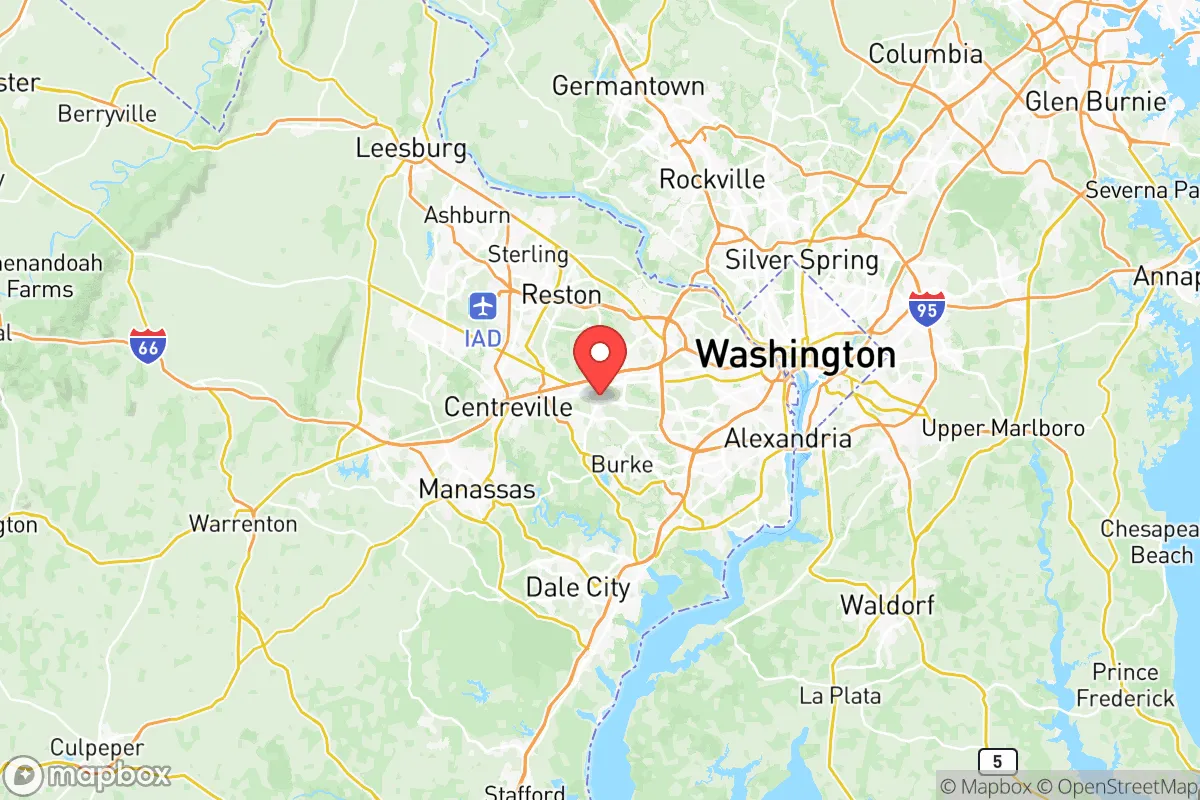
Political ClimatePolitical Climate in Fairfax City County
Showing district-level results — no local-only data available.
Local Political AnalysisPolitical Analysis of Fairfax City County
Fairfax City County leans heavily Democratic, with a Cook PVI of D+18, making it one of the most reliably blue jurisdictions in Virginia. That's a stark contrast to the state's overall D+4 rating, and the gap has widened over the past decade as the county's population has grown more diverse and educated. In the 2024 presidential election, Fairfax County delivered over 63% of its vote to the Democratic candidate, while the state as a whole was decided by a much narrower margin. The county's political trajectory has been steadily leftward since the 1990s, when it was still a competitive swing area, and there's little sign of that trend reversing.
How it compares
Virginia's D+4 PVI reflects a state that's genuinely purple, with deep red rural areas and conservative exurbs balancing out the blue strongholds. Fairfax County, by contrast, is the engine of that blue vote. Within the county itself, there's meaningful variation: Vienna and Falls Church are among the most liberal towns, routinely voting 70%+ Democratic, while Clifton and parts of Lorton lean more conservative, often splitting 50-50 or even tipping red in down-ballot races. Herndon and Reston are solidly blue but with a more moderate, suburban character than the urban-core precincts near Tysons. The swing precincts are mostly in the county's southern and western edges, around Springfield and Burke, where older single-family home neighborhoods still have a noticeable Republican presence. Statewide, Fairfax County alone accounts for roughly 15% of Virginia's total vote, so its political weight is enormous — no Democrat has won a statewide race without carrying Fairfax by at least 15 points since the 1990s.
What this means for residents
For liberal residents, Fairfax County feels like a political safe zone where their views are the norm, from local school board decisions to county board policies on housing and transit. Conservative residents, however, aren't marginalized — they just have to work harder to find their tribe. There are active Republican committees in Clifton and Springfield, and the county still elects a few Republican supervisors and school board members in those pockets. The practical effect is that local governance tends to be pragmatic rather than ideological: the county board, even when all-Democratic, focuses on traffic, schools, and development rather than culture-war issues. State-level politics is where the tension shows, as Fairfax's delegation often clashes with the more conservative General Assembly members from rural Virginia.
Culturally, Fairfax County's political lean translates into a few distinct policy choices. The county has one of the most generous affordable housing trust funds in the state, a robust public transit system that's been expanded under local Democratic leadership, and school policies that emphasize diversity and inclusion. Gun laws are stricter here than in much of Virginia, with local ordinances that go beyond state minimums. The tax burden is higher than the state average, but residents generally accept it as the price of high-quality schools and services. For newcomers, the political climate is less about partisan combat and more about a shared expectation that government should be active and effective — a mindset that sets Fairfax apart from both the rural conservative counties and the more libertarian-leaning parts of Northern Virginia like Loudoun.

State Political ClimatePolitical Climate in Virginia
State Political AnalysisPolitical Environment in the State
Virginia has shifted from a reliably purple swing state to a solidly Democratic-leaning one over the past two decades, with a Cook Partisan Voting Index of D+4. The dominant coalition is a mix of suburban professionals, federal workers, and growing minority populations in Northern Virginia, combined with college towns like Charlottesville and the Hampton Roads area. However, this blue trend masks a deep internal divide: the state’s rural and exurban regions, particularly south of the James River and west of the Blue Ridge, remain deeply conservative, creating a political landscape that feels like two different states under one capitol dome.
Urban vs. rural divide
The political map of Virginia is a story of two Virginias. The blue stronghold is Northern Virginia—specifically the counties of Fairfax, Loudoun, Prince William, and Arlington—which alone generates over a third of the state’s votes and reliably delivers 60-70% Democratic margins. This region’s economy is tied to the federal government, defense contractors, and tech, and its politics reflect the priorities of educated, affluent, and diverse suburbanites. The other major blue anchor is Richmond and its inner suburbs (Henrico, Chesterfield), plus the college town of Charlottesville and the Hampton Roads cities of Norfolk and Virginia Beach (though the latter is more competitive). On the red side, the rural crescent from Roanoke southwest to Bristol and the Shenandoah Valley counties like Augusta and Rockingham vote 65-75% Republican. The key swing areas that decide statewide races are the exurban “collar counties” like Loudoun and Prince William—which flipped from red to deep blue after 2016—and the fast-growing Fredericksburg region. In 2024, Loudoun County voted for the Democratic presidential candidate by roughly 20 points, a stark reversal from its 2012 split.
Policy environment
Virginia’s policy environment is a patchwork that reflects its divided government. The state income tax is a flat 5.75% (one of the highest flat rates in the South), and the sales tax is 5.3% (higher in Northern Virginia with local add-ons). Property taxes are set locally and vary widely—Loudoun County has some of the highest rates in the state, while Pittsylvania County in the south is much lower. Education policy is a major flashpoint: the state has a “right-to-work” law but also a strong teachers’ union presence in blue areas. Virginia’s public schools are generally well-regarded, but there’s been a fierce battle over transgender student policies and parental notification laws. Healthcare is dominated by large systems like Inova (Northern Virginia) and VCU Health (Richmond), and the state expanded Medicaid under the Affordable Care Act in 2019. Election laws are moderately restrictive: Virginia has no-excuse absentee voting and early voting, but requires a photo ID and does not allow same-day registration. The state’s gun laws have tightened significantly since Democrats took full control in 2020, including a “one-handgun-a-month” limit, universal background checks, and a red-flag law.
Recent policy direction
Since 2020, Virginia has moved decisively left on several fronts, though a Republican governor (Glenn Youngkin, elected in 2021) has acted as a brake. Key recent legislation includes the Virginia Clean Economy Act (2020), which mandates a 100% carbon-free electricity grid by 2050, and the repeal of the death penalty (2021). On gun rights, the 2020 package of bills—including the red-flag law and the handgun purchase limit—was a major shift from the state’s historically permissive stance. On education, Youngkin issued executive orders banning “inherently divisive concepts” in schools and requiring parental notification of sexually explicit content, but these have been challenged in court and partially blocked. On abortion, Virginia remains an outlier in the South: abortion is legal up to the second trimester, with a 24-hour waiting period and parental consent for minors, but no heartbeat ban. On voting, the state expanded early voting and no-excuse absentee voting in 2020, but a 2024 law tightened voter ID requirements and purged non-citizens from rolls. Property rights saw a win for landowners with a 2023 law limiting the use of eminent domain for private economic development. For conservatives, the trajectory is concerning: the state’s gun laws are now among the strictest in the South, and parental rights battles are ongoing. For liberals, the gains on climate, voting access, and abortion rights are real but fragile.
Civil unrest & political movements
Virginia has been a national flashpoint for political movements. The 2017 “Unite the Right” rally in Charlottesville—which turned violent and left one counter-protester dead—put the state on the map for white nationalist activity and sparked a statewide debate over Confederate monuments. That debate continues: many localities have removed statues, but a state law (passed in 2020) now allows localities to do so, while a 2024 law protects war memorials from removal. The 2021 gubernatorial race saw massive grassroots energy from both sides, with Youngkin’s focus on “parents’ rights” in schools driving suburban turnout. Immigration politics are less heated than in border states, but Fairfax County and Arlington have sanctuary policies limiting cooperation with ICE, which has drawn criticism from rural conservatives. Election integrity controversies flared after 2020, with some rural counties calling for a “forensic audit” of voting machines, but no widespread fraud was found. The most visible flashpoint for a new resident would be the stark contrast in political signage and activism: drive through Loudoun County and you’ll see “In This House We Believe” signs; head to Franklin County and you’ll see “Don’t Tread on Me” flags. The state also has a small but vocal secession movement in the far southwest, with some counties exploring joining West Virginia, though it remains a fringe idea.
Projection
Over the next 5-10 years, Virginia’s political trajectory points further blue, but with significant friction. The key driver is demographic: Northern Virginia continues to grow faster than the rest of the state, adding tens of thousands of new residents each cycle, most of whom lean Democratic. The rural areas are losing population and aging, which will shrink their electoral weight. However, the exurban counties that flipped blue in 2016-2020 may be more volatile: if the federal workforce shrinks or remote work collapses, some of those voters could swing back. The state’s in-migration from other states (especially from the Northeast and California) is overwhelmingly into blue areas, reinforcing the trend. A realistic projection: by 2032, Virginia’s PVI could shift to D+6 or D+7, making it as reliably blue as New Mexico or Colorado. For a conservative moving in now, expect that the state legislature will likely remain under Democratic control for most of the next decade, with occasional Republican wins in gubernatorial elections (like Youngkin’s) when the national mood shifts. The policy direction on guns, taxes, and education will continue to move left, but the pace will be slowed by the state’s moderate Democratic establishment, which is less progressive than its counterparts in New York or California.
Bottom line for a new resident: If you’re a conservative, you’ll find a strong community in the rural and exurban areas, but you’ll be fighting an uphill battle at the state level—your vote will matter most in local races and the governor’s mansion. If you’re a liberal, you’ll feel at home in the cities and inner suburbs, but be prepared for a state that still has a strong rural conservative voice. The practical takeaway is that Virginia offers a mix of opportunities and trade-offs: lower taxes than the Northeast, but higher than the Deep South; good schools in blue areas, but fierce culture wars over curriculum; and a state government that is increasingly blue, but with enough red in the legislature to prevent the most aggressive progressive policies. Choose your county carefully—it will determine your day-to-day political reality more than the state as a whole.
* Values derived from national, state, county, city and local statistics and may differ in a specific area. Last updated: 2026-06-17T12:46:07.000Z
Narrative content on this page is AI-generated and may contain mistakes. Verify any details that matter before acting on them.
ReloMaps may earn a commission from affiliate links at no extra cost to you.

