Demographics of Fairfax City County
Affluence Level in Fairfax City County
An upper-middle-class area. Household wealth, education levels, and homeownership run ahead of national benchmarks.
People of Fairfax City County
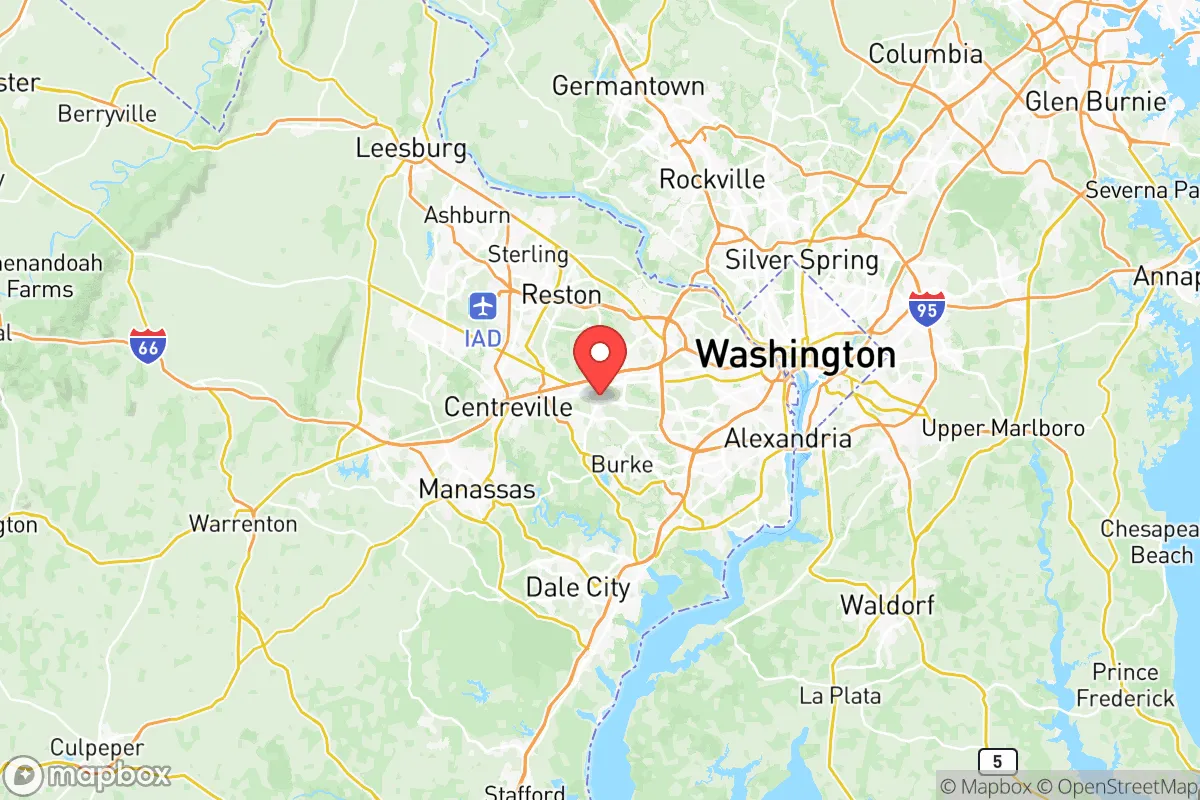
Fairfax City County, Virginia, is a small, densely populated urban enclave of 24,478 residents that stands apart from the surrounding suburban expanse of Fairfax County. Its population is notably diverse, with a White (non-Hispanic) plurality of 52.5%, a significant Hispanic community at 18.3%, and substantial East/Southeast Asian (12.8%) and Indian subcontinent (5.2%) populations. With 62.3% of adults holding a college degree, the city is a hub of highly educated professionals, many of whom work in government, technology, and defense contracting, giving it a character that is both cosmopolitan and family-oriented.
Settlement & growth (pre-1960)
Before European settlement, the area now known as Fairfax City was part of the ancestral homeland of the Doeg and Tauxenent peoples, Algonquian-speaking tribes who lived along the Potomac River and its tributaries. By the early 1700s, English colonists from the Tidewater region had pushed westward, and the Virginia General Assembly created Fairfax County in 1742, named after Thomas Fairfax, the proprietor of the Northern Neck land grant. The city itself was not formally established until 1961, but its core—the village of Providence—had been a crossroads settlement since the 18th century, serving as a stop on the Little River Turnpike (now Route 236) connecting Alexandria to the Shenandoah Valley.
Through the 19th century, the area remained a rural farming community, with a small population of English, Scots-Irish, and German descent. The Civil War brought devastation, as the region was a frequent battleground and supply route for both Union and Confederate forces. After Reconstruction, the local economy slowly shifted from tobacco and grain farming to dairy and market gardening, supplying the growing Washington, D.C. market. The arrival of the Washington and Old Dominion Railroad in the early 1900s spurred modest growth, but Fairfax City remained a sleepy county seat of fewer than 1,000 residents through the 1940s.
The real transformation began after World War II. The 1947 opening of what is now Washington Dulles International Airport (then under construction) and the expansion of the federal government under the Cold War drew thousands of white-collar workers to the region. The GI Bill fueled a housing boom, and developers built suburban tract homes in areas like Mosby Woods and Old Town Fairfax. By 1960, the population had swelled to over 13,000, and the city formally incorporated in 1961 to manage its own growth, separating from Fairfax County. This wave was overwhelmingly White, native-born, and middle-class, drawn by government jobs and affordable housing.
Modern era (post-1965)
The 1965 Hart-Cellar Immigration Act fundamentally reshaped Fairfax City's demographics, as it did across Northern Virginia. The first major new group were East/Southeast Asian immigrants, particularly Vietnamese refugees who arrived after the Fall of Saigon in 1975. Many settled in the Eden Center area of nearby Falls Church, but Fairfax City itself became a secondary hub, with Vietnamese families opening restaurants and shops along the Route 29 and 50 corridors. By the 1990s, Korean and Chinese professionals—many recruited for tech and engineering roles—joined them, clustering in neighborhoods like Pickett's Ridge and Fairfax Circle.
The 1980s and 1990s also saw a surge in Indian subcontinent immigration, driven by the H-1B visa program and the expansion of the tech sector in nearby Tysons Corner and Reston. Indian families concentrated in the western parts of the city, near George Mason University and the Fairfax County Government Center, establishing temples, grocery stores, and cultural organizations. Today, the Indian community (5.2% of the population) is one of the fastest-growing segments, with many residents working in IT, healthcare, and academia.
Hispanic migration accelerated in the 2000s, with immigrants from El Salvador, Guatemala, and Mexico arriving for construction, landscaping, and service jobs. The Hispanic population (18.3%) is now the largest minority group, concentrated in the more affordable eastern and southern parts of the city, near Jermantown Road and Main Street. This wave has been more working-class than the Asian and Indian cohorts, creating a distinct socioeconomic divide within the city's diversity.
Domestic migration has also played a role. Since 2010, Fairfax City has attracted a steady stream of young professionals and families from the Rust Belt and coastal California, drawn by the region's strong job market and relatively lower cost of living compared to Arlington or D.C. proper. However, the city's small land area (6.3 square miles) and strict zoning have limited new housing construction, pushing many newcomers to the surrounding Fairfax County suburbs.
The future
Fairfax City is becoming more diverse, more educated, and more expensive. The White (non-Hispanic) share has declined from 60% in 2010 to 52.5% today, and projections suggest it will fall below 50% within the next decade. The Hispanic and Indian subcontinent populations are growing fastest, while the East/Southeast Asian share is stabilizing as second-generation families move to larger homes in outer suburbs like Centreville and Chantilly.
The city's cultural identity is evolving from a quiet, historically White county seat into a polyglot, globally connected small city. New developments like the Fairfax Boulevard corridor are adding mixed-use apartments and townhomes, attracting younger, more diverse residents. However, the city's limited land and high home prices (median over $700,000) mean that future growth will likely be slow and infill-focused, rather than sprawling outward.
Politically, the city has shifted leftward, reflecting the broader Northern Virginia trend, but it retains a moderate, pragmatic character—many residents are federal employees or contractors who value stability and good schools over ideological purity. The school system (Fairfax County Public Schools) remains a major draw for families of all backgrounds.
For someone moving in now, Fairfax City offers a dense, walkable, and highly educated community with strong public services and proximity to D.C. jobs. The trade-off is high housing costs and limited space. The city is becoming a more diverse, more expensive version of itself—a small but globally connected enclave where the children of Vietnamese refugees, Indian engineers, and Salvadoran landscapers attend the same schools and play in the same parks. It is not a place of dramatic change, but of steady, managed evolution.

* Values derived from national, state, county, city and local statistics and may differ in a specific area. Last updated: 2026-06-17T12:46:07.000Z
Narrative content on this page is AI-generated and may contain mistakes. Verify any details that matter before acting on them.
ReloMaps may earn a commission from affiliate links at no extra cost to you.

