Political ClimatePolitical Climate in Alexandria City County
Showing district-level results — no local-only data available.
Local Political AnalysisPolitical Analysis of Alexandria City County
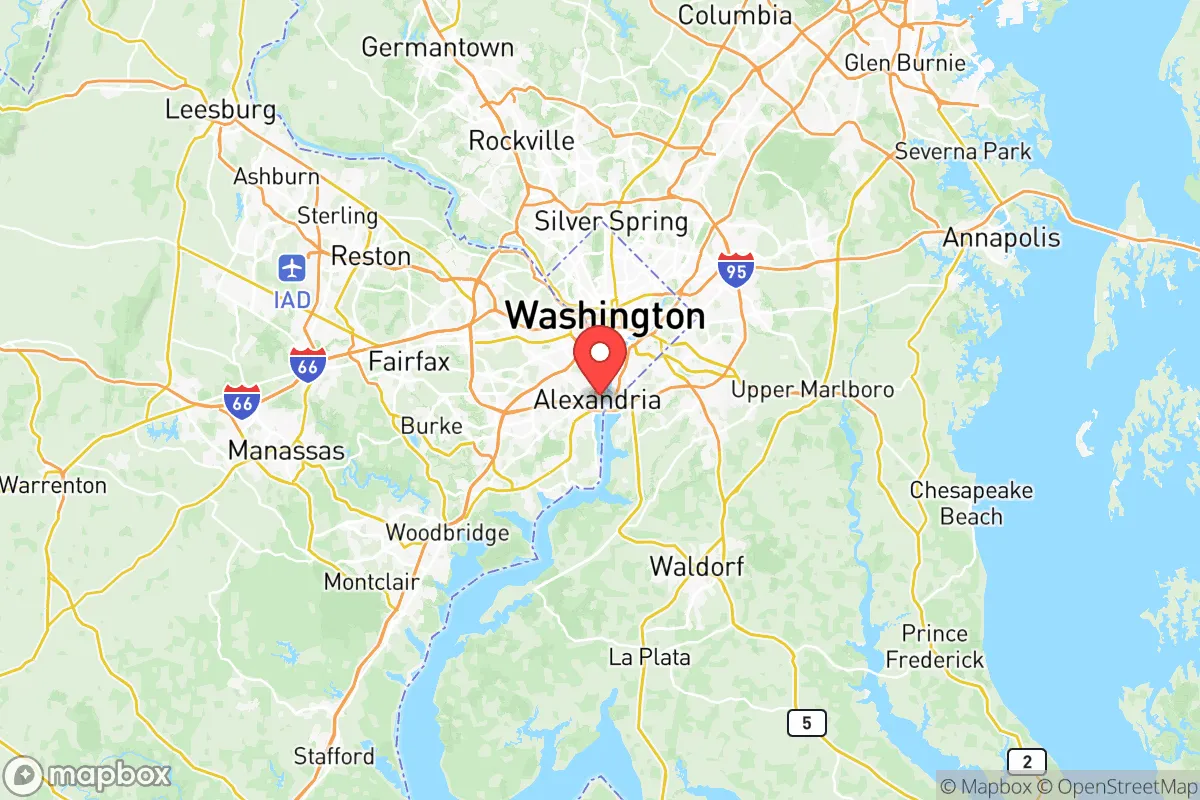
Alexandria City County is one of the most reliably Democratic strongholds not just in Virginia, but in the entire mid-Atlantic region. With a Cook Partisan Voting Index of D+26, the city consistently delivers Democratic margins of victory that are nearly seven times the statewide average for Virginia (which sits at D+4). In the 2024 presidential election, for example, Alexandria’s precincts in the Del Ray and Old Town neighborhoods routinely gave over 80% of their votes to the Democratic candidate, while only the more affluent, less dense pockets near the western edge of the city—like parts of the Seminary Valley area—touched 40-45% Republican. The trajectory is clearly toward even bluer territory, driven by an influx of young professionals and federal workers who prioritize transit-oriented development and progressive social policies.
How it compares
When you compare Alexandria to the rest of Virginia, the difference is stark. The rest of the state includes huge swaths of red territory like Lynchburg or the Shenandoah Valley, plus the fast-growing purple exurbs of Prince William County. But Alexandria is the extreme outlier: its D+26 PVI is more progressive than even the Arlington County next door (D+24) and far left of the statewide consensus. In practice, this means that a Democratic candidate for governor or Senate can expect to win Alexandria by 30-35 points, while the statewide margin might be only 5 points. For a conservative resident, this creates a feeling of being constantly outvoted in local elections—the City Council and School Board have not had a Republican member since the 1990s. Meanwhile, for a liberal resident, it means the city acts as a policy laboratory, often passing local tenant protections, minimum wage hikes, and environmental ordinances years before the state legislature takes them up.
What this means for residents
For progressives, living in Alexandria means that your vote for local office is almost guaranteed to align with the majority. The city has used its deep-blue status to push initiatives like the Eco-City Alexandria plan, which includes aggressive renewable energy targets for city buildings, and a rent control ordinance for older apartment buildings that is unique in the region. For conservatives, the practical reality is moderate. The city’s tax burden is high—the property tax rate of $1.11 per $100 of assessed value is one of the highest in Northern Virginia—but services like trash pickup, parks maintenance, and schools are excellent. Republican residents often find themselves focused on local issues like traffic congestion on Route 1 or school crowding in the West End, where they can sometimes form cross-aisle coalitions. The Potomac Yard development, for instance, divided the city not along party lines but between residents who wanted more retail versus more office space—a rare moment of nonpartisan debate.
The cultural and policy distinctions of Alexandria are directly shaped by its liberal lean. The city was an early adopter of sanctuary city policies for undocumented immigrants, and its public schools teach a comprehensive curriculum that includes LGBTQ+ history—a move that drew both praise and a handful of conservative parental protests. The city’s George Washington Masonic National Memorial and the Torpedo Factory Art Center symbolize a blend of historic preservation and progressive arts funding that feels distinctly Alexandrian. Looking ahead, the city will likely continue to drift left, but the big shift will be demographic: as the Potomac Yard Metro station opens and new high-rise apartments come online east of Eisenhower Avenue, expect the east side of the city to become even younger and more diverse, while the west side remains a mix of established families and older homeowners. The bottom line: if you want a place where your vote feels like it counts in a very specific, progressive direction, and you don't mind paying for top-tier services, Alexandria is your town. If you hold conservative views, you’ll find it politically isolating, but the quality of life still keeps many conservative families here—they just keep their politics to themselves at the farmers market.

State Political ClimatePolitical Climate in Virginia
State Political AnalysisPolitical Environment in the State
Virginia, with a Cook PVI of D+4, is a state that’s been drifting steadily blue over the past two decades, but it’s not a simple deep-blue monolith. It’s a classic “doughnut” state: a deep-blue urban core (Northern Virginia and Richmond) and a few smaller college towns, surrounded by a vast, reddish rural and exurban ring. The state voted Democratic for president from 2008 onward, but it’s also the only former Confederate state to have a Republican-controlled House of Delegates as late as 2019, and it just elected a Republican governor, Glenn Youngkin, in 2021. The trajectory is a slow, steady Democratic trend, driven almost entirely by population growth in the DC suburbs, but it’s still a competitive state in statewide races, with a strong conservative base in the southwest and southside.
Urban vs. rural divide
The political map of Virginia is dramatically split. The engine of the Democratic majority is Northern Virginia, specifically the counties of Fairfax, Prince William, Loudoun, and Arlington, plus the cities of Alexandria and Falls Church. These areas grew explosively over the last 30 years, filling with federal contractors, tech workers, and a diverse, highly educated workforce that reliably votes 20-30 points Democratic. In 2020, Fairfax County alone gave Joe Biden a margin of over 300,000 votes, effectively deciding the state. Richmond, the capital, is another solid blue bastion, powered by a growing professional class and a large Black electorate. Charlottesville and the Hampton Roads city of Norfolk also lean Democratic. The rest of the state—everything south of I-64 and west of I-95—is deeply Republican. The Shenandoah Valley, from Winchester down to Roanoke, has been trending rightward. The Southside and Southwest Virginia, areas like Danville, Martinsville, and the coal counties along the Kentucky border (Wise, Buchanan, Dickenson), are among the most conservative in the country, voting 70-80% Republican. The critical swing suburbs are places like Chesterfield and Henrico around Richmond, and the exurbs of Prince William and Loudoun—these areas can flip a statewide race. Youngkin’s victory in 2021 was built on running up huge margins in western Virginia while making modest inroads in these suburban precincts, particularly on school issues and parental rights.
Policy environment
Virginia’s policy environment is best described as a moderate Democratic framework tempered by a one-term Republican governor and a narrowly divided legislature. The state income tax is a flat 5.75% (recently reduced from 6.0% under Youngkin), and the sales tax is 5.3% (plus local add-ons). Property taxes are relatively low and set locally. There is no marriage penalty, no estate tax, and no state-level Social Security tax, which appeals to retirees. On education, Virginia has a mixed record. It fully legalized recreational marijuana in 2021, but retail sales keep getting delayed (they’re now projected for 2025). The state expanded Medicaid in 2018 under Governor Ralph Northam, a major shift for a historically conservative southern state. Gun laws are moderate for a blue state: Virginia requires a background check for all sales, has a one-handgun-a-month law, and has a red flag law (passed in 2020), but it’s a “shall issue” state for concealed carry and has no ban on common semi-automatic rifles. Election laws are moderate: no-excuse absentee voting, same-day registration, and early voting in person for 45 days. This was a major battlefield in 2020-2021, with Republicans pushing for voter ID and Democrats pushing for vote-by-mail expansion.
Recent policy direction
The last few years have been a tug-of-war. Since Democrats took full control of state government in 2020, they passed the Virginia Clean Economy Act (mandating 100% carbon-free electricity by 2050), repealed the death penalty, legalized marijuana, and expanded voting access. They also passed a sweeping anti-discrimination law (the Virginia Values Act) and repealed the state’s right-to-work law for public-sector unions. On the flip side, Governor Youngkin’s 2022 budget provided a $4 billion tax cut package, including a retroactive cut to the income tax rate and an increase in the standard deduction. He also issued an executive order on “parental rights” in schools, which became a flashpoint in Loudoun County.
The most concrete recent pieces of legislation for a relocator to know: HB 831 (2020) expanded the state’s hate crime law to include sexual orientation and gender identity. HB 1/SB 1 (2020) ended the “shall not be infringed” standard for carrying firearms in public spaces, allowing cities to ban them at government meetings and parks. SB 991 (2021) ended the death penalty. On abortion, Virginia has remained a relative outlier in the South: it did not pass any new restrictions after Dobbs, and it remains legal up to 26 weeks, with a Democratic governor vetoing a 15-week ban in 2023. On property rights, the state has no statewide rent control, but localities can enact inclusionary zoning. A major 2023 law, SB 1084, banned “habitual offender” driving charges for unpaid court costs, a civil rights issue. On privacy, a 2021 law (SB 1392) prohibits employers from requiring employees to be implanted with microchips. The state also passed the Virginia Consumer Data Protection Act (2021), giving residents control over how companies sell their data.
Civil unrest & political movements
Virginia has a history of sharp political confrontation. The Unite the Right rally in Charlottesville in August 2017, where a white nationalist drove into a crowd of counter-protesters, killing one, was a national flashpoint. That event turbocharged the state’s gun control movement and reshaped its politics. Since then, the most persistent political movement has been on the right, around parental rights, school curriculum, and transgender athlete policies, particularly in Loudoun County, where heated school board meetings became ground zero for national culture wars in 2021-2022.
On immigration, Virginia has a patchwork: Northern Virginia localities, including Fairfax and Arlington, are de facto sanctuary jurisdictions, declining to honor most ICE detainers. The Virginia Values Act (2020) extended non-discrimination protections to immigrants regardless of status. There is no state-level sanctuary law, but the difference between Deep Southwest Virginia (where immigrant populations are tiny) and the NoVA suburbs (where nearly 20% of residents are foreign-born) is stark. On election integrity, the 2020 election was not subject to the same lawsuit-driven controversies as Georgia or Arizona, but Republicans have pushed for tighter voter ID laws (which they failed to pass under Youngkin). The “Stop the Steal” movement held a rally at the state capitol in January 2021, but it was smaller and less violent than in DC. Secession or nullification talk is nonexistent; Virginia is solidly part of the national mainstream on that front.
Projection
Over the next 5-10 years, the trend line is clear: Virginia will continue to get bluer at the state level, driven by the relentless growth of Northern Virginia. By 2030, the PVI could easily shift to D+6 or D+7 as Loudoun and Prince William fill with more Democratic-voting tech workers. The rural vote is shrinking and aging. However, don’t expect a left-wing juggernaut. The state has a strong history of electing moderate governors from both parties (McAuliffe, Youngkin are both centrists). The incoming demographic wave in the exurbs—particularly places like Spotsylvania, Stafford, and Frederick County—is more conservative than the inner suburbs, so the outer ring of the “doughnut” will remain competitive. Expect continued fights over parental rights, education funding, and housing affordability, which cuts across partisan lines. If the national Republican Party keeps nominating candidates too conservative for the Virginia suburbs, Democrats will dominate. If the GOP can run suburban-friendly moderates (like Youngkin), they can win statewide.
For a new resident, the bottom line is that Virginia offers a genuinely moderate environment compared to its neighbors. You get the professional, cosmopolitan economy of Northern Virginia while living a short drive from conservative, rural communities with lower taxes and different values. The state does not feel as polarized in daily life as the headlines suggest—most neighbors, regardless of party, care about traffic, schools, and the rising cost of housing. The biggest practical takeaway: if you move to Loudoun County, you’re in a competitive swing county with a loud political culture. If you move to Roanoke or Danville, you’re in a deeply conservative area that votes straight red. If you move to Arlington or Richmond City, you’re in a pervasively blue environment. Pick your locality according to your own comfort with the local dialogue—Virginia is a state of distinct political ecosystems, not one single atmosphere.
* Values derived from national, state, county, city and local statistics and may differ in a specific area. Last updated: 2026-07-01T06:41:34.000Z
Narrative content on this page is AI-generated and may contain mistakes. Verify any details that matter before acting on them.
ReloMaps may earn a commission from affiliate links at no extra cost to you.

