Demographics of Alexandria City County
Affluence Level in Alexandria City County
An upper-middle-class area. Household wealth, education levels, and homeownership run ahead of national benchmarks.
People of Alexandria City County
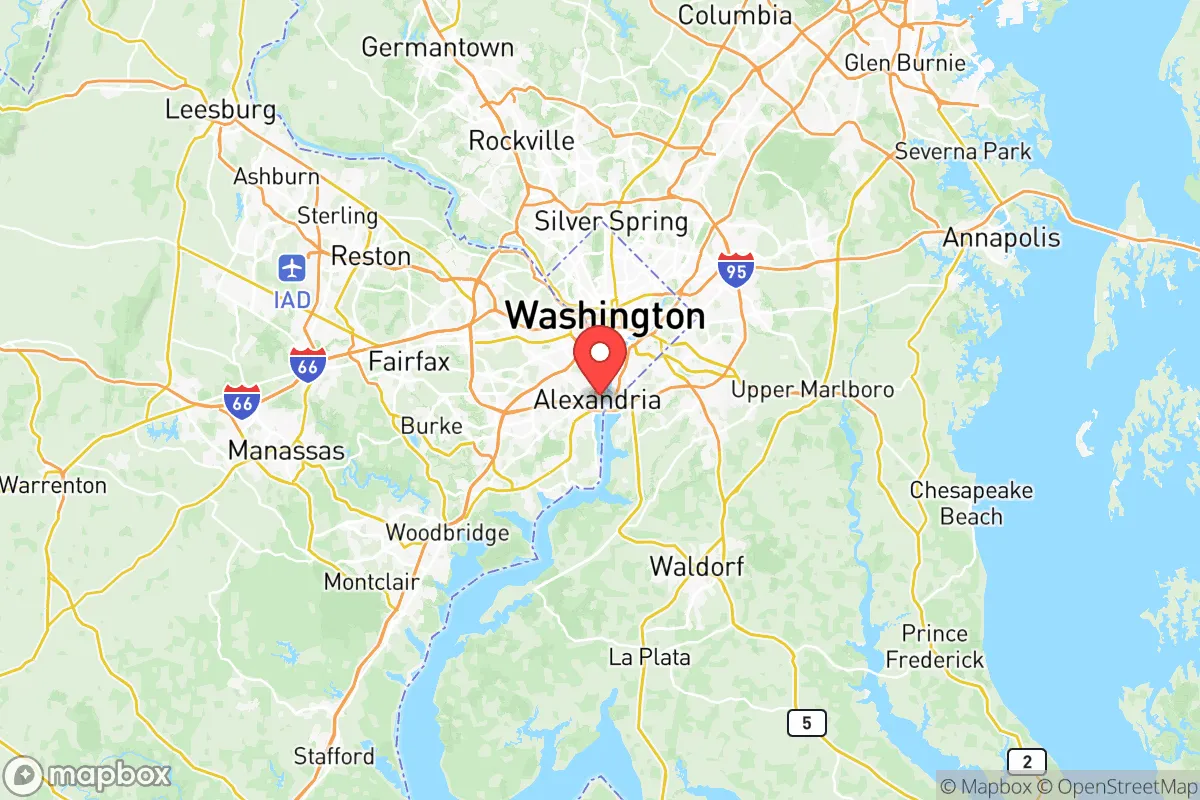
Alexandria City County, VA, is home to 156,788 residents in a compact, intensely urbanized setting just south of Washington, D.C., where the Potomac River meets historic shipping routes. Its population is highly educated — 65.8% hold college degrees — and racially diverse, with a White plurality (49.6%), a significant Black community (20.7%), a growing Hispanic population (18.2%), and notable East/Southeast Asian (4.6%) and Indian (1.6%) communities. The city’s identity blends deep-rooted Tidewater traditions with the transient, professional energy of the D.C. metro area, creating a dense, walkable environment where historic row houses share blocks with modern condos.
Settlement & growth (pre-1960)
Before European settlement, the Potomac River’s western shore was part of the Algonquian-speaking Powhatan Confederacy, with the Patawomeck and Doeg tribes (among others) fishing the tidal creeks and cultivating maize along the waterfront. The area was lightly settled by Europeans until the mid-18th century, when Scottish merchants — drawn by tobacco and transatlantic shipping — established a warehouse and port at what is now Old Town Alexandria (founded 1749). The town’s deep-water access made it a primary entrepôt for the Potomac tobacco trade, and by the Revolutionary War, Alexandria was one of the busiest ports in the colonies. George Washington owned a townhouse here at 508 Cameron Street and worshipped at Christ Church on Cameron Street, anchoring the city’s early elite planter-merchant class.
Through the 19th century, Alexandria’s population grew more slowly than nearby Washington. It was part of the District of Columbia from 1791 to 1846, then retroceded back to Virginia. The Alexandria Canal (opened 1843) connected the city to the Chesapeake & Ohio Canal, bringing coal and goods from the interior. The city was a major slave-trading hub — the "Franklin & Armfield" office at 1315 Duke Street (today the Freedom House Museum) was the nation’s largest domestic slave-trading firm in the 1830s-1840s, trafficking thousands through the port. The Civil War saw Alexandria occupied by Union forces from 1861 to 1865; large numbers of freedmen gathered in camps near Fort Ward and Peters Hill in what is now the Northwest Alexandria area, forming the foundation of the city’s postwar Black community.
After Reconstruction, Alexandria’s economy shifted from slave-based tobacco to manufacturing. The Potomac Yard railroad classification yard (opened 1906 around the present-day National Landing and Potomac Yard neighborhood) attracted hundreds of Irish, Italian, and Eastern European laborers. German immigrants worked in the breweries and bakeries along King Street. By the 1930s, the city had a substantial working-class Black population concentrated in the Uptown/Parker-Gray neighborhood (centered on West Street between King and Madison Streets), which became a self-contained community of Black-owned businesses, churches, and schools under segregation. World War II brought a massive federal workforce expansion; the Mark Center (then the Pentagon’s northern annex) and the U.S. Patent Office complex in Old Town drew thousands of new residents, many of whom settled in the Braddock Road and Eisenhower Valley areas. By 1960, Alexandria’s population had reached 91,023, still majority White but with a significant Black minority (roughly 15%).
Modern era (post-1965)
The 1965 Hart-Cellar Act fundamentally reshaped Alexandria’s demography, as it did the entire D.C. region. The 1970s and 1980s saw the first substantial influx of Hispanic immigrants, largely from El Salvador, Guatemala, and Honduras, fleeing civil wars and seeking construction and service jobs in the booming D.C. suburbs. By the 1990s, the Arlandria neighborhood (roughly bounded by Four Mile Run, West Glebe Road, and Mount Vernon Avenue) had become a primary corridor for Hispanic businesses — bodegas, panaderias, and Salvadoran pupuserias line the streets. The city’s Hispanic population grew from 5.9% in 1990 to 18.2% today, with the largest concentration still in Arlandria and the adjacent Chirilagua area (named for a Salvadoran town).
Domestic migration shifted equally dramatically. From the 1960s through the 1990s, middle-class White and Black families moved into newly built subdivisions in the West End (Duke Street corridor west of I-395) and Seminary Valley areas, annexed from Fairfax County in 1952. More recently, gentrification has pushed the city’s affordable housing stock toward its historic core: Old Town and the King Street Metro corridor have seen rapid upzoning and luxury condominium development, attracting a young, professional, largely White and Asian population. The East/Southeast Asian community (4.6%) is small but concentrated in the Van Dorn Street corridor, where Vietnamese and Korean groceries and restaurants cluster. The Indian community (1.6%) is more dispersed, with professionals working in tech and health fields living throughout the city but with a notable presence in the Potomac West area (near the Braddock Road Metro). The Black community, historically concentrated in Parker-Gray and Uptown, has dispersed into the Del Ray and Rosemont neighborhoods as home values have risen, while still forming the largest minority voting block in the city.
The future
Alexandria is projected to become more diverse, but in ways that reflect national trends. The city’s White share fell from 61.7% in 2010 to 49.6% in 2024; that decline appears likely to continue, though slowly, as foreign-born households (12.7% of the population) increase through Hispanic and East/Southeast Asian immigration. The Hispanic population is young — median age 29, versus 41 for the city overall — meaning natural increase will sustain its growth even if immigration slows. The Black population share has stabilized near 20%, but younger Black residents are more likely to be college-educated professionals relocating from other metro areas than descendants of the historic Parker-Gray community. Housing costs — median home price above $650,000 — will continue to filter out lower-income families, meaning much of the city’s future diversity will be concentrated in the remaining affordable pockets: the Arlandria and Four Mile Run neighborhoods, plus subsidized units in Alexandria West. The city’s cultural identity — historically Tidewater Virginian, then federal-worker suburb, now dense urban core of the D.C. region — is settling into a permanent hybrid: old row homes with new residents speaking Spanish or Vietnamese, and a political climate that is among the most liberal in Virginia.
For someone moving in now, Alexandria offers the experience of a small historic city that is rapidly diversifying and densifying. The population is better-educated and more transient than even a decade ago, but is also becoming more varied in its origins. The city’s future is that of a globally connected, pedestrian-oriented suburb-city, where the historic Potomac port and the modern immigrant enclaves coexist within a few blocks.

* Values derived from national, state, county, city and local statistics and may differ in a specific area. Last updated: 2026-07-01T06:41:34.000Z
Narrative content on this page is AI-generated and may contain mistakes. Verify any details that matter before acting on them.
ReloMaps may earn a commission from affiliate links at no extra cost to you.

