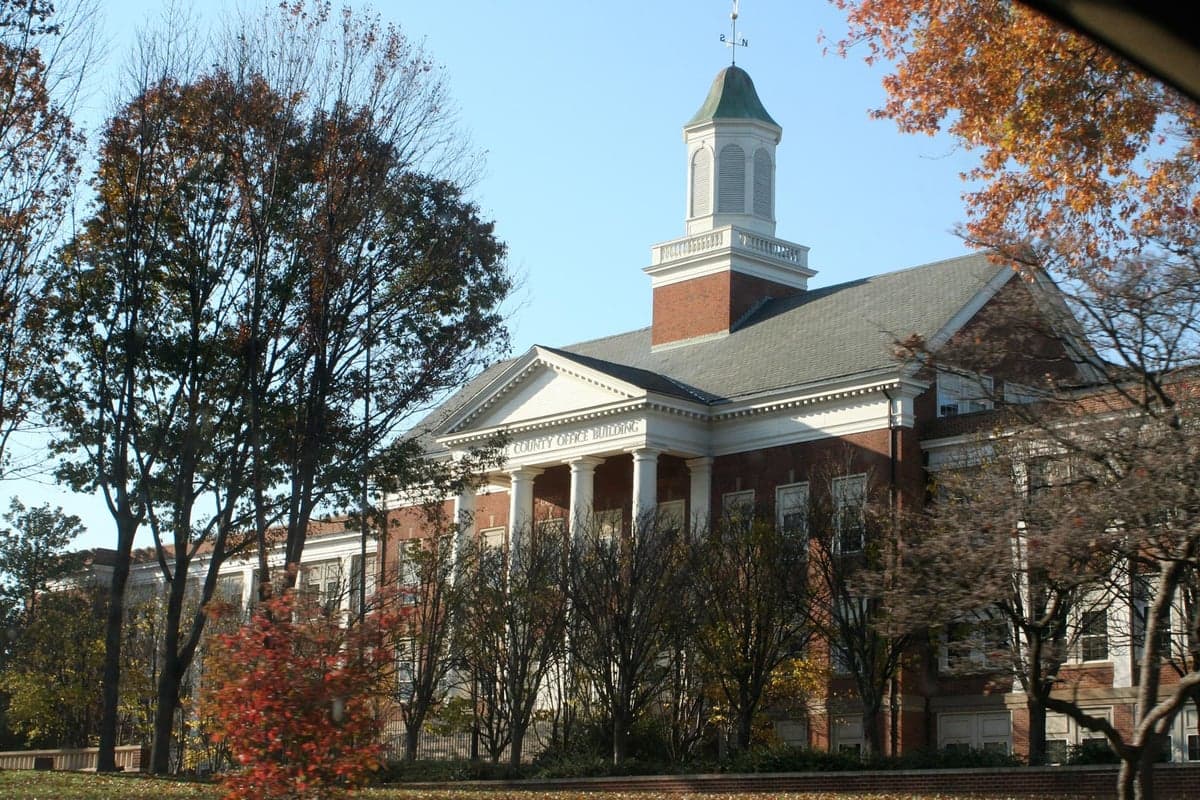
Photo: Wikipedia
Demographics of Albemarle County
Affluence Level in Albemarle County
An upper-middle-class area. Household wealth, education levels, and homeownership run ahead of national benchmarks.
People of Albemarle County
Today, Albemarle County’s 113,683 residents form a predominantly white, highly educated population centered around the city of Charlottesville, with a distinctive blend of historic Southern roots and modern university-driven growth. The county is characterized by its 60.6% college-educated rate—nearly double the national average—and a foreign-born population of just 5.7%, reflecting a community shaped more by domestic migration than international immigration. While the county remains 74.0% white, its Black (8.8%), Hispanic (7.3%), East/Southeast Asian (3.0%), and Indian-subcontinent (2.5%) communities are growing, creating a slowly diversifying landscape that still feels distinctly Virginian.
Settlement & growth (pre-1960)
The land that became Albemarle County was originally inhabited by the Monacan Indian Nation, a Siouan-speaking people who lived in settled villages along the Rivanna River and its tributaries. Their presence is still remembered in place names like the Monacan Trail and in the continued existence of the Monacan Indian Nation, whose tribal headquarters are near the town of Madison, just north of the county line. European settlement began in earnest in the 1720s and 1730s, when English and Scots-Irish pioneers pushed westward from the Tidewater region, drawn by the promise of fertile Piedmont land granted through the headright system. These early settlers established farms and small communities, with the town of Scottsville (founded 1744) becoming a key tobacco port on the James River, and Charlottesville (founded 1762) emerging as the county seat and commercial hub.
Throughout the 18th and 19th centuries, the population remained overwhelmingly of British and Scots-Irish stock, with a significant enslaved Black population that worked the county's tobacco and wheat plantations. By 1860, roughly half of Albemarle's residents were enslaved African Americans, concentrated on large estates like those around Monticello and Shadwell. The post-Civil War period brought emancipation and a slow, often difficult transition to freedom. Many freed Black families remained in the county, establishing communities such as Union Ridge and Prospect near Charlottesville, and Esmont in the southern part of the county. These communities, though small, formed the backbone of Black rural life in Albemarle for generations.
The early 20th century saw little new immigration to Albemarle. The county's economy remained agricultural, with apple orchards and dairy farming supplementing tobacco. The founding of the University of Virginia in 1819 had already begun to shape Charlottesville as a center of learning, but it was not until the post-World War II era that the university's growth truly began to transform the county's population. The GI Bill brought a wave of students and faculty to the area, many of them from outside Virginia, and the 1950s saw the first significant influx of Northern-born residents. This period also saw the beginning of suburbanization, with new neighborhoods springing up in North Garden and along the Route 29 corridor north of Charlottesville.
Modern era (post-1965)
The 1965 Hart-Cellar Act had a relatively muted effect on Albemarle County compared to major metropolitan areas, but it did open the door for a gradual diversification. The most notable post-1965 immigrant group has been East/Southeast Asian professionals, particularly those employed by the University of Virginia and the region's growing medical and technology sectors. These families have concentrated in Charlottesville's North Downtown neighborhood and in newer subdivisions near the university, such as those around Fontaine Avenue. The Indian-subcontinent community, while smaller at 2.5%, has also grown through university and tech employment, with families settling in similar areas. The Hispanic population, now 7.3%, has a more varied origin story: some families arrived as agricultural laborers in the 1990s, working in the county's orchards and vineyards, while others have come for construction and service jobs in the growing Charlottesville area. The Hispanic community is most visible in Charlottesville's South First Street area and in the rural community of Crozet.
Domestic migration has been the far larger driver of population change since 1965. The University of Virginia's rise to national prominence, combined with the area's natural beauty and quality of life, has attracted a steady stream of domestic migrants from the Northeast, Midwest, and West Coast. This influx has been overwhelmingly white and college-educated, reinforcing the county's already high educational attainment levels. The 1990s and 2000s saw particularly rapid growth, with new subdivisions spreading across the county's rural areas, especially along the Route 250 corridor west of Charlottesville toward Crozet and along the Route 29 corridor north toward Ruckersville. This growth has created a cultural tension between long-time residents—many of them from families who have lived in the county for generations—and newer arrivals, who often hold more liberal political views and have different expectations for land use and development.
The Black population, which was roughly 20% of the county in 1970, has declined to 8.8% today, a trend driven by out-migration of younger Black residents to larger cities and by the in-migration of white newcomers. This demographic shift has been most pronounced in Charlottesville's historically Black neighborhoods, such as Vinegar Hill and Fife's End, where gentrification and rising property values have displaced many long-time Black families. The county's Black community today is older and more geographically dispersed than in the past, with significant concentrations remaining in the Union Ridge area and in southern Albemarle around Scottsville.
The future
Albemarle County's population is projected to continue growing slowly, reaching perhaps 125,000 by 2035. The primary driver will remain domestic migration, particularly of retirees and remote workers drawn by the area's quality of life and the university's cultural amenities. This will likely reinforce the county's character as a highly educated, predominantly white, and politically moderate-to-liberal enclave within a more conservative region. The Hispanic and East/Southeast Asian populations are expected to grow modestly, driven by continued employment in agriculture, construction, and the university, but the county is unlikely to become a major immigrant destination. The Indian-subcontinent community may see modest growth as the university's tech and medical sectors expand.
The most significant demographic trend may be the continued aging of the population, as the county attracts retirees while younger residents, particularly those without college degrees, move away for more affordable housing and job opportunities. This could exacerbate the county's already stark educational and economic divides. The county's cultural identity will likely continue to evolve away from its historic Southern roots toward a more cosmopolitan, university-centered character, a shift that will be most visible in Charlottesville and its immediate suburbs, while the more rural parts of the county—places like White Hall and Earlysville—may retain a more traditional character.
For someone moving to Albemarle County today, the bottom line is this: you are joining a community that is highly educated, increasingly affluent, and culturally shaped by the University of Virginia. The county offers a high quality of life with strong schools and abundant outdoor recreation, but it is also an expensive place with a growing economic divide and a demographic profile that is slowly diversifying from a very homogeneous base. The county's future will be defined by how it manages the tension between growth and preservation, and between its historic identity and its evolving character.

* Values derived from national, state, county, city and local statistics and may differ in a specific area. Last updated: 2026-10-27T21:07:59.000Z
Narrative content on this page is AI-generated and may contain mistakes. Verify any details that matter before acting on them.
ReloMaps may earn a commission from affiliate links at no extra cost to you.

