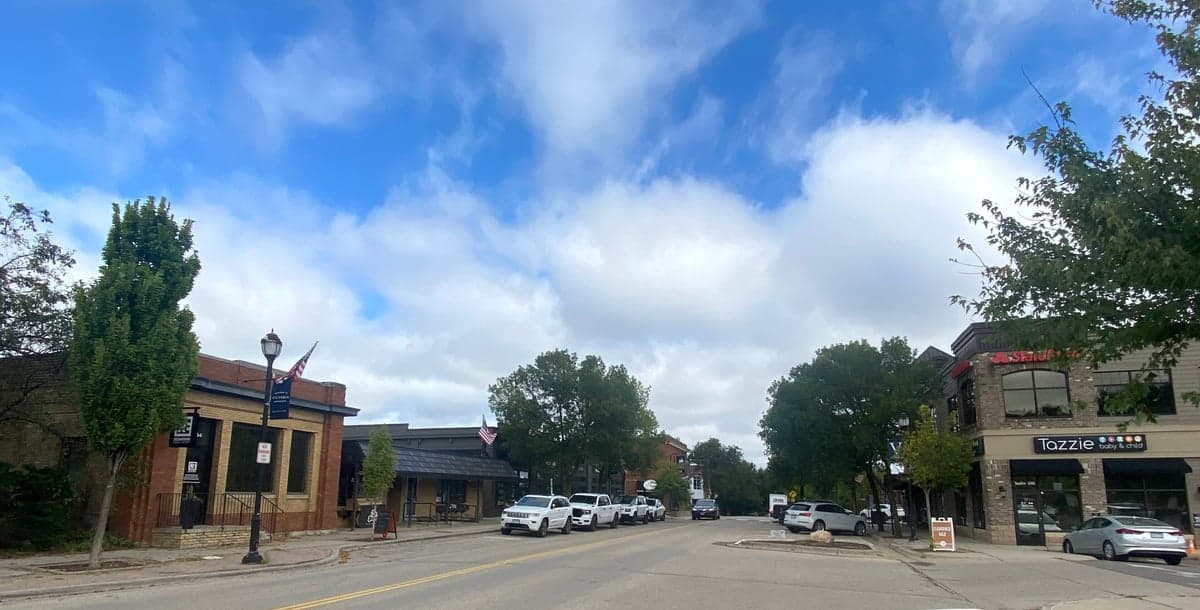
Photo: Wikipedia
Demographics of Victoria, MN
Affluence Level in Victoria, MN
A wealthy area with high-earning, well-educated households. Incomes, home values, and educational attainment meaningfully outpace national averages.
People of Victoria, MN
The people of Victoria, Minnesota, today number 10,972 and form a predominantly white, highly educated, and family-oriented community. With 87.6% of residents identifying as white, 67.3% holding a college degree, and a foreign-born population of just 2.9%, the city is characterized by its professional-class homogeneity and suburban stability. Distinctive markers include a strong local school system, a concentration of dual-income households, and a civic identity rooted in the city’s small-town origins even as it absorbs commuters to the Twin Cities.
How the city was settled and grew
Victoria’s original population was drawn by the promise of agricultural land and the railroad. The city was platted in 1855 along the Minnesota River bluffs, and the first wave of settlers were primarily Yankee and German immigrant farmers. The Historic Downtown district, centered on Victoria Drive and Stieger Lake Lane, was the commercial and social hub built by these early families. A second wave of German Catholic and Scandinavian farmers arrived in the 1870s and 1880s, settling the St. Victoria area around the church and cemetery that still anchors the community. The city remained a tiny farming hamlet through the mid-20th century, with a population that barely exceeded 500 as late as 1960. No major industrial or land-grant event drew a large non-white population during this period; the area was almost entirely white and rural.
Modern era (post-1965)
The post-1965 transformation of Victoria was driven not by immigration reform but by domestic suburbanization. The 1990s and 2000s saw explosive growth as the Twin Cities exurban frontier expanded westward. New subdivisions such as Lake Minnewashta Shores and Stonegate attracted white, college-educated families seeking larger lots and newer homes than those available in closer-in suburbs like Chanhassen or Eden Prairie. The city’s population jumped from 1,200 in 1990 to over 10,000 by 2020. The foreign-born share remains low at 2.9%, but the composition has shifted slightly: the 2.5% Indian-subcontinent population is the largest non-white group, concentrated in newer developments like Victoria Fields and Ridgeview, where tech and medical professionals from companies such as UnitedHealth Group and Medtronic have settled. The 3.2% Black population and 2.8% Hispanic population are dispersed across the city, with no single neighborhood forming a majority-minority enclave. The 0.8% East/Southeast Asian population is similarly scattered, often living in the Lake Minnewashta area. The city’s racial and ethnic diversity, while still modest, is almost entirely a product of domestic migration from other parts of the metro area, not international immigration.
The future
Victoria’s population is projected to continue growing slowly, reaching roughly 13,000–14,000 by 2040, driven by infill development and the completion of the Southwest LRT extension (though the station is in neighboring Chanhassen). The city is becoming slightly more diverse, but the pace is gradual. The Indian-subcontinent share is likely to rise as tech employment in the western suburbs grows, and new developments like Victoria Commons (a mixed-use project near the future transit corridor) may attract a broader mix of young professionals and empty-nesters. However, the white share will remain above 80% for the foreseeable future. The Hispanic and Black populations are expected to grow slowly, primarily through domestic relocation from within the metro. The city’s cultural identity is evolving from a purely rural-exurban enclave to a more suburban, amenity-oriented community, but it remains a place where homogeneity and high educational attainment define the social fabric. For a family moving in now, Victoria offers a stable, low-crime, high-opportunity environment with a population that is overwhelmingly white, well-educated, and politically moderate-to-conservative—a demographic profile that is unlikely to change dramatically in the next decade.
Victoria is becoming a more polished, commuter-oriented suburb while retaining its small-town feel and predominantly white, professional-class character. For a relocating family or individual seeking a safe, high-performing school district and a community where most neighbors share similar educational and economic backgrounds, the city offers a predictable and stable environment. The gradual diversification will add some cultural variety, but the core identity—white, college-educated, and family-focused—will remain the dominant reality for the foreseeable future.

* Values derived from national, state, county, city and local statistics and may differ in a specific area. Last updated: 2026-10-10T16:29:16.000Z
Narrative content on this page is AI-generated and may contain mistakes. Verify any details that matter before acting on them.
ReloMaps may earn a commission from affiliate links at no extra cost to you.

