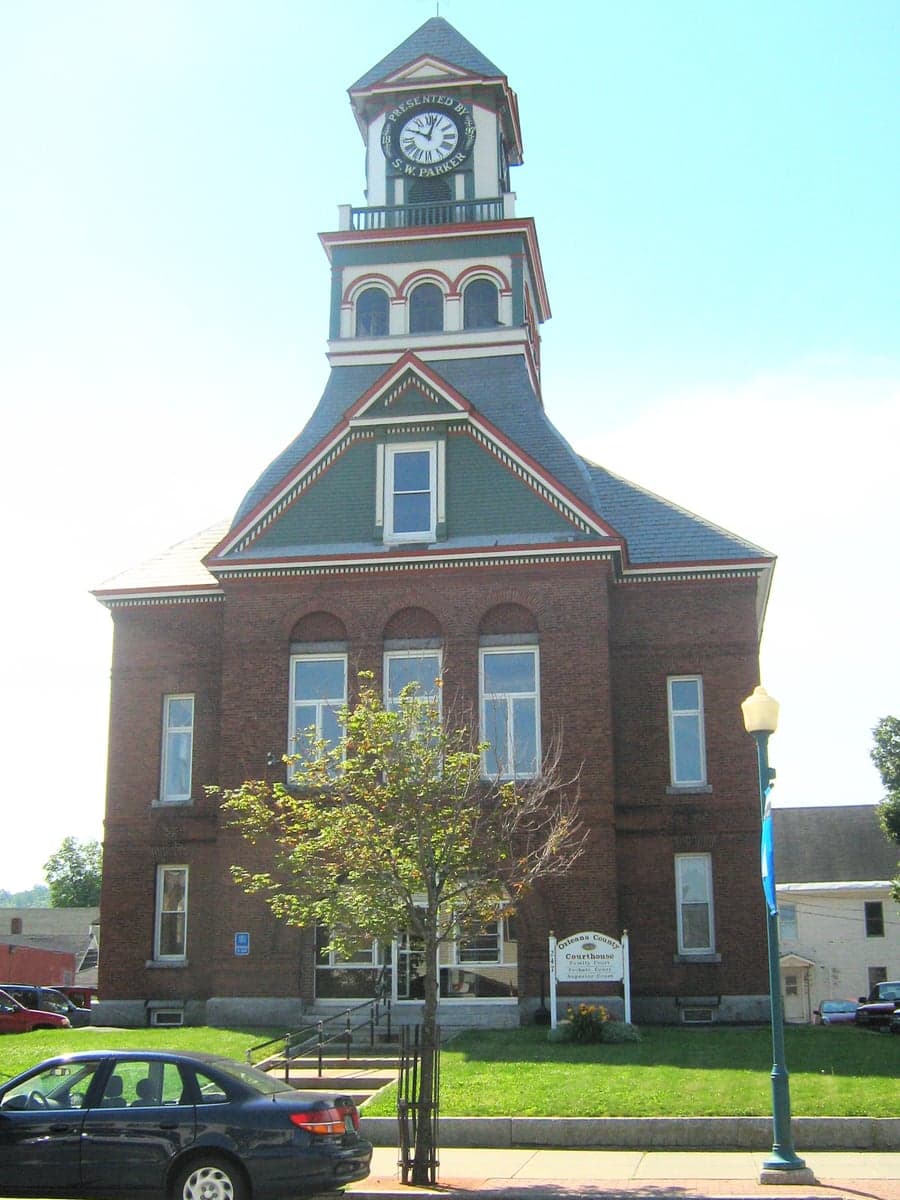
Photo: Wikipedia
Demographics of Orleans County
Affluence Level in Orleans County
A middle-class area roughly in line with national averages across income, home values, education, and employment.
People of Orleans County
The people of Orleans County, Vermont, today number roughly 27,500, making it one of the state's most sparsely populated regions. The county is overwhelmingly white (93.3%) and native-born (98.9% of residents were born in the United States), with a foreign-born population of just 1.1%. This is a place where the population is older than the state average, with a median age of 44.5, and where the cultural identity remains deeply rooted in the agricultural and industrial traditions of the 19th and early 20th centuries.
Settlement & growth (pre-1960)
Before European settlement, the area now known as Orleans County was part of the traditional territory of the Western Abenaki people, particularly the Sokoki band. The Abenaki used the region for seasonal hunting and fishing, with the Missisquoi River and Lake Memphremagog serving as key travel corridors. European contact was limited until the mid-18th century, as the area was a contested frontier between French Canada and the British colonies.
Permanent American settlement began in earnest after the Revolutionary War, when the state of Vermont granted charters for townships in the Northeast Kingdom to attract settlers. The first wave of settlers, arriving between 1790 and 1820, were primarily of English and Scots-Irish stock, moving north from southern New England and eastern New York. They established the county's earliest towns: Craftsbury (chartered 1781), Greensboro (1781), and Barton (1789). These early settlers were subsistence farmers, clearing dense forest for small-scale agriculture.
A second, larger wave arrived between 1820 and 1850, drawn by the construction of the stagecoach roads and, later, the railroads. This period saw the founding of Newport (chartered 1802, but slow to grow until the railroad arrived in 1863), Derby, and Irasburg. The population was still overwhelmingly of British Isles ancestry—English, Scots-Irish, and a smaller number of Scots—but a distinct French-Canadian presence began to emerge. French-Canadian families crossed the border from Quebec, settling in Derby Line and Newport, where they found work in the growing lumber mills and on the railroads. By 1870, French-Canadians made up roughly 15% of the county's population.
The late 19th and early 20th centuries brought a modest industrial boom. The county's abundant water power—particularly along the Barton, Missisquoi, and Clyde Rivers—fueled sawmills, gristmills, and, most notably, the granite and marble quarries. The town of Albany became a center for granite quarrying, while Lowell and Westfield saw growth from logging and small-scale manufacturing. A small number of Italian and Irish immigrants arrived during this period to work in the quarries and on the railroad, but their numbers were never large. The county's population peaked at roughly 28,000 in 1900 and then began a slow, steady decline as the industrial economy faltered and younger residents left for cities in southern New England and the Midwest.
Between 1900 and 1960, the county's population remained relatively stable, hovering between 25,000 and 28,000. The Great Depression hit the region hard, but the construction of the Newport-to-Montreal rail line and the expansion of dairy farming provided a modest economic floor. The population during this period was almost entirely white and native-born, with the French-Canadian community remaining the largest ethnic minority. By 1960, the county was 99.5% white, and the foreign-born share had fallen below 2%.
Modern era (post-1965)
The 1965 Hart-Cellar Act, which dramatically expanded immigration from Asia, Africa, and Latin America, had almost no effect on Orleans County. The county's foreign-born population today stands at just 1.1%, compared to a national average of 13.7%. The small immigrant population that does exist is scattered, with no single ethnic enclave forming. The largest non-white group is Hispanic (1.8%), followed by Black (0.8%), East/Southeast Asian (0.4%), and Indian subcontinent (0.2%). These numbers are so small that they represent a few hundred individuals at most.
The major demographic story of the post-1965 era in Orleans County is not immigration but domestic out-migration and aging. The county's population fell from 28,000 in 1960 to a low of 26,000 in 1990, before recovering slightly to the current 27,492. Young adults have consistently left for college and jobs in Burlington, Boston, and beyond, leaving behind an aging population. The county's median age of 44.5 is nearly five years older than the national median. The only significant in-migration has been a modest wave of retirees and second-home buyers drawn to the lakes—particularly Lake Memphremagog in Newport and Caspian Lake in Greensboro—and a small number of back-to-the-land homesteaders who arrived in the 1970s and 1980s.
Suburbanization has been minimal. The county has no interstate highway and no major urban center. Newport, the county seat, has a population of just 4,500. The only area that has seen any suburban-style growth is the Derby area, where a handful of strip malls and housing developments have appeared along U.S. Route 5 near the Canadian border. But even there, the pace of growth has been slow, and the county's overall character remains rural and small-town.
The future
Orleans County is likely to remain one of the whitest and most native-born counties in the United States for the foreseeable future. The foreign-born population is projected to remain below 2%, and the non-white share is unlikely to exceed 10% by 2040. The county's population is expected to continue its slow decline, falling to roughly 25,000 by 2040, as the death rate exceeds the birth rate and out-migration continues.
The most significant demographic shift underway is the aging of the population. The share of residents aged 65 and older is projected to rise from 22% today to over 30% by 2040. This will put pressure on the county's healthcare system and housing stock, as older residents seek to downsize or move into assisted living. At the same time, the county is seeing a small but steady influx of remote workers and lifestyle migrants, drawn by the region's natural beauty and low cost of living. Towns like Craftsbury and Greensboro have become modest magnets for this group, which tends to be younger and more educated than the existing population.
Culturally, the county is becoming slightly more diverse in terms of political and lifestyle preferences, but the core identity remains deeply rooted in the agricultural and working-class traditions of the 19th century. The French-Canadian heritage, once a defining feature of communities like Derby Line and Newport, is fading as younger generations assimilate and the older generation passes away. The county's cultural identity is increasingly defined not by ethnicity but by a shared sense of rural independence and self-reliance.
For someone moving in now, Orleans County offers a stable, safe, and deeply traditional community. The population is homogeneous, the pace of life is slow, and the economy is modest. The county is not becoming more diverse or more urban; it is becoming older, quieter, and more dependent on tourism and second-home owners. The appeal lies in the landscape, the low crime rate, and the sense of belonging to a place that has changed very little in a century. The trade-off is limited economic opportunity, a shrinking tax base, and a social environment that may feel insular to newcomers from more diverse regions.

* Values derived from national, state, county, city and local statistics and may differ in a specific area. Last updated: 2026-07-02T19:46:59.000Z
Narrative content on this page is AI-generated and may contain mistakes. Verify any details that matter before acting on them.
ReloMaps may earn a commission from affiliate links at no extra cost to you.

