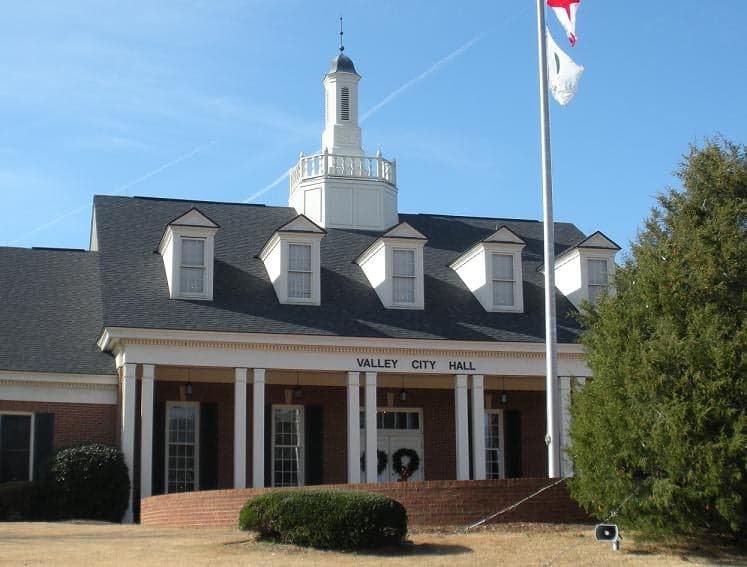
Photo: Wikipedia
Demographics of Valley, AL
Affluence Level in Valley, AL
A below-average socioeconomic profile. Incomes, home values, and educational attainment trail the U.S., with higher poverty and unemployment.
People of Valley, AL
The people of Valley, Alabama, today form a community of roughly 10,400 residents characterized by a significant Black majority (37.5%) alongside a White plurality (56.1%), with a small but present Hispanic (2.7%) and East/Southeast Asian (1.1%) population. The city’s identity is rooted in its industrial past, with a lower college attainment rate (17.6%) reflecting a workforce historically tied to manufacturing and textiles. Valley is a compact, family-oriented place where neighborhoods often retain the character of the mill-village era, and the population is slowly diversifying while remaining predominantly native-born (only 2.8% foreign-born).
How the city was settled and grew
Valley was not a gradual settlement but a planned industrial town, incorporated in 1980 from four distinct mill villages—Fairfax, Langdale, River View, and Shawmut—that were built by the West Point Manufacturing Company beginning in the 1860s. The original population was drawn by textile jobs, with the company recruiting White workers from surrounding rural areas and, later, Black workers for lower-skilled positions. The mill villages were racially segregated by design: Fairfax and Langdale housed White mill families in company-owned row houses, while Black workers were largely confined to separate enclaves like “The Bottom” in River View and smaller pockets near the mills. By the 1920s, the area’s population was almost entirely native-born, with a small number of European immigrants (mostly Italian and Polish) working as skilled machinists. The Great Depression and World War II brought a second wave of rural White and Black families from Georgia and Alabama, seeking steady mill wages. The neighborhoods remained rigidly segregated through the mid-20th century, with Shawmut emerging as a predominantly White middle-class area and River View becoming the most heavily Black district.
Modern era (post-1965)
The post-1965 era brought significant demographic change, driven by the decline of the textile industry and the Civil Rights movement. The 1970s and 1980s saw White flight from older mill villages like Fairfax and Langdale to newer subdivisions on the city’s periphery, such as Valley Ridge and Oak Park, while Black families moved into the vacated mill housing. By 1990, the Black population had risen to roughly 30%, and it has since climbed to 37.5% as of the 2020 Census. The Hispanic population, now 2.7%, began arriving in the 1990s, drawn by poultry processing and construction jobs, and has concentrated in the River View and Fairfax areas, where older, affordable housing stock is available. The East/Southeast Asian community (1.1%) is small and largely consists of Vietnamese and Filipino families who came in the 2000s, often working in healthcare or small retail, and they are dispersed across the city with no single ethnic enclave. The Indian subcontinent population is effectively zero (0.0%). The foreign-born share remains low at 2.8%, well below the national average, as Valley has not attracted significant international immigration. The city’s college education rate (17.6%) is notably low, reflecting the loss of higher-skilled jobs and a population that has not been replaced by more educated newcomers.
The future
The population of Valley is projected to remain stable or decline slightly, as the city lacks the job growth to attract large numbers of new residents. The White population is slowly shrinking as older residents age and younger families move to larger cities like Auburn or Columbus, Georgia. The Black population is expected to grow modestly, potentially reaching 40-42% by 2040, driven by natural increase and some in-migration from nearby rural areas. The Hispanic share may rise to 4-5% as families already in the area grow, but new immigration is unlikely to be a major factor. The East/Southeast Asian population will likely remain small and dispersed. The city’s cultural identity is becoming more distinctly Black and working-class, with the old mill-village divisions fading as neighborhoods like Fairfax and Langdale become majority-Black and Valley Ridge and Oak Park remain predominantly White. New residential development is concentrated in the Valley Ridge area, attracting a mix of White and Black middle-class families, while the older mill villages continue to age. For someone moving in now, Valley offers a quiet, affordable, and family-oriented environment with a strong sense of local history, but limited economic opportunity and a population that is becoming less diverse in terms of national origin even as it grows more racially balanced.
Valley is becoming a more racially integrated but economically stagnant community, where the legacy of the mill villages still shapes neighborhood character and the population is slowly shifting toward a Black majority. For a new resident, this means a place with deep roots, low cost of living, and a straightforward, no-frills lifestyle, but also limited job growth and a population that is not rapidly changing in terms of new arrivals or cultural diversity.

* Values derived from national, state, county, city and local statistics and may differ in a specific area. Last updated: 2026-10-20T05:45:48.000Z
Narrative content on this page is AI-generated and may contain mistakes. Verify any details that matter before acting on them.
ReloMaps may earn a commission from affiliate links at no extra cost to you.

