Political ClimatePolitical Climate in Valentine, NE
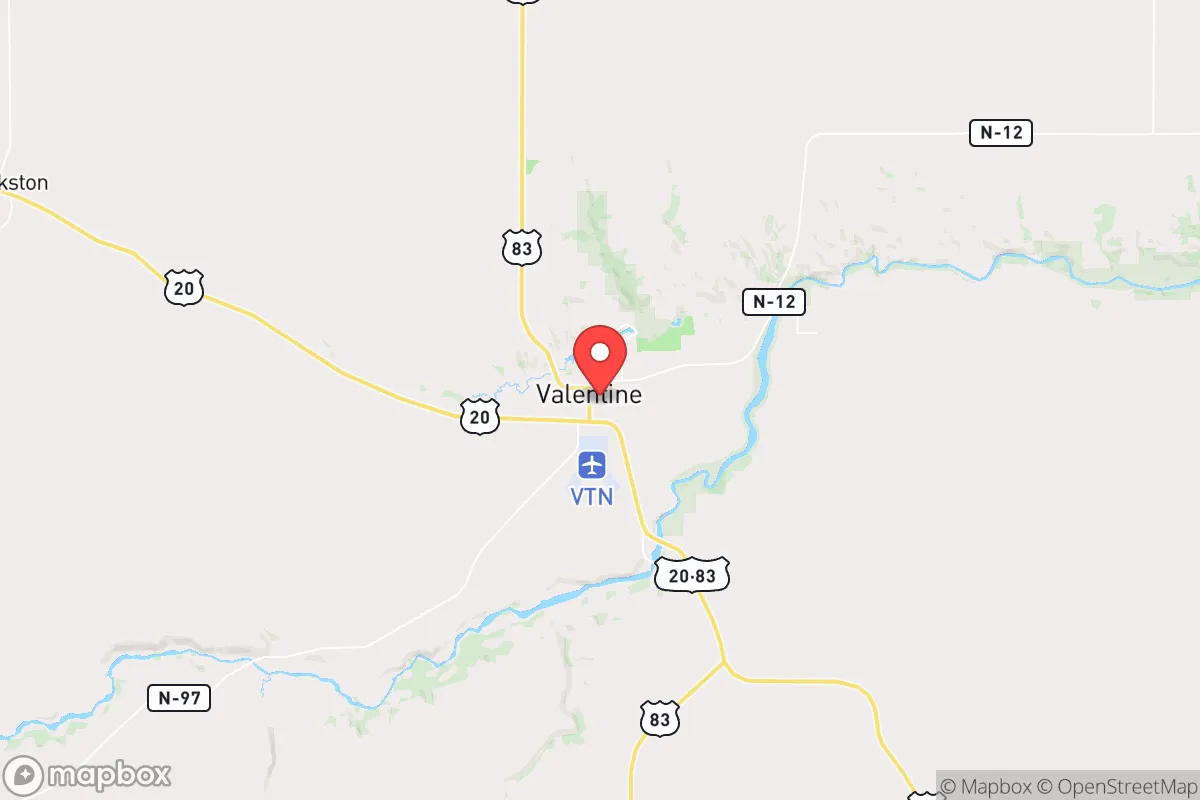
District shown is the primary district for this city’s centroid. Cities may span multiple districts.
Local Political AnalysisPolitical Analysis of Valentine, NE
Valentine, Nebraska, is one of the most reliably Republican areas in the entire state, with a Cook Partisan Voting Index (PVI) of R+27. That’s a full 17 points more conservative than the state of Nebraska as a whole, which sits at R+10. In practice, this means that in a typical election, a Republican candidate can expect to win by a landslide margin of nearly 30 points here, while statewide races are often decided by a much closer 10-point spread. The area’s political identity is deeply rooted in ranching, agriculture, and a strong sense of local independence, and that hasn’t changed much over the decades—if anything, the gap between Valentine and the rest of the state has widened as some parts of Nebraska have become more competitive.
How it compares
To understand just how conservative Valentine is, it helps to look at the surrounding region. While Nebraska as a whole is solidly red, the state’s political map is not uniform. The eastern part of the state, particularly around Omaha and Lincoln, leans more moderate or even Democratic in some precincts. In contrast, Valentine sits in the Sandhills, an area that is overwhelmingly rural and Republican. Nearby towns like Ainsworth and O’Neill are also deeply conservative, but none quite match Valentine’s R+27 rating. The closest political contrast within a reasonable drive would be to the south or east, where towns like Broken Bow or even North Platte have slightly more moderate leanings, though still firmly Republican. The real political divide for Valentine residents isn’t between left and right locally—it’s between the values of the Sandhills and the more urban, diverse politics of Lincoln or Omaha, which can feel like a different world entirely.
What this means for residents
For conservative residents, Valentine is about as comfortable as it gets politically. Local elections, school board decisions, and county policies almost always align with traditional Republican values—limited government, strong Second Amendment protections, and a focus on agricultural and rural issues. There’s little need to campaign hard for conservative candidates because the electorate is already overwhelmingly on the same page. For liberal or moderate residents, the reality is more challenging. They are a distinct minority, and while there’s no hostility in daily life, they may feel their views are rarely represented in local government or public discourse. National political debates often feel distant here, but when they do hit home, the local consensus can feel isolating for those who don’t share it. That said, most residents—regardless of party—agree on practical matters like maintaining good roads, supporting the local hospital, and keeping the town’s economy stable. Politics here is less about partisan fighting and more about a shared way of life.
One cultural distinction worth noting is how Valentine’s political climate shapes policy on land use and natural resources. The area is heavily dependent on the Niobrara River and the surrounding ranchlands, so local politics often revolve around water rights, grazing permits, and conservation versus development. These aren’t abstract issues—they directly affect livelihoods. While the national Republican party might focus on tax cuts or immigration, here the conversation is more likely to be about the cost of fencing, the price of hay, or the latest drought conditions. That practical, boots-on-the-ground focus is what defines Valentine’s political reality. It’s a place where party labels matter less than whether you can fix a fence or help a neighbor during calving season. For anyone moving here, understanding that local priorities often trump national ones is key to fitting in.

State Political ClimatePolitical Climate in Nebraska
State Political AnalysisPolitical Environment in the State
Nebraska is a solidly Republican state with a Cook PVI of R+10, but its politics are far more nuanced than that number suggests. The state has been trending rightward over the past 10-20 years, driven by rural consolidation and the GOP’s dominance in the Omaha suburbs, though the city of Omaha itself has become a Democratic stronghold. The real story is the urban-rural split, with Lincoln and Omaha acting as blue islands in a deep red sea, while the rest of the state has moved decisively toward the GOP.
Urban vs. rural divide
The political map of Nebraska is a textbook case of the urban-rural divide. Omaha (Douglas County) is the state’s largest city and a Democratic stronghold, consistently voting blue in presidential elections and sending progressive-leaning representatives to the state legislature. Lincoln (Lancaster County) is similarly Democratic, driven by the University of Nebraska and a growing professional class. Together, these two metros account for roughly half the state’s population. Outside of them, the political landscape shifts dramatically. Grand Island, Kearney, and North Platte are reliably Republican, with rural counties like Cherry County and Box Butte County often voting 80% or more for GOP candidates. The 2nd Congressional District (Omaha metro) is the state’s only competitive district, flipping between parties in recent cycles. In 2020, it cast a single electoral vote for Joe Biden, the first time Nebraska split its electoral votes since 2008. The 3rd District, which covers the vast rural west, is one of the most Republican districts in the nation.
Policy environment
Nebraska’s policy environment is broadly conservative, but with some notable exceptions. The state has no income tax on Social Security benefits and a flat state income tax rate of 5.58% (as of 2025), with a push to lower it further. Property taxes are high relative to the region, a perennial source of frustration for homeowners and farmers. The state is a right-to-work state, and its regulatory posture is business-friendly, with minimal zoning restrictions outside of Omaha and Lincoln. Education policy is a hot topic: the state passed a school choice law in 2023 allowing tax credits for private school scholarships, but it was narrowly upheld after a repeal effort. The state’s public schools are generally well-regarded, especially in suburban Omaha districts like Millard and Elkhorn. Healthcare policy is mixed; Nebraska expanded Medicaid under the Affordable Care Act in 2020 via a ballot initiative, but the state has not pursued a state-based exchange. Election laws are moderately restrictive: voter ID is required (passed in 2023), and the state has no same-day registration. Nebraska is one of two states that splits its electoral votes by congressional district, a system that has drawn national attention.
Recent policy direction
Over the past five years, Nebraska has moved decisively to the right on several fronts. Gun and self-defense law: the state passed constitutional carry in 2023, allowing permitless concealed carry for residents 21 and older. Parental and education rights: the 2023 school choice law and a 2024 law banning instruction on sexual orientation and gender identity in K-12 schools (LB 575) reflect a strong parental rights push. Speech and privacy: the state has not enacted broad social media content laws, but there is ongoing debate about data privacy and minors’ online access. Medical and bodily autonomy: Nebraska banned abortion at 12 weeks in 2023 (LB 574), with exceptions for rape, incest, and medical emergencies. A 2024 ballot initiative to enshrine abortion rights failed to qualify. Property rights: the state has strong eminent domain protections, and a 2024 law limited local governments’ ability to impose rent control. Taxation: the legislature passed a significant income tax cut in 2023, reducing the top rate from 6.84% to 5.58% by 2027, with further cuts proposed. Voting and ballot access: voter ID was implemented in 2024, and the state has maintained its unique electoral college system despite periodic challenges. The overall direction is toward lower taxes, expanded gun rights, and tighter restrictions on abortion and LGBTQ+ instruction in schools.
Civil unrest & political movements
Nebraska is not known for widespread civil unrest, but there have been flashpoints. The 2020 George Floyd protests in Omaha turned violent, with property damage and clashes with police, leading to a lasting divide between the city’s progressive activists and law enforcement. The state has seen organized activism on both sides: Nebraska Families Alliance (conservative) and Civic Nebraska (progressive) are active on education and voting issues. Immigration politics are relatively quiet, though there was controversy in 2023 over a bill to ban sanctuary cities, which ultimately failed. The state has no sanctuary cities, and local law enforcement generally cooperates with federal immigration authorities. Election integrity has been a minor issue; the 2020 election was not contested in Nebraska, but the state’s electoral college system has been criticized by both parties. A 2024 proposal to switch to a winner-take-all system failed, keeping the current district-based method in place. The most visible political movement in recent years has been the push for school choice, which drew large rallies at the state capitol in Lincoln.
Projection
Over the next 5-10 years, Nebraska is likely to become more Republican, but the urban-rural divide will deepen. Omaha and Lincoln will continue to grow and become more Democratic, while rural counties will shrink and become more conservative. The state’s in-migration is modest, but the people moving in tend to be retirees and remote workers from blue states, which could slightly moderate the GOP’s dominance in the Omaha suburbs. The 2nd Congressional District will remain competitive, and the state’s electoral college system may face renewed challenges if a national popular vote compact gains traction. The legislature will likely continue to push tax cuts, school choice, and abortion restrictions, but the pace may slow as the state’s budget tightens. A new resident moving in now should expect a state that is reliably conservative but not monolithic, with a vibrant blue urban core and a deep red rural expanse. The culture war battles over education and LGBTQ+ rights will persist, but the state’s overall stability and low crime rate make it a relatively calm place to live regardless of political affiliation.
For a new resident, the bottom line is that Nebraska offers a conservative policy environment with low taxes, strong gun rights, and a business-friendly climate, but with the trade-off of high property taxes and limited abortion access. Liberals will find a welcoming community in Omaha or Lincoln, but will face an uphill battle on state-level policy. The state is politically engaged but not chaotic, and the urban-rural divide means your experience will vary dramatically depending on where you live. If you’re looking for a place where your vote counts in a meaningful way, the 2nd District is one of the few competitive seats in the region. If you want a reliably conservative environment, the rest of the state delivers that in spades.
* Values derived from national, state, county, city and local statistics and may differ in a specific area. Last updated: 2026-06-30T19:35:20.000Z
Narrative content on this page is AI-generated and may contain mistakes. Verify any details that matter before acting on them.
ReloMaps may earn a commission from affiliate links at no extra cost to you.

