Demographics of Valentine, NE
Affluence Level in Valentine, NE
A middle-class area roughly in line with national averages across income, home values, education, and employment.
People of Valentine, NE
The people of Valentine, Nebraska, today number 2,632, forming a tight-knit, predominantly white community with a strong ranching and tourism identity. The city serves as the commercial and cultural hub of the Sandhills, characterized by a slower pace of life, a high rate of homeownership, and a population that is notably older and less diverse than the national average. With a 79.4% white population and a foreign-born share of just 2.0%, Valentine retains a distinctly rural, Midwestern character, though its role as a gateway to the Niobrara River and Fort Niobrara National Wildlife Refuge brings a steady stream of seasonal visitors and some new residents.
How the city was settled and grew
Valentine was founded in 1883 as a railroad town on the Fremont, Elkhorn and Missouri Valley Railroad, which was pushing westward through the sparsely populated Sandhills. The original settlers were a mix of railroad workers, cattle ranchers, and merchants drawn by the promise of cheap land under the Homestead Act and the Kinkaid Act of 1904, which offered 640-acre parcels in the Sandhills. The first wave of European settlers was overwhelmingly of German, Irish, and English descent, with many families arriving from the Upper Midwest and the Great Lakes region. The original townsite, centered around Main Street and the railroad depot, became the commercial core, while the area known as West Side (west of Main Street) developed as the primary residential district for early merchants and railroad employees. A distinct neighborhood called South Valentine, south of the railroad tracks, grew as a working-class area housing ranch hands and laborers. The city's early growth was modest but steady, reaching about 1,500 residents by 1920, supported by the cattle industry and the establishment of the Valentine National Wildlife Refuge in 1935, which brought federal jobs and conservation workers.
Modern era (post-1965)
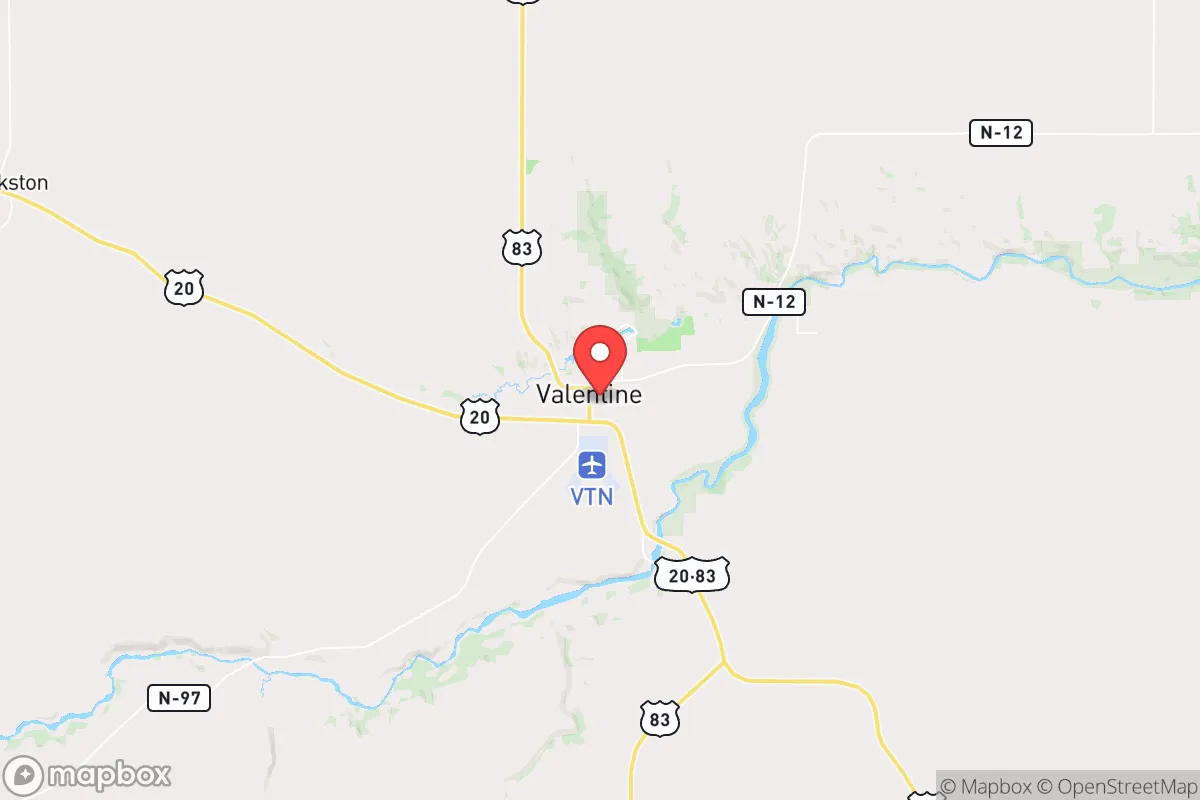
Following the 1965 Immigration and Nationality Act, Valentine saw very little change in its ethnic composition, as the city's remote location and limited industrial base did not attract the waves of immigration that transformed larger Nebraska cities like Omaha or Lincoln. The post-1965 period was instead defined by domestic in-migration from other parts of the Great Plains, as family farms consolidated and rural residents moved to town for services and employment. The North Valentine neighborhood, along Highway 83 north of the Niobrara River bridge, expanded in the 1970s and 1980s as a newer residential area for professionals, including teachers at Valentine High School and staff at the Cherry County Hospital. The East Side, near the Valentine Golf Club and the airport, saw modest suburban-style development in the 1990s and 2000s, attracting retirees and second-home buyers drawn to the area's hunting and fishing opportunities. Today, the city's small Hispanic community (4.0%) is concentrated in the South Valentine area, where seasonal agricultural workers and meatpacking employees from the region's feedlots have settled. The East/Southeast Asian population (2.4%) is largely composed of professionals in healthcare and education, scattered across the newer subdivisions rather than forming a distinct ethnic enclave. The Black population (1.1%) and Indian subcontinent population (0.0%) remain negligible, reflecting the city's limited economic draw for diverse populations.
The future
Valentine's population is projected to remain stable or decline slightly over the next decade, as the region's aging demographic profile and outmigration of young adults to larger cities offset any new arrivals. The city's cultural identity is likely to remain overwhelmingly white and conservative, with the Hispanic share growing slowly as agricultural labor demands persist, but not enough to significantly alter the community's character. New residential development is concentrated in the Highway 20 Corridor, east of the historic downtown, where a few small subdivisions have been built to accommodate retirees and remote workers seeking a low-cost, rural lifestyle. The city's future depends heavily on its ability to retain young families and attract newcomers in the tourism and renewable energy sectors, particularly wind energy development in the Sandhills. For a prospective resident, Valentine offers a stable, safe, and culturally homogeneous environment where community ties are strong, but where ethnic diversity and urban amenities are minimal. The city is becoming a quieter, older version of itself, with the population gradually shifting toward the 55-plus demographic and the younger workforce increasingly commuting from outlying areas.
Valentine is becoming a retirement and recreation destination for those seeking solitude and natural beauty, rather than a growing, diversifying hub. For someone moving in now, the city offers a predictable, low-crime, and neighborly atmosphere, but with limited economic opportunity and little demographic change on the horizon.

* Values derived from national, state, county, city and local statistics and may differ in a specific area. Last updated: 2026-06-30T19:35:20.000Z
Narrative content on this page is AI-generated and may contain mistakes. Verify any details that matter before acting on them.
ReloMaps may earn a commission from affiliate links at no extra cost to you.

