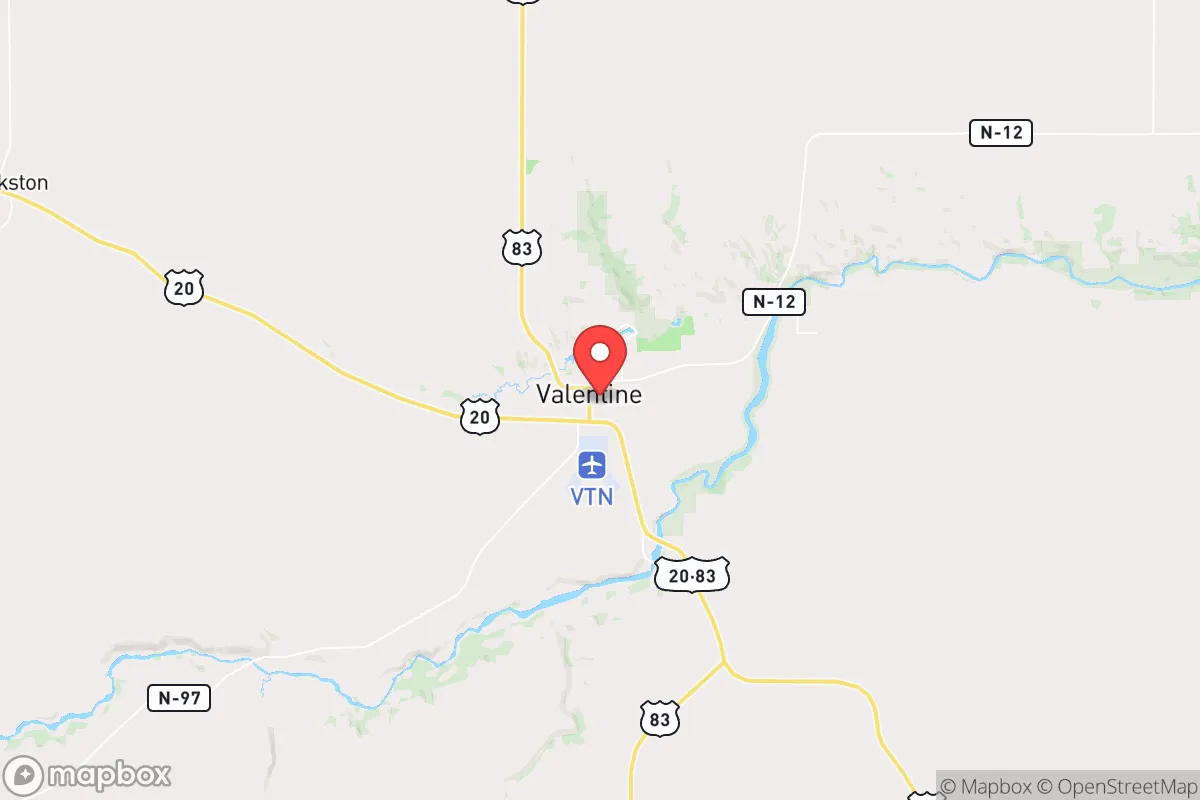
Strategic Assessment of Valentine, NE
Strong survivability profile. Good buffer from population centers, with manageable environmental and tactical risks.
What does the Strategic Assessment tell us?
Our Strategic Assessment grades tactical survivability of an area. Major population centers, military targets, fallout zones, natural disasters, and border exposure all drive risk — lower exposure means a more defensible position in a crisis.
This is heavily inspired by Joel Skousen's Strategic Relocation book. Highly recommended you checkout the book ($)What does this tell us?
Our Strategic Assessment grades tactical survivability of an area. Major population centers, military targets, fallout zones, natural disasters, and border exposure all drive risk — lower exposure means a more defensible position in a crisis.
This is heavily inspired by Joel Skousen's Strategic Relocation book. Highly recommended you checkout the book ($)Strategic Pillars

Key Distances
Regional Safe Places
Below is our recommended "safe zones" in Nebraska and the surrounding area based on our strategic heuristics. For most people, it's unrealistic to live in a “safe zone” full-time due to work, family or other personal reasons. They tend to be more rural. However, many of these areas are perfect for second homes and retreat properties that double as a vacation home or even a short-term rental.
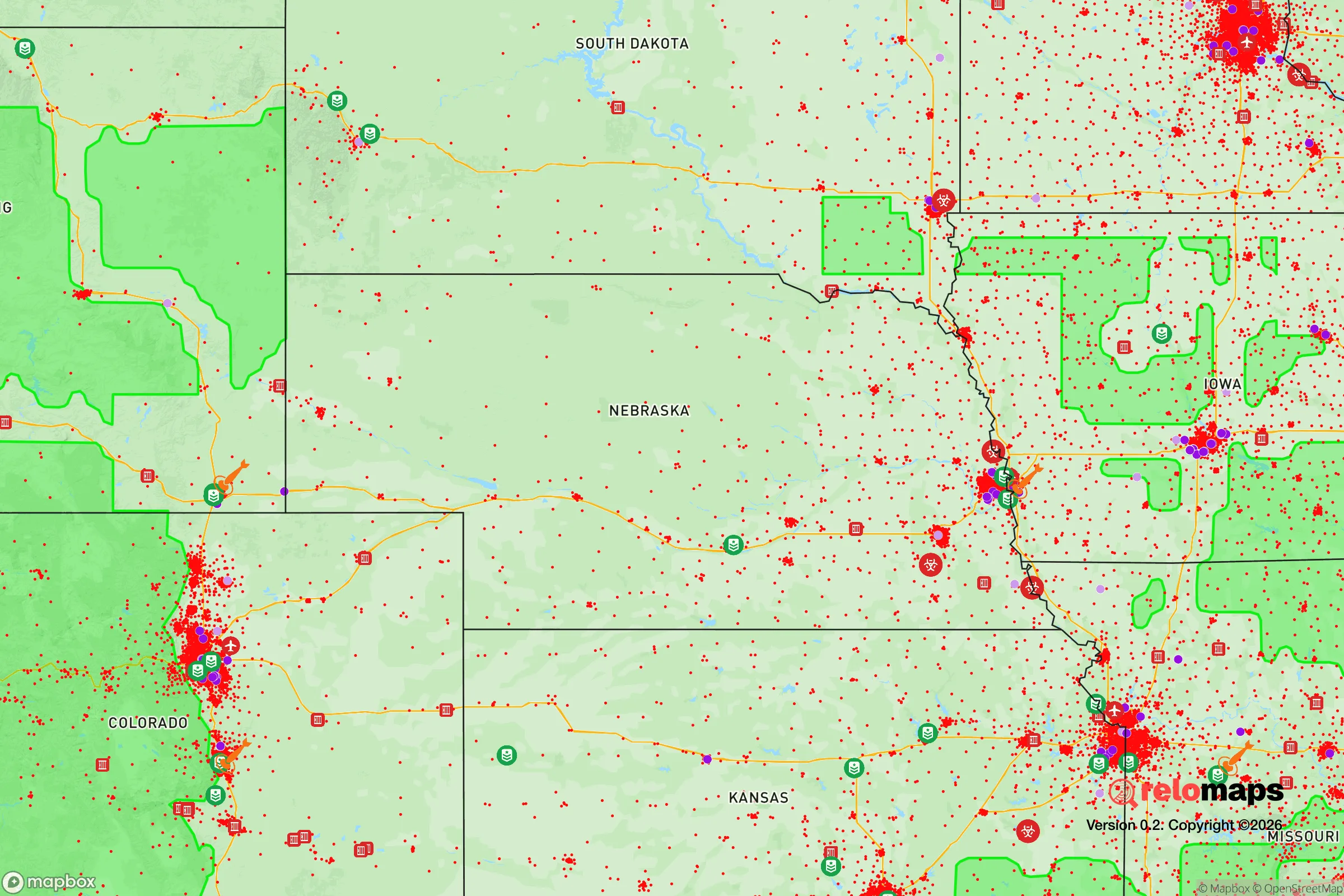
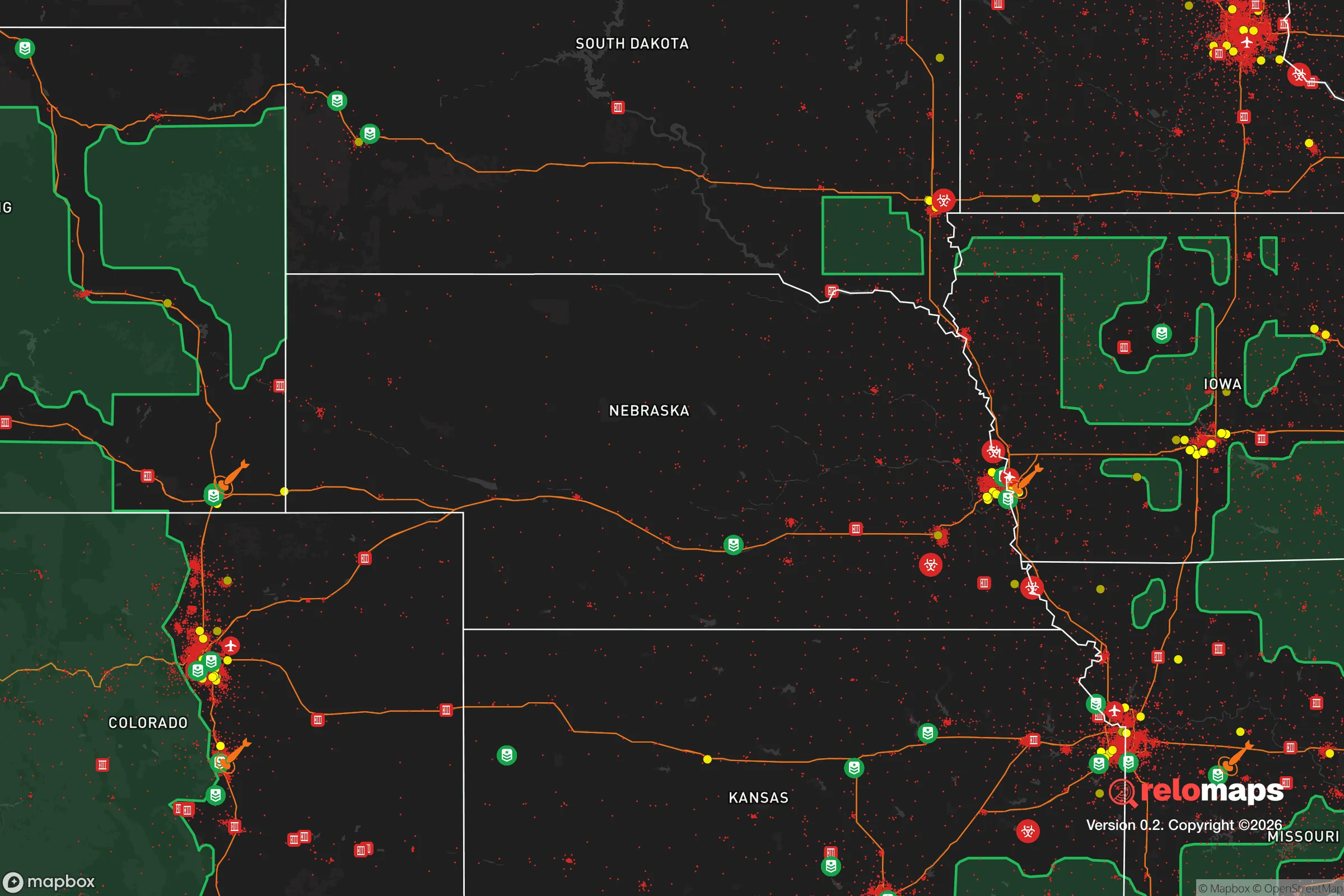


Important Note: For informational purposes only. This does not mean nothing bad ever happens in the green zones. Please use common sense. This is based on public data and modeled with AI. We tried to take a conservative approach but mistakes happen. We update this regularly as new information becomes available.
Solar Generator Recommendations
Backup power matters more here than in safer locations. We've picked three solar generators across budgets and capacity tiers — start with the budget unit if you only need a few essentials, or step up if you want to run a fridge and HVAC for days at a time.

Jackery Portable Power Station Explorer 300
Budget OptionPower on the Go: Weighing only 11 lbs, it's convenient to set up and store with book-sized foldable solar panels

BLUETTI Portable Power Station AC180
Designed for both indoor and outdoor scenarios, AC180 is highly capable as it has a robost capacity and continuous output power.

EF ECOFLOW DELTA Pro Ultra Power Station
Upgraded PickEcoFlow DELTA Pro Ultra is a whole-home energy system designed to grow with your family. Integrated with the Smart Home Panel 2, it scales to meet your evolving energy needs — keeping your home powered, intelligent, and secure through every stage of life.
We earn a commission, at no additional cost to you.
Strategic Assessment Analysis
Valentine, Nebraska, offers a compelling mix of geographic isolation and practical self-sufficiency that makes it a serious contender for those prioritizing disaster readiness and long-term resilience. Sitting in the north-central Sandhills region, roughly 60 miles from the South Dakota border, the town of roughly 2,800 people benefits from low population density, a dry continental climate, and a location far removed from major metropolitan targets. For a relocator thinking about fallout risks, supply chain disruptions, or societal instability, Valentine’s combination of remoteness, natural resources, and a tight-knit community presents a defensible base of operations — but not without its own set of trade-offs and exposures.
Geographic position and natural advantages for long-term security
Valentine’s primary strategic asset is its location in the Nebraska Sandhills, a vast, sparsely populated region of grass-stabilized dunes covering roughly 19,000 square miles. This terrain is difficult to traverse at scale, which naturally limits the flow of displaced populations during a crisis. The area sits well away from major interstate corridors — I-80 runs about 120 miles south — and is not near any significant rail hubs or military installations that might draw secondary effects. The Niobrara River runs through the town, providing a reliable surface water source, and the Ogallala Aquifer lies beneath the region, offering deep groundwater reserves that are less vulnerable to surface contamination than many other parts of the country. The local topography is gently rolling rather than mountainous, which avoids the avalanche and landslide risks common in the West, and the region is not seismically active. Tornado risk is present but moderate compared to areas farther south and east; the Sandhills’ lower population density means a direct hit is statistically unlikely. For a relocator, the key takeaway is that Valentine sits in a zone where natural disasters are infrequent and man-made threats are minimized by sheer distance from high-value targets.
Risks, exposures, and proximity to fallout-relevant landmarks
No location is immune to risk, and Valentine has specific vulnerabilities that a serious prepper must weigh. The most significant is its proximity to the U.S. Strategic Command (STRATCOM) at Offutt Air Force Base near Omaha, roughly 250 miles southeast. While 250 miles offers substantial standoff distance from a ground burst, prevailing westerly winds could carry fallout from a strike on Offutt across parts of central Nebraska, depending on the season and yield. Additionally, the Minuteman III missile fields of western Nebraska and eastern Wyoming are within a few hundred miles; while these are hardened silos, a coordinated strike on the U.S. nuclear arsenal could produce multiple ground bursts that generate widespread fallout patterns. Valentine’s position north of the Platte River valley and west of the Missouri River places it somewhat outside the most likely fallout corridors from strikes on Omaha or Kansas City, but it is not outside the envelope entirely. The town itself has no hardened public shelters, and most residential basements are shallow or absent due to the sandy soil — a critical gap for anyone planning to ride out a nuclear event in place. Wildfire risk is moderate, particularly during drought years when the Sandhills’ grass cover becomes dry fuel, and the town’s volunteer fire department has limited capacity for a large-scale event. Winter blizzards are a recurring hazard, capable of cutting roads for days and straining fuel and food supplies if not pre-staged.
Practical resilience for a relocator: food, water, energy, and defensibility
Valentine scores well on basic life-support resources, which is the foundation of any resilient relocation. The Niobrara River and the Ogallala Aquifer provide abundant fresh water; a well-drilled property with a hand pump or solar-powered pump can secure water independent of municipal systems. The Sandhills are ranch country, meaning local beef and bison are available, and the short growing season (roughly 120 frost-free days) limits row crops but supports hay, alfalfa, and hardy vegetables in a protected garden or greenhouse. The town has a small but functional grocery store, a hardware store, and a farm supply co-op, but for serious bulk prepping, most supplies must be brought in from larger towns like O’Neill (80 miles east) or North Platte (120 miles south). Energy resilience is mixed: the local grid is served by the Nebraska Public Power District, which relies heavily on coal and nuclear generation (the Cooper Nuclear Station is 150 miles southeast). Off-grid solar is viable given the region’s 220+ sunny days per year, but wind is the more consistent resource — small wind turbines paired with battery storage are a practical investment here. Defensibility is a double-edged sword. The low population density means fewer potential threats from desperate neighbors, but it also means longer response times from law enforcement (Cherry County Sheriff’s Office is the primary agency, covering over 6,000 square miles with a handful of deputies). A well-chosen property with good sight lines, a reliable water source, and a defensible perimeter is achievable, but the open terrain offers little natural cover. Community cohesion in Valentine is strong — it’s the kind of place where neighbors help with calving and haying — which is a resilience asset that cannot be bought. For a relocator, the practical takeaway is that Valentine offers a solid foundation for self-sufficiency, but only if you arrive with the right gear, skills, and a realistic plan for the gaps in local infrastructure.
Overall, Valentine presents a balanced strategic picture for the disaster-ready relocator. Its isolation, water resources, and low-target profile are genuine advantages that few other locations in the central U.S. can match at this price point. The risks — fallout from distant strategic targets, limited shelter infrastructure, and the logistical challenges of a remote location — are real but manageable with proper planning and investment. For a single individual or family willing to put in the work on well drilling, solar or wind power, food storage, and community integration, Valentine offers a defensible, sustainable base that is far enough from the chaos to matter, but close enough to civilization to avoid total isolation. It is not a bug-out location for a weekend; it is a long-term relocation for someone serious about building a resilient life in a place that rewards preparation and punishes complacency.

* Values derived from national, state, county, city and local statistics and may differ in a specific area. Last updated: 2026-06-30T19:35:20.000Z
Narrative content on this page is AI-generated and may contain mistakes. Verify any details that matter before acting on them.
ReloMaps may earn a commission from affiliate links at no extra cost to you.

