
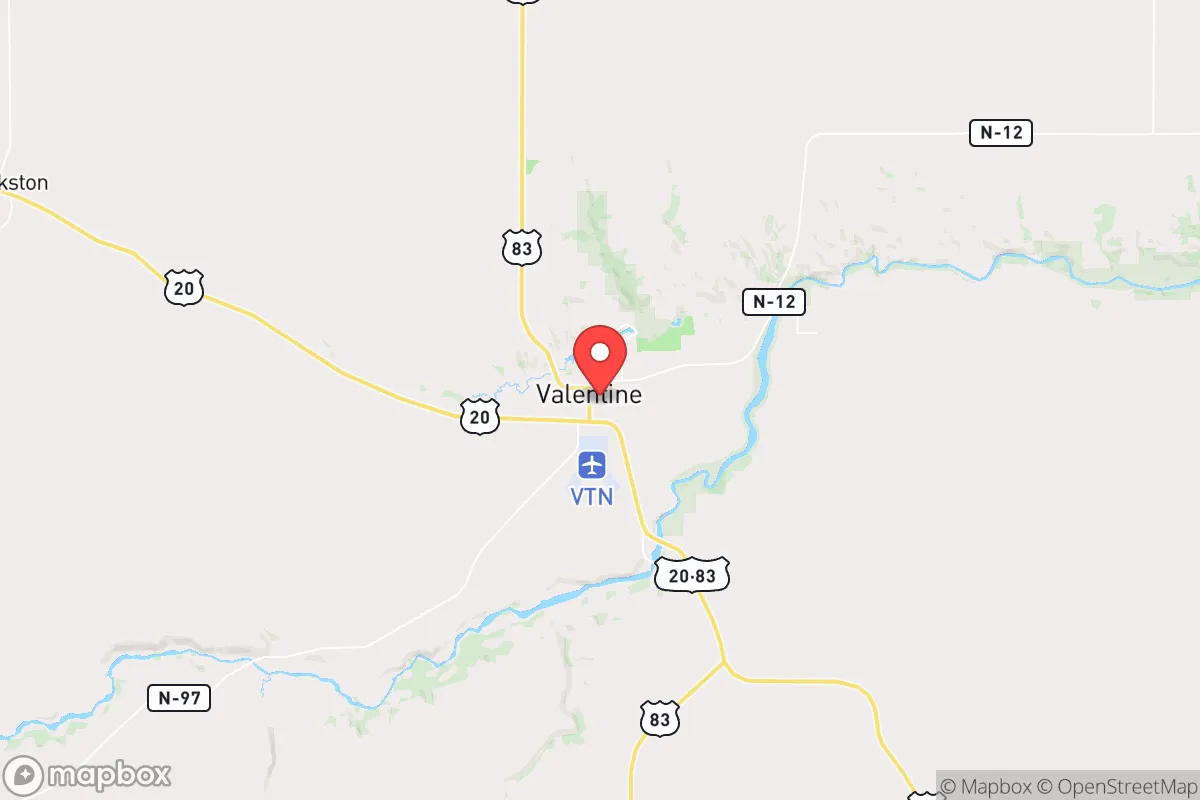
Personal Sovereignty in Valentine, NE
Viable for self-reliance. Generally workable, though some barriers may limit total independence.
What does Personal Sovereignty tell us?
Personal Sovereignty measures your capacity for self-reliance and independence with minimal government friction. Higher scores mean fewer barriers between you and the way you want to live... but it assumes you have the space you need and good neighbors.
What does this tell us?
Personal Sovereignty measures your capacity for self-reliance and independence with minimal government friction. Higher scores mean fewer barriers between you and the way you want to live... but it assumes you have the space you need and good neighbors.
State Policy
Energy independence: Importer (35% of energy produced in-state)
Personal Liberty
Homesteading

Personal Liberty Analysis
Valentine, Nebraska, offers a notably high degree of personal sovereignty, rooted in the state's strong tradition of limited government and a rural, self-reliant culture. For individuals and families who prioritize autonomy, the area presents a regulatory environment that is light-touch by national standards, with low taxes, permissive gun laws, and a legal framework that generally defers to individual and parental decision-making. While not a legal free-for-all, the practical reality in Cherry County is that government oversight is minimal, and personal responsibility is the expected norm.
Tax burden and regulatory posture in Cherry County
Nebraska's overall tax burden is moderate, but Valentine benefits from a relatively low cost of local government. The state levies a progressive income tax with rates from 2.46% to 6.64% (as of 2025), and a state sales tax of 5.5% (with local options adding up to 1.5% in Valentine). Property taxes in Cherry County are assessed at the market value, but the effective rate is often lower than in urban Nebraska counties due to higher land values per capita and lower service demands. The county's regulatory posture is decidedly hands-off: there is no county-wide zoning in most unincorporated areas, and the city of Valentine has minimal business licensing requirements. Building permits are required for new construction but are straightforward to obtain, with no design review boards or historic district overlays to navigate. For a relocation-minded reader, the key takeaway is that the bureaucratic friction of daily life—permits, inspections, fees—is substantially lower here than in most of the country.
Self-defense and gun law specifics in Nebraska
Nebraska is a shall-issue state for concealed carry permits, meaning the county sheriff must issue a permit if the applicant meets statutory criteria (age 21, no disqualifying criminal history, completion of a certified firearms training course). As of 2023, Nebraska also became a permitless (constitutional) carry state for residents 21 and older, allowing lawful carry without a permit. Open carry is legal without a permit for anyone who can legally possess a firearm. Valentine and Cherry County are generally supportive of Second Amendment rights; local law enforcement does not engage in enforcement actions that would infringe on lawful carry. There are no magazine capacity restrictions, no assault weapon bans, and no firearm registration requirements at the state or local level. The state does have a "stand your ground" law (Neb. Rev. Stat. § 28-1409), removing any duty to retreat before using deadly force in self-defense when lawfully present. For those prioritizing personal protection, Valentine offers one of the most permissive legal environments in the Midwest.
Self-reliance and homesteading viability in the Sandhills
Valentine sits in the heart of the Nebraska Sandhills, a region defined by large ranches and wide-open spaces. For those interested in homesteading or off-grid living, the area presents both opportunity and constraint. Lot sizes in the city of Valentine are typically standard residential parcels (6,000 to 10,000 square feet), but just outside city limits, land is available in 40-acre to 160-acre parcels at prices significantly below national averages—often $1,500 to $3,000 per acre for grassland. There are no county-level restrictions on rainwater collection, composting toilets, or solar panel installation. Off-grid living is legally feasible, though the county does require a minimum dwelling size (typically 400 square feet) and a septic system permit from the Nebraska Department of Environment and Energy. Well drilling is permitted with a state registration, and the water table in the Sandhills is generally high and clean. The biggest practical challenge is the climate: USDA Hardiness Zone 4b with winter lows reaching -30°F, which demands serious investment in heating, insulation, and water line protection. For a determined homesteader, the regulatory barriers are low, but the environmental ones are real.
Personal liberties: parental rights, medical autonomy, and speech
Nebraska law provides strong protections for parental rights. State statute 43-2461 explicitly recognizes the fundamental right of parents to direct the upbringing, education, and care of their children. This includes the right to opt children out of public school curricula without penalty, to homeschool without extensive state oversight (only a simple notification and annual standardized test or evaluation are required), and to make medical decisions without interference from child protective services unless there is clear evidence of abuse or neglect. On medical autonomy, Nebraska does not have a state-level vaccine mandate for adults, and while schools require standard immunizations for attendance, philosophical and religious exemptions are available. The state passed a law in 2023 (LB 574) restricting gender-affirming care for minors, which aligns with the values of many conservative families. Free speech is protected under both the U.S. and Nebraska Constitutions, and there are no local hate speech ordinances or social media content regulations in Cherry County. Property rights are robust: Nebraska is a "Dillon's Rule" state, meaning local governments have only the powers explicitly granted by the state, but Cherry County exercises its authority lightly. There is no county-wide planning commission, no rental inspection program, and no noise ordinance outside city limits. For a reader who values being left alone to live as they see fit, Valentine offers a legal environment that largely delivers on that promise.
Compared to other relocation destinations in the Mountain West or Upper Midwest, Valentine stands out for its combination of low regulatory friction, strong Second Amendment protections, and a legal culture that respects individual and parental autonomy. It is not as tax-friendly as Wyoming or South Dakota, but it offers a more balanced mix of services (a good hospital, a public school system, reliable utilities) with a genuinely hands-off local government. For the conservative-leaning individual or family seeking a place where personal sovereignty is the default rather than something to fight for, Valentine, Nebraska, is a strong contender.

* Values derived from national, state, county, city and local statistics and may differ in a specific area. Last updated: 2026-06-30T19:35:20.000Z
Narrative content on this page is AI-generated and may contain mistakes. Verify any details that matter before acting on them.
ReloMaps may earn a commission from affiliate links at no extra cost to you.

