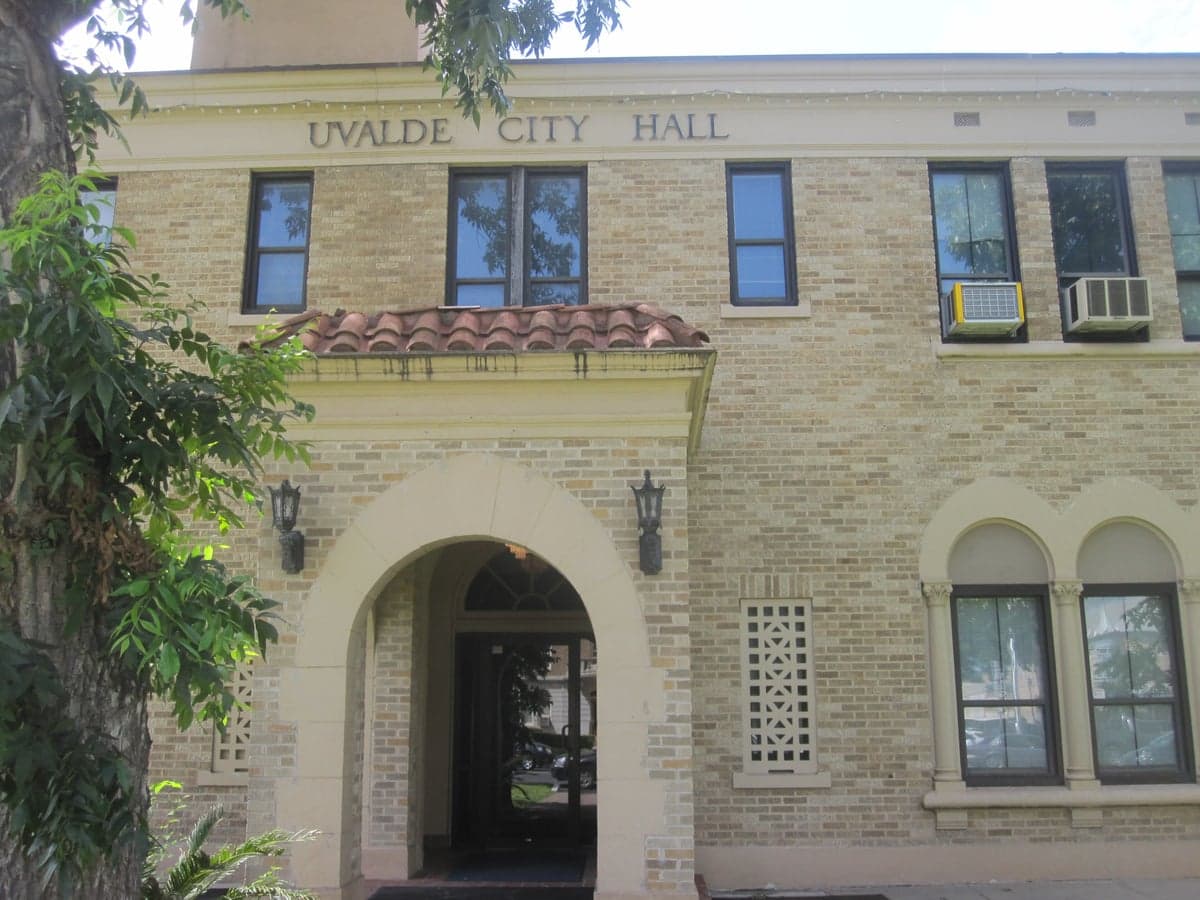

Photo: Wikipedia
Political ClimatePolitical Climate in Uvalde, TX
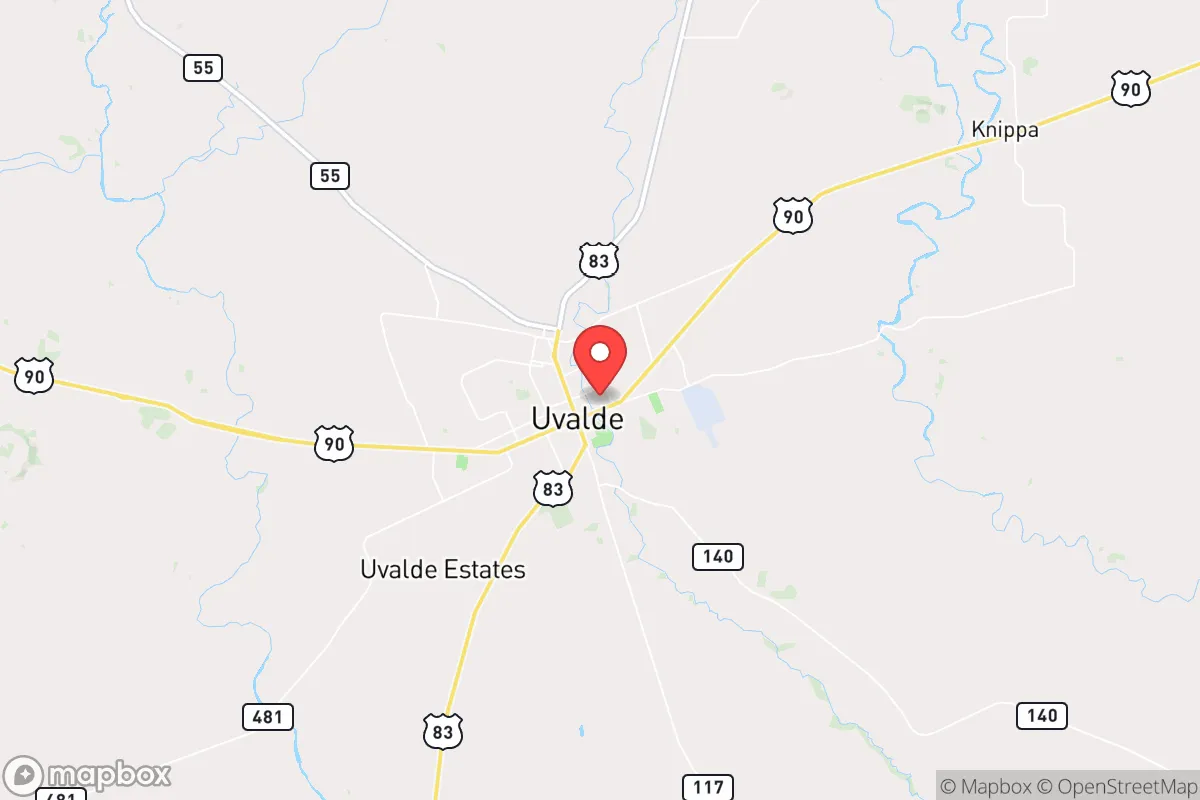
District shown is the primary district for this city’s centroid. Cities may span multiple districts.
Local Political AnalysisPolitical Analysis of Uvalde, TX
Uvalde has long been a reliably conservative community, and that hasn't changed much over the years. The area sits at a Cook Partisan Voting Index (PVI) of R+7, meaning it votes about seven points more Republican than the national average. In practice, that translates to most local and county offices being held by Republicans, and the area consistently backing GOP candidates for statewide and federal races. While the surrounding state of Texas as a whole also leans right—with a PVI that's generally considered R+5 or R+6 depending on the cycle—Uvalde is a bit more Republican than the state average. That said, it's not a deep-red stronghold like some of the more rural counties to the north and west, such as Real County or Edwards County, which can run R+30 or higher. Instead, Uvalde sits in a kind of middle ground: solidly conservative, but with a noticeable Democratic minority that shows up in local races and school board elections.
How it compares
Compared to the broader state of Texas, Uvalde's political lean is slightly more conservative, but the gap isn't huge. The big difference is in the trajectory. Texas as a whole has been inching toward the center over the past decade, especially in the fast-growing suburbs of Dallas-Fort Worth, Houston, and Austin, where Democratic gains have been real. Uvalde, by contrast, has stayed put. Its population is stable and aging, with little of the in-migration that's reshaping politics in places like San Antonio (about 90 miles east) or Austin. The nearby city of Del Rio, about 60 miles west, is similarly conservative but has a larger Hispanic population that sometimes votes more Democratic in local elections. Uvalde's own demographics—roughly 80% Hispanic—might suggest a more competitive landscape, but in practice, the area's cultural conservatism on issues like gun rights, abortion, and immigration keeps it firmly in the Republican column. The 2022 school shooting did spark some local political activism, but it hasn't fundamentally shifted the partisan balance.
What this means for residents
For conservative residents, Uvalde's political climate means their values are reflected in local governance. The city council, county commissioners, and school board are generally aligned with traditional Republican positions. Taxes are kept relatively low, and there's little appetite for new regulations or spending. For liberal residents, the reality is more of a challenge. They're a clear minority, and their views on issues like gun control or environmental policy rarely gain traction in local elections. That said, Uvalde isn't a place where political differences lead to open conflict. Most people know each other, and the community tends to prioritize neighborliness over partisanship. The biggest practical impact is on policy: if you're a liberal, you'll likely find yourself on the losing side of most votes, but you won't be ostracized for it. The area's small size and tight-knit nature mean that personal relationships often trump political labels.
One cultural distinction worth noting is Uvalde's relationship with the border. While it's not a border town itself—it's about 60 miles from the Rio Grande—the area's politics are heavily shaped by immigration and border security concerns. This is a place where you'll hear strong opinions on both sides, but the dominant view is that the federal government needs to do more to secure the border. That stance cuts across party lines to some degree, but it's a key reason why the area remains so reliably Republican. Looking ahead, I don't see Uvalde's political lean changing much in the next decade. The population isn't growing fast enough to bring in new voters, and the existing residents are pretty set in their ways. It's a conservative town in a conservative state, and it's likely to stay that way.

State Political ClimatePolitical Climate in Texas
State Political AnalysisPolitical Environment in the State
Texas has been a reliably Republican state in presidential elections since 1980, but the margin has narrowed significantly over the past two decades. In 2024, Donald Trump carried the state by roughly 14 points, down from the 16-point margin in 2020 and the 26-point margin in 2004. The dominant political coalition remains conservative, anchored by suburban and rural voters, but explosive population growth in the major metros—especially the "Texas Triangle" of Dallas-Fort Worth, Houston, San Antonio, and Austin—is steadily shifting the state’s overall complexion. For a relocator, the practical reality is that Texas is still a red state with deep conservative roots, but it’s trending purple in a way that creates distinct political environments depending on where you land.
Urban vs. rural divide
The political map of Texas is a study in contrasts. The state’s five largest counties—Harris (Houston), Dallas, Tarrant (Fort Worth), Bexar (San Antonio), and Travis (Austin)—account for nearly half the state’s population, and they are increasingly Democratic strongholds. Travis County, home to Austin, voted for Joe Biden by a staggering 56-point margin in 2020, while Harris County went for Biden by 13 points. Meanwhile, the vast rural and exurban counties that make up the rest of the state are deeply Republican. The Panhandle, West Texas, and much of East Texas routinely vote 70-80% Republican. The most interesting shift is in the suburbs: Collin County (north of Dallas) and Denton County, once reliably red, have become competitive, with Biden losing Collin by only 5 points in 2020. The Rio Grande Valley, historically a Democratic stronghold, has been trending right, with counties like Zapata and Starr flipping to Trump in 2020 and 2024. For a new resident, this means your political experience will vary dramatically depending on whether you settle in a dense urban core like Austin, a fast-growing suburb like Frisco, or a small town like Lubbock.
Policy environment
Texas operates under a conservative policy framework that has been largely stable for decades. There is no state income tax, which is the single biggest draw for many relocators. Property taxes are high to compensate—averaging around 1.6-1.8% of assessed value—and there is no cap on how fast appraisals can rise, though the state legislature has periodically passed compression measures. The regulatory environment is business-friendly, with minimal zoning in many cities and a right-to-work law that limits union power. On education, the state uses a school finance system that relies heavily on local property taxes, leading to wide disparities between wealthy and poor districts. The Texas Education Agency (TEA) has taken over several struggling districts, most notably Houston ISD in 2023. Healthcare policy is marked by the state’s refusal to expand Medicaid under the Affordable Care Act, leaving roughly 18% of the population uninsured—the highest rate in the nation. Election laws have been tightened in recent years, with the 2021 Senate Bill 1 restricting mail-in voting, adding ID requirements, and limiting drive-through and 24-hour voting options. For a conservative relocator, the low tax burden and light regulation are clear positives; for a liberal one, the gaps in healthcare access and education funding are significant concerns.
Recent policy direction
The last several legislative sessions have pushed Texas further into a posture of cultural and legal conservatism, particularly on social issues. In 2021, the state passed the "Heartbeat Act" (SB 8), banning abortion after roughly six weeks and creating a private enforcement mechanism that effectively ended most abortion access in the state. In 2023, the legislature passed a near-total abortion ban (SB 831) with no exceptions for rape or incest. On gun policy, Texas is a permitless carry state as of 2021 (HB 1927), meaning anyone over 21 who can legally possess a firearm can carry it openly or concealed without a license. On parental rights, the 2023 "Parental Bill of Rights" (HB 900) requires schools to get parental consent for certain health services and restricts library materials deemed "sexually explicit." The state has also passed laws limiting how schools can teach about race and gender (SB 3 in 2021, HB 3979 in 2021). On privacy and surveillance, Texas passed a data privacy law (HB 4390) in 2023 that gives residents more control over how companies use their personal data. Property rights remain strong, with no state-level rent control and relatively few land-use restrictions outside of incorporated cities. Voting access has been tightened, as noted, but early voting hours remain generous by national standards. For a relocator weighing personal freedoms, the trade-off is clear: Texas offers broad latitude on gun ownership, property use, and low taxation, but imposes significant restrictions on abortion access and certain educational content.
Civil unrest & political movements
Texas has seen its share of political flashpoints in recent years. The 2020 Black Lives Matter protests in Austin, Dallas, and Houston were large and occasionally violent, leading to property damage and a heavy police response. In response, the 2021 legislature passed a law (HB 9) that increased penalties for rioting and made it easier to sue local governments that "defund" police. Immigration politics are a constant presence, especially along the border. Governor Greg Abbott’s Operation Lone Star, launched in 2021, deployed state troopers and National Guard to the border, bused migrants to Democratic-led cities, and led to the arrest of thousands on state trespassing charges. The state has also passed laws (SB 4 in 2017, SB 24 in 2023) that ban "sanctuary city" policies and require local law enforcement to cooperate with federal immigration authorities. Secession rhetoric, often called "Texit," flares up periodically but remains a fringe movement with no serious political traction. Election integrity controversies have been a recurring theme, with the 2020 election leading to multiple lawsuits from the state challenging results in other states, and the 2021 voting law sparking legal challenges from civil rights groups. For a new resident, the most visible sign of political tension is likely to be the heavy law enforcement presence along the border and the occasional protest in major cities, but daily life for most Texans is politically calm.
Projection
Over the next 5-10 years, Texas is likely to continue its slow drift toward competitiveness at the statewide level, driven by in-migration from blue states and the natural growth of the urban cores. The 2024 election results suggest the Republican margin may stabilize in the low double digits, but the state is unlikely to flip blue in a presidential race before 2032 at the earliest. The state legislature, which is heavily gerrymandered, will remain firmly Republican-controlled for the foreseeable future. The biggest wild card is the suburban shift: if fast-growing counties like Collin, Denton, and Fort Bend continue to move left, the state could become a true battleground by the early 2030s. For a conservative relocator, this means the state will likely remain a safe haven for conservative policy for at least another decade. For a liberal relocator, it means you’ll be living in a state where your vote may matter more over time, but where state-level policy will remain out of reach for a while.
For someone moving to Texas, the bottom line is that you are choosing a state with a stable conservative policy environment, low taxes, and a growing economy, but one that is politically diverse at the local level. If you want to live in a deep-red community, look at the Panhandle, West Texas, or the exurbs of Dallas and Houston. If you want a blue enclave, Austin, Houston’s inner loop, and parts of Dallas are your best bets. The state’s political trajectory is toward more competition, but not overnight. You can expect the same basic policy framework—no income tax, loose gun laws, restricted abortion access, and a business-friendly regulatory climate—to remain in place for the next decade at least.
* Values derived from national, state, county, city and local statistics and may differ in a specific area. Last updated: 2026-10-23T21:24:08.000Z
Narrative content on this page is AI-generated and may contain mistakes. Verify any details that matter before acting on them.
ReloMaps may earn a commission from affiliate links at no extra cost to you.

