Photo: Wikipedia
Demographics of Uvalde, TX
Affluence Level in Uvalde, TX
A middle-class area roughly in line with national averages across income, home values, education, and employment.
People of Uvalde, TX
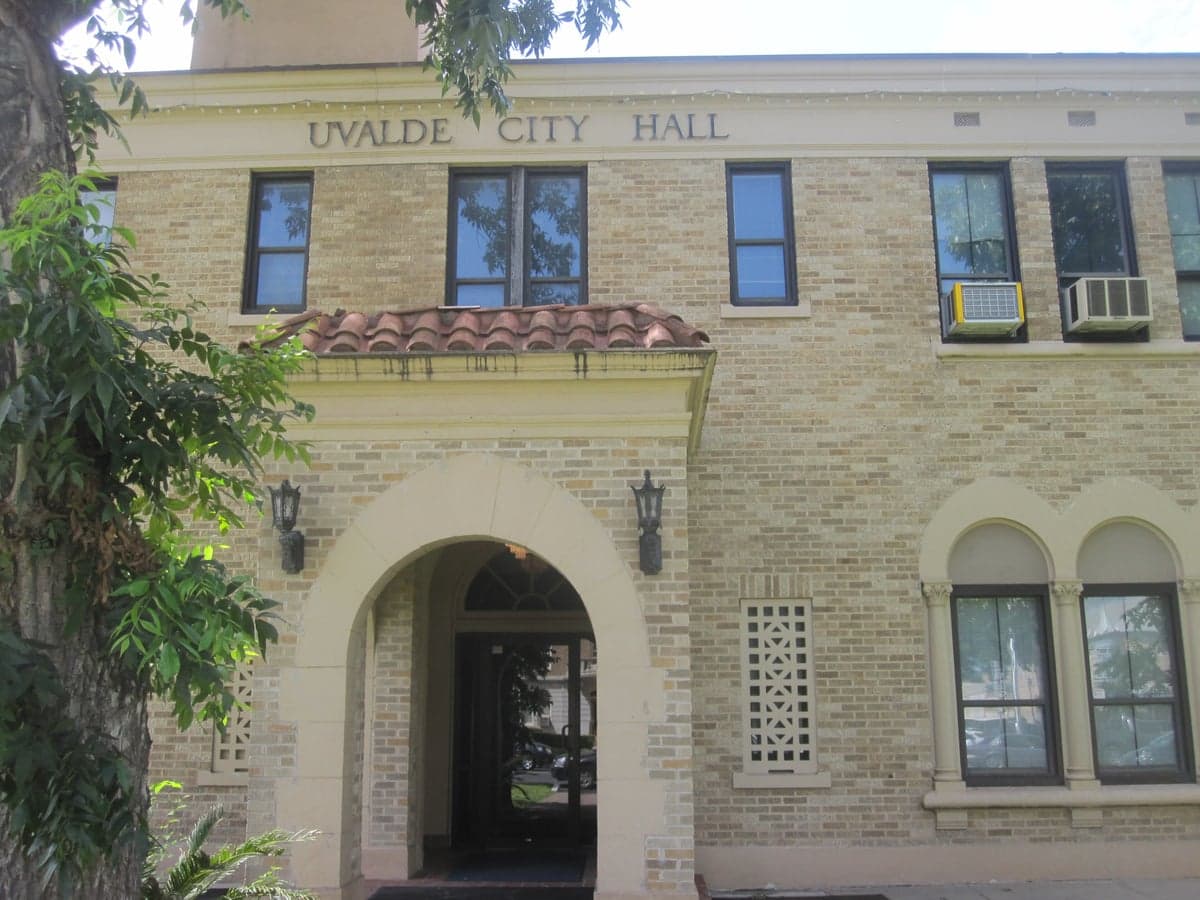
The people of Uvalde, Texas today number roughly 15,344, forming a predominantly Hispanic community (80.1%) with a smaller White population (15.3%) and very small Black (0.9%), East/Southeast Asian (1.3%), and Indian subcontinent (0.4%) communities. The city is characterized by its deep South Texas roots, a strong sense of local identity tied to ranching and agriculture, and a relatively low college attainment rate (16.3%) that reflects its working-class heritage. Uvalde feels more like a traditional border-region town than a modern suburb, with a population density that clusters around the historic downtown and spreads into established neighborhoods like East Uvalde and West Uvalde.
How the city was settled and grew
Uvalde’s population history begins with its founding in 1853 as a trading post on the Leona River, named after Spanish governor Juan de Ugalde. The original settlers were primarily Anglo-American ranchers and farmers drawn by the promise of fertile land and open range, arriving from the southern United States after the Mexican-American War. The 1881 arrival of the Galveston, Harrisburg and San Antonio Railway transformed the town into a regional shipping hub for wool, mohair, and cattle, attracting a wave of Mexican and Mexican-American laborers who built the railroad and worked the ranches. These early Hispanic settlers concentrated in what became Barrio de los Mexicanos (now often referred to as South Uvalde), a neighborhood south of the railroad tracks that remains a core Hispanic enclave today. By the early 20th century, the city’s economy diversified with the discovery of oil in the 1920s and the establishment of Garner Field (now Uvalde Municipal Airport) as a World War II training base, which brought a temporary influx of military personnel and their families. The post-war decades saw steady growth, with Anglo families settling in North Uvalde near the airport and along the newer commercial corridors, while Hispanic families continued to expand in East Uvalde and West Uvalde, creating a pattern of residential separation that persisted into the 1960s.
Modern era (post-1965)
The 1965 Hart-Cellar Act, which ended national-origin quotas, had a limited direct effect on Uvalde’s demographics because the city was already heavily Hispanic. Instead, the major post-1965 shift was domestic: the mechanization of agriculture and the decline of ranching pushed many rural Hispanic families into town, while Anglo families began a slow out-migration to larger cities like San Antonio and Austin for better economic opportunities. This trend accelerated after the 1990s, with the Hispanic share of the population rising from roughly 60% in 1980 to 80% by 2020. The small East/Southeast Asian community (1.3%) is a recent arrival, largely concentrated in North Uvalde near the hospital and the Uvalde Consolidated Independent School District’s newer campuses, drawn by employment in healthcare and education. The Indian subcontinent community (0.4%) is even smaller and more dispersed, with no single neighborhood concentration. The Black population (0.9%) has remained stable and is scattered across the city, with a historic presence in East Uvalde near the old segregated school sites. The foreign-born share (5.9%) is modest for a Texas border-region city, indicating that most Hispanic residents are U.S.-born, often multi-generational families who have lived in Uvalde for decades.
The future
Uvalde’s population is projected to become slightly more Hispanic over the next 10–20 years, as the Anglo population continues a slow decline due to out-migration and an aging demographic. The city’s low college attainment rate (16.3%) and limited high-wage job base mean that younger residents often leave for larger metros, keeping the population relatively flat or growing only modestly. New residential development is occurring primarily on the northern and western edges of town, in areas like North Uvalde and West Uvalde, where newer subdivisions are attracting a mix of Hispanic families and a small number of Anglo retirees. The city’s cultural identity is evolving from a historically divided Anglo-Hispanic town toward a more uniformly Hispanic community, though the legacy of segregation in neighborhoods like South Uvalde and East Uvalde remains visible in housing stock and infrastructure. The 2022 Robb Elementary School shooting has also reshaped the city’s identity, drawing national attention and prompting some families to move away, though the long-term demographic impact is unclear.
For someone moving in now, Uvalde is a predominantly Hispanic, working-class city with a strong sense of place but limited economic dynamism. The population is becoming more homogeneous ethnically, even as it remains diverse in terms of generational roots and local history. Newcomers will find a community that values family, faith, and tradition, but should expect a slower pace of life and fewer amenities than in larger Texas cities. The best fit is likely for those seeking an affordable, close-knit environment in the Texas Hill Country, with an understanding that the city’s demographic future is one of gradual Hispanic consolidation rather than rapid diversification.

* Values derived from national, state, county, city and local statistics and may differ in a specific area. Last updated: 2026-10-23T21:24:08.000Z
Narrative content on this page is AI-generated and may contain mistakes. Verify any details that matter before acting on them.
ReloMaps may earn a commission from affiliate links at no extra cost to you.

