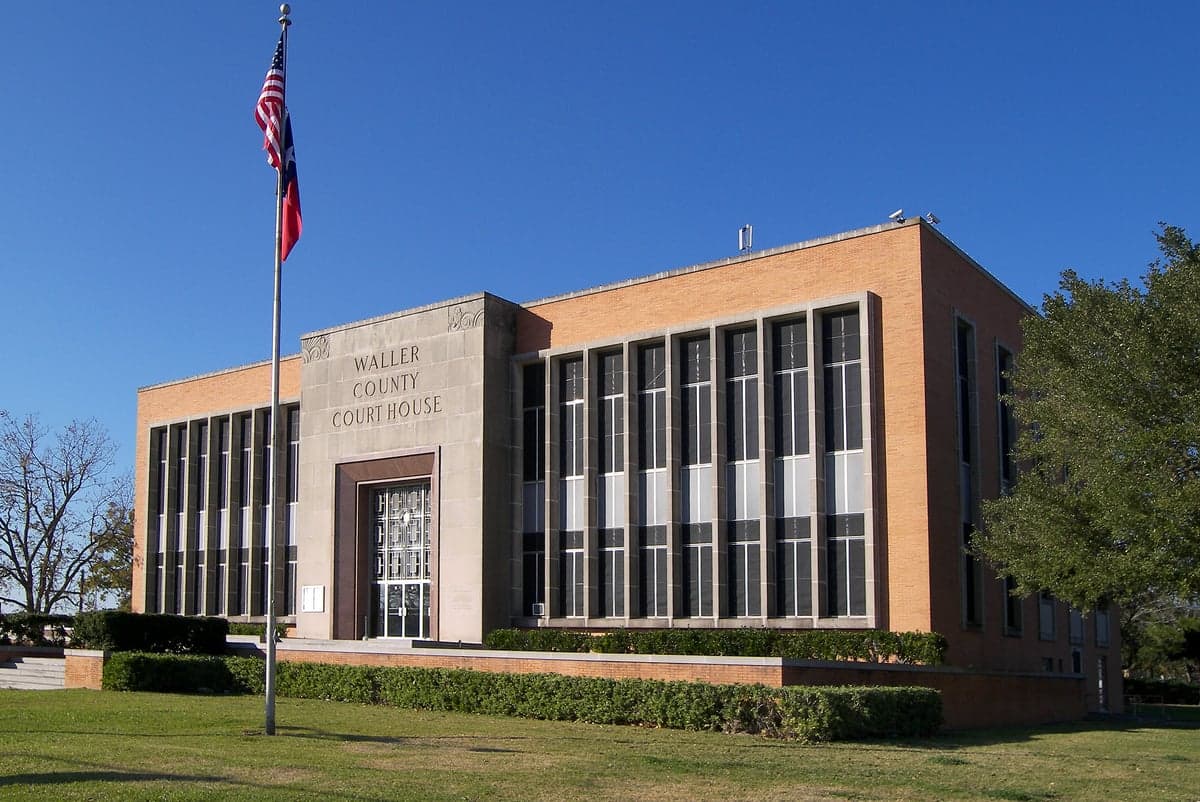
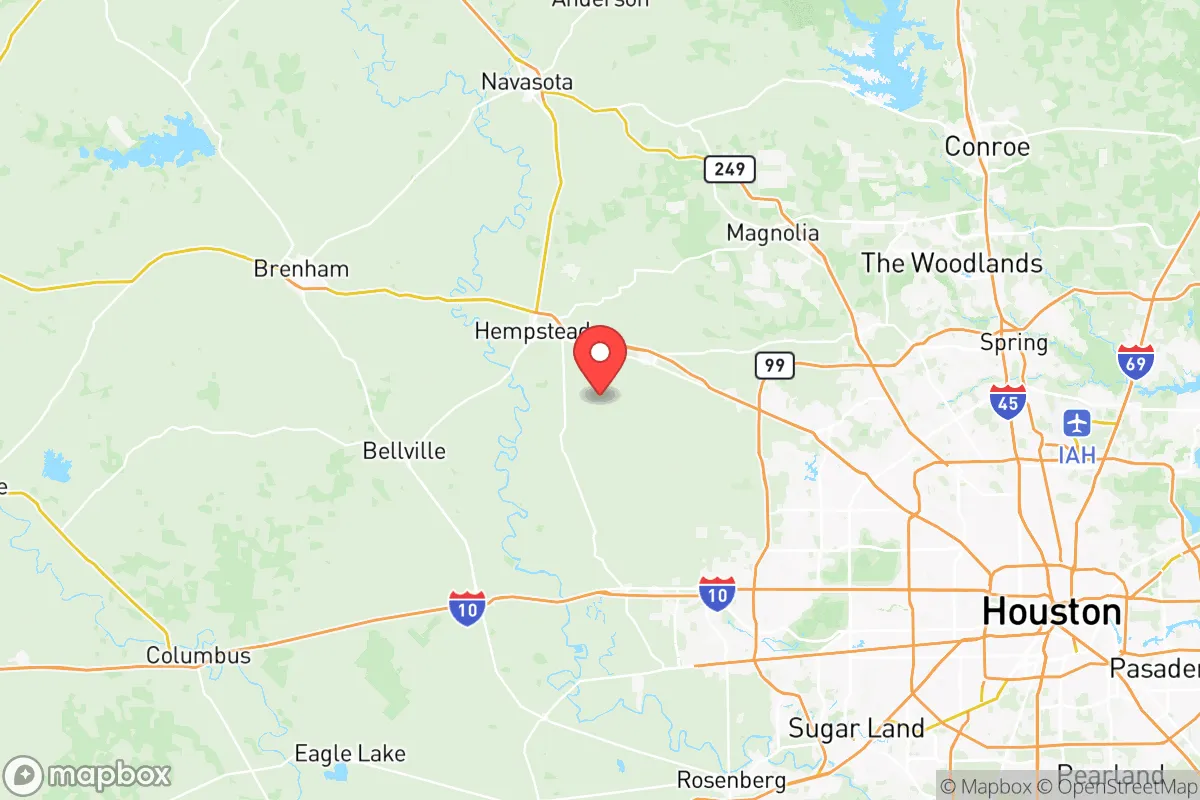
Photo: Wikipedia
Political ClimatePolitical Climate in Waller County
Showing district-level results — no local-only data available.
Local Political AnalysisPolitical Analysis of Waller County
Waller County leans solidly Republican with a Cook PVI of R+12, making it significantly more conservative than Texas as a whole (R+4). The county has been trending redder over the past decade, driven by rapid growth in exurban subdivisions and a influx of conservative-leaning families from Houston’s western suburbs. However, the political landscape is not monolithic — the county’s two main population centers, Hempstead and Prairie View, vote very differently, creating a distinct urban-rural split that shapes local elections.
How it compares
Waller County’s R+12 rating places it among the most reliably Republican counties in the Greater Houston area, well to the right of neighboring Fort Bend County (R+2) and Harris County (D+15). The county’s GOP strength is concentrated in the unincorporated areas around Brookshire, Pattison, and the rapidly growing master-planned communities along Highway 90. These areas routinely deliver 70-75% of the vote for Republican candidates. In contrast, the city of Prairie View — home to Prairie View A&M University — is a Democratic stronghold, often voting 80%+ for Democratic candidates. Hempstead, the county seat, is more competitive, with precincts near the historic downtown leaning Democratic while newer subdivisions on the outskirts vote Republican. The swing precincts are generally found in the central corridor between Hempstead and Brookshire, where moderate voters in newer housing developments can tip close races.
What this means for residents
For conservative residents, Waller County offers a political environment where their views are the clear majority. Local government, from the commissioners court to the school board, is dominated by Republicans, and policy decisions — such as tax rates, land use regulations, and law enforcement priorities — generally reflect conservative values. For liberal residents, particularly those in Prairie View, the political reality is one of limited local influence. Prairie View’s city council and school board are reliably Democratic, but countywide offices remain out of reach. This dynamic means that progressive residents often focus their political energy on state and federal races, where their votes can still matter in a county that is not as deeply red as rural West Texas. The presence of Prairie View A&M also injects a consistent liberal voice into local discourse, particularly on issues like voting access and criminal justice reform.
Culturally, Waller County feels more like a traditional Texas farming and ranching community than a Houston suburb, despite its proximity to the city. The county’s political identity is closely tied to its agricultural heritage, gun rights, and low taxes — values that resonate strongly with the majority of voters. However, the rapid growth along the Highway 90 corridor is slowly changing the county’s character. New residents from Harris and Fort Bend counties are bringing more diverse political perspectives, and some local races have become more competitive in recent cycles. The county’s Republican primary remains the de facto general election for most offices, but the Democratic presence in Prairie View and Hempstead ensures that local debates are not entirely one-sided. For anyone moving to Waller County, understanding this political geography — where you live within the county matters as much as the county’s overall lean — is essential to navigating local life.

State Political ClimatePolitical Climate in Texas
State Political AnalysisPolitical Environment in the State
Texas has been a reliably Republican state for over three decades, but its political reality is far more complex than a simple red label. The state’s Cook Partisan Voting Index of R+4 reflects a solid, though not overwhelming, GOP lean, but the trajectory over the last 10-20 years shows a slow but steady shift toward competitiveness, driven by explosive growth in the urban crescent from Dallas-Fort Worth down through Austin to San Antonio and Houston. While the state hasn’t voted for a Democrat for president since 1976, the margin has narrowed from 16 points in 2012 to 9 points in 2016 and just under 6 points in 2020, and the 2022 gubernatorial race saw Republican Greg Abbott win by 11 points—a comfortable win, but one that masks deep internal fractures between the fast-growing, diversifying cities and the vast, deeply conservative rural and exurban areas.
Urban vs. rural divide
The political map of Texas is a study in stark contrasts. The major metropolitan engines—Harris County (Houston), Dallas County, Bexar County (San Antonio), and Travis County (Austin)—are now solidly Democratic, with Travis County delivering over 71% of its vote to Joe Biden in 2020. These urban cores are powered by a coalition of young professionals, Hispanic voters (who lean Democratic but are not monolithic), African Americans, and a growing number of out-of-state transplants from blue states. Meanwhile, the vast rural and exurban expanses—places like Lubbock, Midland, and the Panhandle—vote Republican by margins of 70-80% or more. The real battleground is the rapidly growing suburban ring counties: Collin County (north of Dallas), Denton County, Fort Bend County (southwest of Houston), and Williamson County (north of Austin). These once-reliable GOP strongholds are trending purple. Collin County, for example, went from a 27-point Romney win in 2012 to a 14-point Trump win in 2020. The 2022 midterms saw Democrats flip a state Senate seat in Fort Bend and come within a few points in several suburban House districts. The divide isn’t just geographic—it’s cultural, with urban and suburban voters increasingly prioritizing issues like abortion access, gun safety, and public school funding, while rural voters focus on property rights, energy regulation, and border security.
Policy environment
Texas’s policy environment is a textbook example of a low-regulation, low-tax state. There is no state income tax, which is the single biggest draw for relocating individuals and families. Property taxes are high to compensate—averaging around 1.6-1.8% of assessed value—but the state offers a homestead exemption and a 10% cap on annual appraisal increases for homeowners. The regulatory posture is business-friendly: Texas is a “right-to-work” state, meaning union membership is voluntary, and there are no state-level occupational licensing requirements for many trades. On education, the state funds public schools through a complex Robin Hood system that redistributes property tax revenue from wealthier districts to poorer ones, but per-pupil spending remains below the national average. School choice is a live issue: the 2023 legislative session saw a major push for education savings accounts (vouchers), which passed the Senate but stalled in the House. Healthcare policy is notably limited: Texas has not expanded Medicaid under the Affordable Care Act, leaving roughly 1.5 million low-income adults in the coverage gap. Election laws have tightened: the 2021 Senate Bill 1 restricted mail-in voting, added ID requirements for absentee ballots, and banned 24-hour and drive-through voting, which had been used heavily in Harris County during the 2020 pandemic election.
Recent policy direction
The last three legislative sessions (2021, 2023, 2025) have pushed Texas sharply in a conservative direction across multiple fronts. On gun and self-defense law, Texas became a permitless carry state in 2021 (HB 1927), allowing most adults to carry a handgun without a license or training. On parental and education rights, the 2023 session passed HB 900, which restricts “sexually explicit” books in school libraries and requires parental consent for library materials, and the state has aggressively pursued curriculum transparency laws. Speech and privacy saw the passage of the 2021 “social media censorship” law (HB 20), which prohibits large platforms from banning users based on their viewpoint—a law currently tied up in court. Medical and bodily autonomy is a flashpoint: the state’s near-total abortion ban (SB 8, 2021, and the trigger law that took effect in 2022) prohibits abortion from conception with no exceptions for rape or incest, only for medical emergencies. Property rights remain strong, with no state-level rent control and a robust eminent domain compensation framework. Taxation has seen modest relief: the 2023 session passed a $18 billion property tax cut package, funded by the state’s massive budget surplus, which included a higher homestead exemption and a compression of school district tax rates. Voting and ballot access remain contentious: the 2021 law tightened rules, but turnout in 2022 was still high, suggesting the changes haven’t suppressed participation as much as critics feared.
Civil unrest & political movements
Texas has been a stage for high-profile political movements and civil unrest, particularly around immigration and abortion. The border crisis has fueled ongoing tensions: Governor Abbott’s Operation Lone Star, launched in 2021, deployed state troopers and National Guard to the border, bused migrants to Democratic-led cities like New York and Chicago, and installed razor wire and buoys in the Rio Grande—actions that have drawn lawsuits from the Biden administration and civil rights groups. Sanctuary city policies are banned statewide (SB 4, 2017), but some cities like Austin and Dallas have resisted cooperation with federal immigration enforcement, leading to legal battles. The 2022 Supreme Court decision overturning Roe v. Wade triggered immediate protests in every major city, with thousands marching in Austin and Houston. The “secession” or “Texit” movement, while loud on social media and in some GOP primary races, has no serious legislative traction—a 2023 poll found only 14% of Texans support it. Election integrity controversies have simmered since 2020, with the state conducting a forensic audit of four counties (including Harris and Dallas) that found no evidence of widespread fraud. A new resident would notice the political polarization in everyday life: bumper stickers, yard signs, and even church affiliations can signal political alignment, especially in smaller towns.
Projection
Over the next 5-10 years, Texas is likely to become more competitive at the statewide level, but not necessarily Democratic. The key demographic driver is the continued growth of the Hispanic population, which now makes up 40% of the state’s residents. While Hispanic voters have trended slightly more Republican in recent cycles (especially among working-class men in the Rio Grande Valley), they are not a monolith, and their turnout remains lower than white voters. The in-migration of roughly 1,000 people per day, many from California and the Northeast, is slowly shifting the suburbs leftward. However, the state’s Republican-controlled legislature is likely to continue drawing congressional and state legislative maps that protect GOP incumbents, and the party’s base in rural and exurban areas is deeply entrenched. The wild card is the state’s energy transition: as renewable energy (wind and solar) grows, particularly in West Texas, it may create new economic interests that soften the state’s hardline oil-and-gas posture. A relocator moving in now should expect a state that remains Republican-controlled for the foreseeable future, but with increasingly competitive statewide races—think 2026 governor’s race as a potential toss-up—and a policy environment that will continue to prioritize low taxes, limited regulation, and cultural conservatism, even as the urban centers push back.
For a new resident, the bottom line is that Texas offers a genuinely low-tax, low-regulation environment that rewards economic ambition, but you’ll need to navigate a polarized landscape where your zip code largely determines your political experience. If you live in Lubbock or Midland, you’ll find a deeply conservative community where church and family are central. If you settle in Austin or Houston, you’ll encounter a vibrant, diverse, and increasingly progressive urban culture that clashes with state policy on abortion, guns, and education. The suburbs—places like Frisco, Cedar Park, and Katy—are the true battlegrounds, where you’ll find a mix of both worlds and the most dynamic political change. The state’s trajectory is toward a more competitive, more diverse, and more contentious future, but the fundamentals—no income tax, strong property rights, and a business-friendly climate—are unlikely to change. If you’re moving here, come ready to engage with a place that takes its politics seriously, but also offers the freedom to build the life you want, largely on your own terms.
* Values derived from national, state, county, city and local statistics and may differ in a specific area. Last updated: 2026-08-08T14:26:24.000Z
Narrative content on this page is AI-generated and may contain mistakes. Verify any details that matter before acting on them.
ReloMaps may earn a commission from affiliate links at no extra cost to you.

