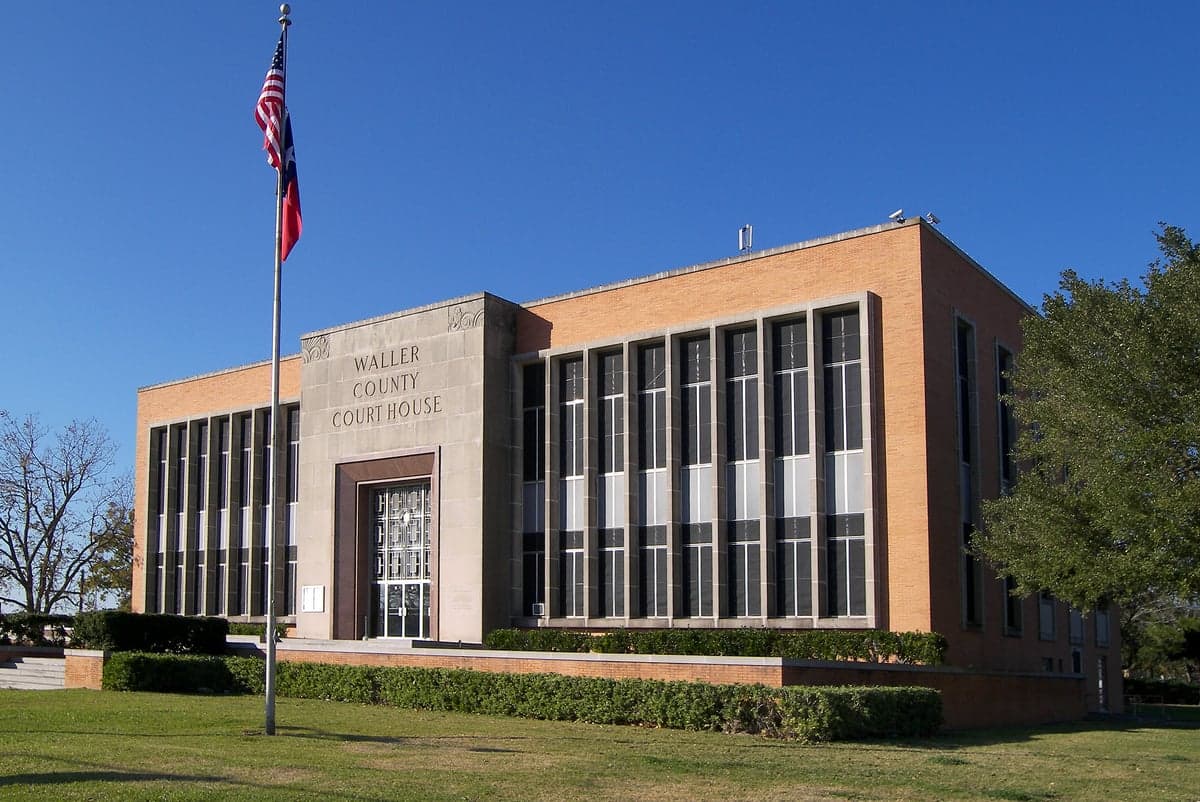
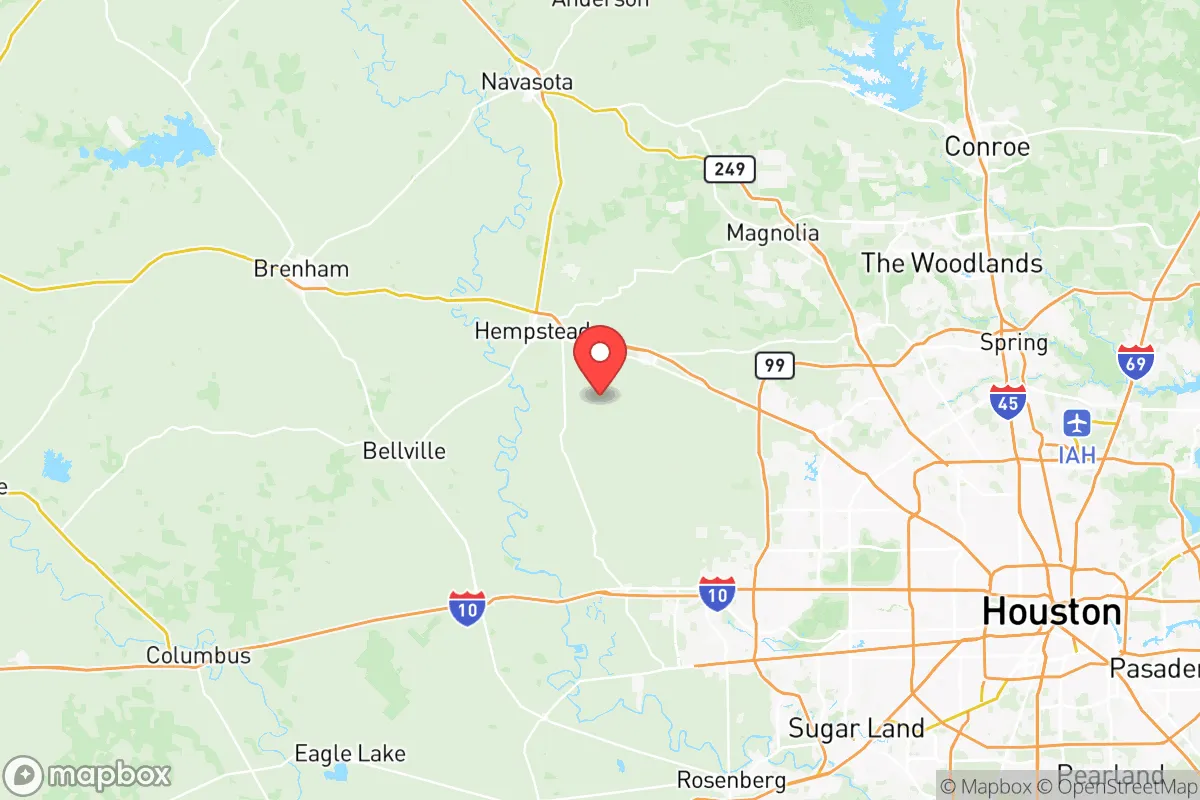
Photo: Wikipedia
Personal Sovereignty in Waller County
Strong independent fundamentals that actively favor personal liberty and low regulation.
What does Personal Sovereignty tell us?
Personal Sovereignty measures your capacity for self-reliance and independence with minimal government friction. Higher scores mean fewer barriers between you and the way you want to live... but it assumes you have the space you need and good neighbors.
What does this tell us?
Personal Sovereignty measures your capacity for self-reliance and independence with minimal government friction. Higher scores mean fewer barriers between you and the way you want to live... but it assumes you have the space you need and good neighbors.
State Policy
Energy independence: Net exporter (220% of energy produced in-state)
Personal Liberty
Homesteading

Personal Liberty Analysis
Waller County offers a notably high degree of personal sovereignty relative to the Houston metro area it borders, combining Texas’s broad state-level preemption laws with a local culture that prizes self-reliance and minimal government interference. The county’s unincorporated areas—stretching from the rural crossroads of Monaville to the prairie around Pattison—operate under a lighter regulatory touch than what residents would find in nearby Harris or Fort Bend counties. For individuals and families who prioritize autonomy over convenience, Waller County presents a strategic middle ground: close enough to Houston’s job market to sustain a livelihood, yet far enough to avoid the denser zoning, higher taxes, and more prescriptive local ordinances that characterize suburban life closer to the city core.
Tax burden and regulatory posture: how Waller County compares to surrounding areas
Waller County’s tax burden is moderate by Texas standards, but its regulatory posture is notably leaner than in adjacent counties. The county’s property tax rate hovers around 0.45% to 0.50% of assessed value for the county portion, with total rates (including school districts and cities) typically landing between 2.0% and 2.5%—competitive with rural Texas but lower than Harris County’s typical 2.5%–3.0% range. There is no county-level income tax, consistent with Texas law. The regulatory environment is shaped by the county’s limited zoning: unincorporated areas have no county-wide zoning ordinance, meaning land use is governed primarily by subdivision regulations and deed restrictions where they exist. Towns like Brookshire and Hempstead have their own municipal zoning, but outside city limits, residents face fewer hurdles for building, operating a home business, or keeping livestock. The county’s approach to building permits is also lighter: unincorporated Waller County does not require a building permit for most residential structures under a certain size, though septic system permits are enforced through the Texas Commission on Environmental Quality. This regulatory posture makes Waller County attractive for those who want to build or modify property without navigating layers of municipal bureaucracy.
Self-defense and gun law specifics: what the Second Amendment looks like on the ground
Waller County is a strong Second Amendment area, with local law enforcement and elected officials generally supportive of gun rights. Texas law governs the core framework: permitless carry (constitutional carry) has been in effect since 2021, allowing any law-abiding adult 21 or older to carry a handgun openly or concealed without a license. Waller County’s sheriff’s office has publicly stated it will not enforce federal gun regulations it deems unconstitutional, a stance common in rural Texas counties. The county has no local ordinances restricting firearm possession beyond state law, and there are no additional waiting periods or registration requirements. For practical self-defense, residents in unincorporated areas like Fieldstore or Pine Island enjoy the ability to discharge firearms on private property for target practice or pest control, subject only to state-level restrictions on discharging within 100 feet of a public road or near a school. The county’s gun-friendly culture is reinforced by the presence of several local gun shops and shooting ranges, including the Waller County Shooting Range near Hempstead. For families, the legal environment supports home defense without the additional restrictions found in some urban Texas jurisdictions, where city ordinances may limit magazine capacity or require safe storage.
Self-reliance and homesteading viability: lot sizes, zoning, and off-grid feasibility
Waller County is one of the more viable areas near Houston for homesteading and off-grid living, thanks to its large minimum lot sizes in unincorporated areas and minimal zoning. The county’s subdivision regulations require a minimum of one acre for a single-family home on a septic system, with larger minimums (often 5–10 acres) in areas without public water. This effectively prevents dense development and preserves the rural character that attracts self-reliant residents. Off-grid feasibility is high: there are no county ordinances prohibiting rainwater collection, solar panels, or composting toilets, though septic systems must meet state standards. The county does not require connection to municipal water or sewer in unincorporated areas, so wells and septic are standard. Towns like Prairie View and Waller have more suburban-style zoning within their city limits, but the vast majority of the county’s land area—particularly around Monaville and Pattison—is zoned agricultural or rural residential. Livestock (chickens, goats, cattle) are generally allowed on parcels of one acre or more, with no county-level restrictions on the number of animals beyond basic animal cruelty statutes. For families seeking to grow their own food, raise animals, or reduce reliance on utility grids, Waller County offers a regulatory environment that supports these goals without the friction found in more urbanized counties.
Personal liberties: parental rights, medical autonomy, speech, and property
Waller County reflects the broader Texas trend toward strong parental rights and limited government intrusion into family decisions. Texas law gives parents broad authority over their children’s education, medical care, and religious upbringing, and Waller County’s school districts—including Waller ISD and Royal ISD—generally defer to parental input on curriculum and health policies. The county has no local ordinances that restrict medical autonomy beyond state law; there are no mask mandates, vaccine requirements for adults, or local health orders that exceed state guidance. On speech and assembly, Waller County is a typical Texas jurisdiction: no local noise ordinances that would prevent political gatherings or religious services on private property, and no restrictions on signage beyond state highway regulations. Property rights are strongly protected: the county has no rent control, no short-term rental bans in unincorporated areas, and no additional permitting for home-based businesses beyond what state law requires. Eminent domain is exercised sparingly, and the county’s conservative commissioners court has historically opposed using condemnation for private economic development projects. For property owners, this means a high degree of control over how land is used, sold, or developed, with minimal interference from local government.
Overall, Waller County ranks among the more sovereignty-friendly areas within commuting distance of Houston. Its combination of low property taxes, minimal zoning, strong gun rights, and permissive homesteading regulations places it in the top tier of Texas counties for personal autonomy. While it lacks the extreme libertarian posture of some West Texas counties (which may have no building codes at all), it offers a practical balance: enough regulation to maintain basic health and safety standards, but far less than what residents would encounter in Harris, Fort Bend, or Montgomery counties. For individuals and families who value self-reliance and want to live with minimal government oversight while still having access to urban employment and healthcare, Waller County represents a strategic choice that delivers on the promise of Texas freedom without the trade-offs of more remote rural areas.

* Values derived from national, state, county, city and local statistics and may differ in a specific area. Last updated: 2026-08-08T14:26:24.000Z
Narrative content on this page is AI-generated and may contain mistakes. Verify any details that matter before acting on them.
ReloMaps may earn a commission from affiliate links at no extra cost to you.

