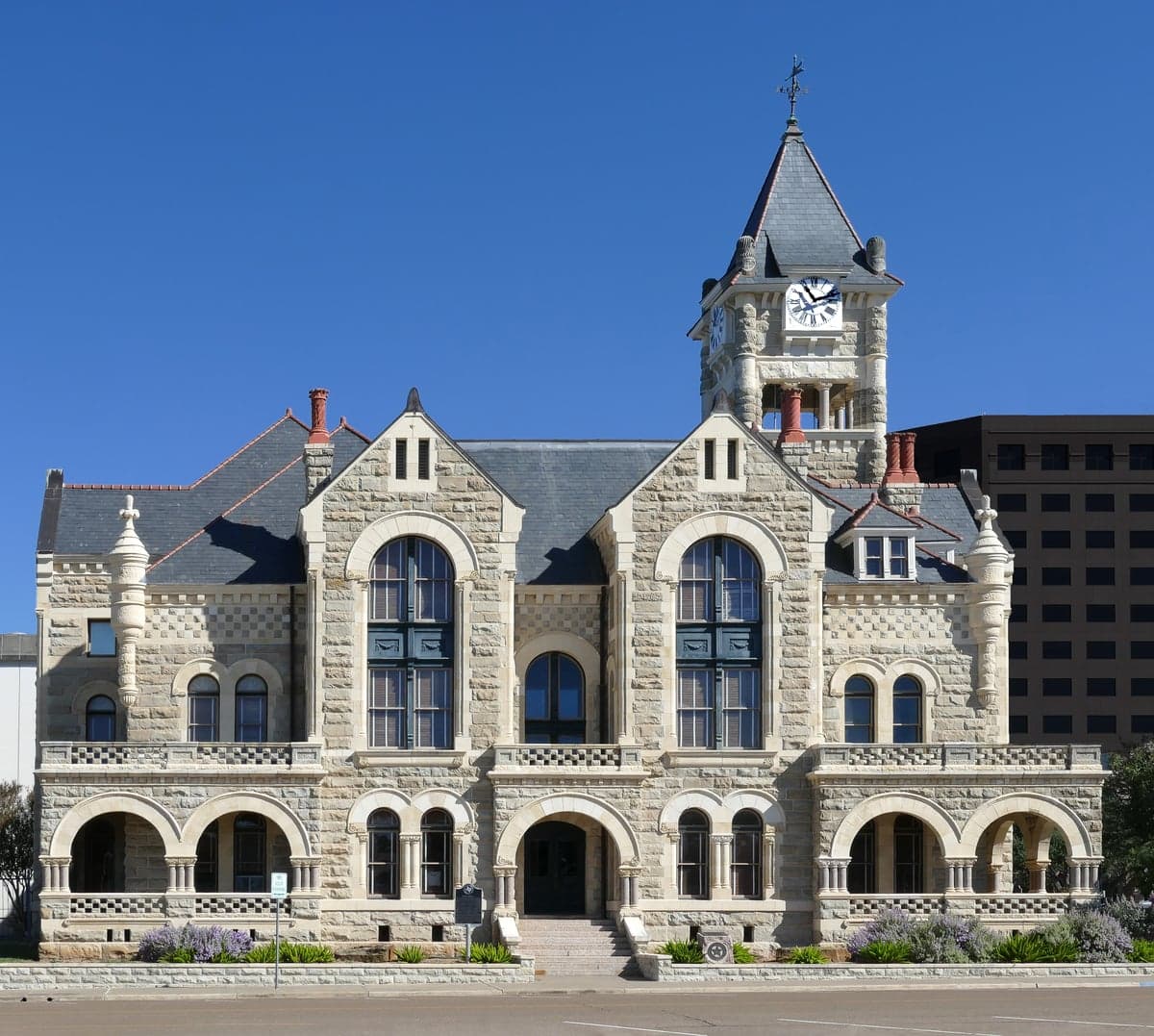
Photo: Wikipedia
Political ClimatePolitical Climate in Victoria County
Showing district-level results — no local-only data available.
Local Political AnalysisPolitical Analysis of Victoria County
Victoria County leans solidly Republican, carrying a Cook Partisan Voting Index of R+14 — a full ten points redder than Texas as a whole at R+4. That gap hasn't shrunk much over the past decade either. The county voted for Donald Trump by similar margins in 2020 and 2024, though turnout in the small but growing precincts around Victoria, the county seat, has nudged a few points blueward over the same period. Still, outside city limits, the rural precincts — places like Inez, Placedo, and Telferner — are as reliably Republican as any in the state. If you walk into a coffee shop in Victoria, you'll hear a mix of political talk, but drive ten miles out and the yard signs are almost entirely Red.
How it compares
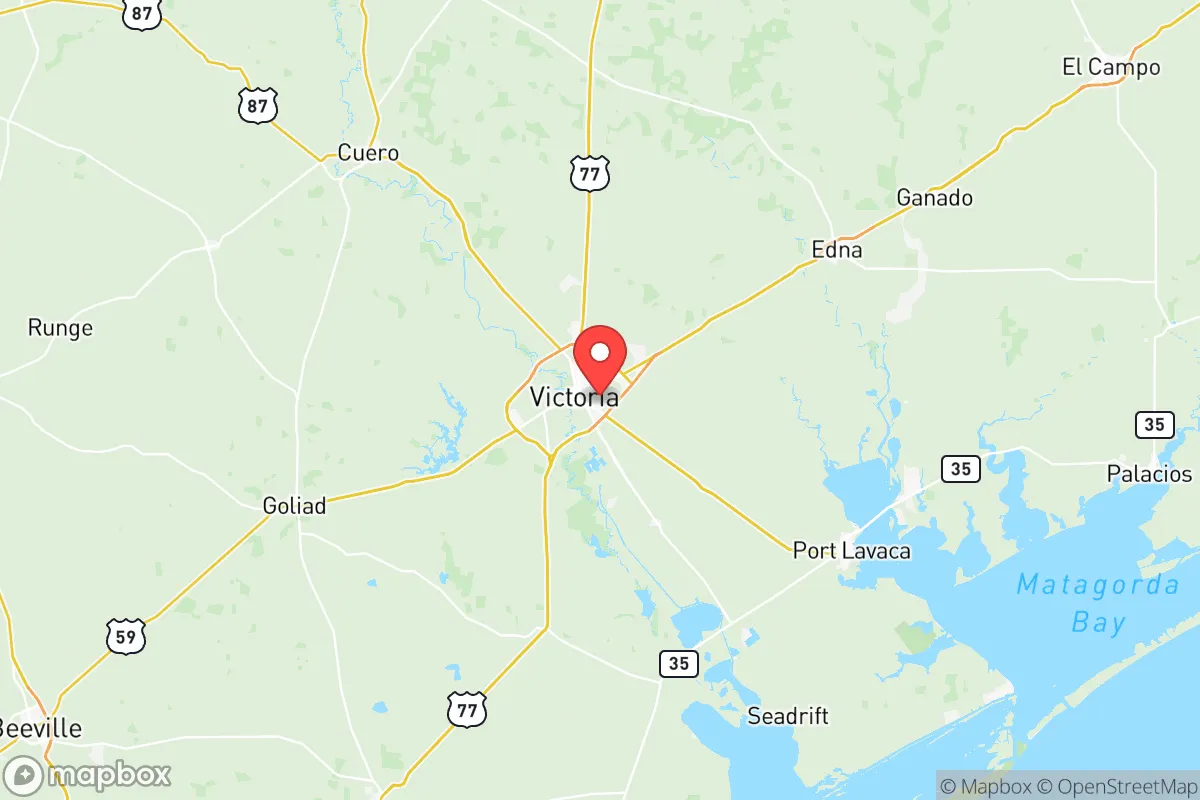
Compared to Texas overall, Victoria County is a Republican stronghold. The state at R+4 is already considered red-leaning, but Victoria County is in a different league — more like the Midland-Odessa or Lubbock range than the purple-tinged suburbs of Dallas or Houston. Within the county itself, you see some internal variation: the city of Victoria has a handful of precincts — around the Victoria College campus and near the Citizens Medical Center — where Democratic candidates can pull 40-45% of the vote. In contrast, the unincorporated areas like Bloomington and Nursery routinely give Republicans 75% or more. The swing precincts — the ones that sometimes flip between elections — are mostly the newer subdivisions on the north side of Victoria, where transplants from Houston and San Antonio have settled. Those precincts still lean R, but by single digits rather than double. Meanwhile, Port Lavaca and Cuero, which are in adjacent counties but sometimes grouped with Victoria for media markets, are also R+ but with more moderate tendencies, especially among Hispanic voters.
What this means for residents
For conservative residents, the county's politics are comfortable: local offices — county commissioner, sheriff, school board — are almost entirely held by Republicans. Tax rates stay low, and there's little appetite for red light cameras or other progressive urban policies. For liberal residents, it's not hostile, but it is isolating. The Democratic Party in Victoria County is small and mostly active around the Victoria Public Library and a few local nonprofits. You won't be shouted down in most public meetings, but you'll often be outvoted. What's interesting is how few truly divisive issues surface at the local level. The county's big debates are usually about flood control (regional drainage plans) and road improvements — not symbols or culture war stuff. The school system, Victoria ISD, manages to avoid the worst of state-level political fights, though the school board elections are competitive and sometimes feature candidates backed by local church groups.
A key cultural distinction in Victoria County is the strong influence of the petrochemical industry — Formosa Plastics and DuPont are major employers — which tends to reinforce pro-business, pro-energy politics. That means even moderate Democrats here often run as "jobs first" candidates. The county government also tends to be more hands-off on land use, which appeals to ranchers and rural landowners. From a policy standpoint, residents get a fairly traditional Texas conservative experience: low property taxes relative to the state average (though rising), limited public transit, and a heavy reliance on personal vehicles. If you're moving here and care deeply about local politics, the takeaway is simple: the county is overwhelmingly red, but the city of Victoria offers a sliver of purple, and the real action is in county-level decisions about infrastructure and industrial permits, not national partisan fights.

State Political ClimatePolitical Climate in Texas
State Political AnalysisPolitical Environment in the State
Texas is a Republican stronghold with a Cook PVI of R+4, meaning the state votes about four points more Republican than the national average in presidential elections. That sounds clear-cut, but the reality on the ground is more layered — the GOP's dominance is driven by massive rural and exurban turnout, while the state's biggest metros are either blue or trending hard that way. Over the last 20 years, Texas has shifted from safe red to competitive red, with Democrats growing their base in urban centers and the fast-growing suburbs of Collin, Williamson, and Hays counties narrowing the statewide margin to single digits in the last three presidential cycles.
Urban vs. rural divide
The Texas political map is a stark study in contrasts. The major metros — Austin, Dallas, Houston, and San Antonio — are solidly Democratic or trending purple-to-blue, fueled by younger, more diverse, and college-educated populations. Austin, the bluest big city in Texas, votes 70-75% Democratic in most elections. El Paso, the state's westernmost major city, is another deep blue anchor. Meanwhile, the vast rural and exurban stretches — from the Panhandle down through West Texas (Lubbock, Midland) and across much of East Texas — are deep Republican. The suburbs have become the ultimate battleground: Collin County (north of Dallas) and Williamson County (north of Austin) were once red bastions but have shifted competitive, with Democrats winning county-level races in recent cycles. Tarrant County (Fort Worth) flipped Democratic in 2018 and 2020 before trending back slightly. This geographic split means statewide Republicans rely on crushing margins in rural counties to offset big metro deficits.
Policy environment
Texas has no state income tax — the single biggest policy draw for new residents. Property taxes are high to compensate, and the state's sales tax rate of 6.25% (with local add-ons up to 8.25%) is among the nation's highest. The regulatory posture is business-friendly, with limited zoning in many cities and a right-to-work law barring union security agreements. On education, Texas funds public schools through a complex recapture system (Robin Hood) that shifts local property tax revenue from wealthier districts to poorer ones; school choice debates have dominated recent legislative sessions. Healthcare policy is defined by Texas's decision not to expand Medicaid, leaving roughly 1.5 million low-income adults in the coverage gap. Election law is governed by SB 1 (2021), which introduced new ID requirements for mail ballots, limited drop box locations, and banned drive-through and 24-hour voting options used by Harris County (Houston) in 2020.
Recent policy direction
The 2021 and 2023 legislative sessions produced a wave of high-profile conservative bills that define Texas's current trajectory. On gun rights: the state enacted permitless carry (HB 1927, 2021), allowing most adults to carry a handgun without a license. On abortion: SB 8 (2021) banned the procedure after roughly six weeks and created a novel private enforcement mechanism; the trigger law (HB 1280) banned nearly all abortions once Roe fell, and the state has since clarified that performing the procedure is a felony punishable by up to life in prison. On parental and education rights: HB 900 (2023) required book vendors to rate library materials for sexual content, and a 2023 law restricted how schools can discuss race and gender in classrooms (though many provisions were tied up in court). On speech and privacy: HB 20 (2023) regulated social media platforms' content moderation, requiring them to post transparency reports and restricting viewpoint-based banning. On medical and bodily autonomy: SB 29 (2023) banned COVID-19 vaccine mandates for private employers who don't accept federal funds, while a 2021 law (SB 968) prohibited vaccine passports. On property rights: SB 147 (2023) restricted certain foreign nationals from purchasing land near military installations, airports, and critical infrastructure. On voting: SB 1 (2021) tightened mail ballot access and banned local officials from proactively sending out applications. Taken together, the direction is toward a state that aggressively asserts its own legal framework, particularly on social and medical issues, while maintaining a light touch on economic regulation.
Civil unrest & political movements
Texas has been the site of major flashpoints in recent years. The 2020 protests following George Floyd's murder in Minneapolis sparked sustained demonstrations in Houston, Austin, and Dallas, with Austin seeing dozens of consecutive nights of protest and a police budget reallocation battle. The abortion ban has galvanized organized opposition, with grassroots groups like the Texas Equal Access Fund and the West Fund (El Paso) continuing to provide practical support across state lines. Immigration politics are especially charged along the border — Operation Lone Star, launched by Governor Greg Abbott in 2021, deployed state troopers and National Guard to the border and bused migrants to Democratic-led cities. Eagle Pass and the Rio Grande Valley (McAllen, Brownsville) have become ground zero for state-federal clashes over border enforcement. Secession rhetoric ("Texit") has risen among a vocal minority of Republican activists, though it remains a fringe movement — a 2023 poll found about 20% of Texans support it. Election integrity remains a live issue: the state's forensic audit of 2020 results in four counties (Dallas, Harris, Tarrant, and Collin) found no evidence of widespread fraud but has kept the topic in the news cycle. Visible signs of polarization include political yard signs in suburbs, dueling protests at the Capitol (particularly during the 2023 special sessions on property tax relief and school vouchers), and the ongoing migration of both conservative and liberal residents between Texas and other states.
Projection
Over the next 5-10 years, Texas is likely to remain Republican-controlled at the state level but with a narrower margin. Demographic trends work against the GOP in raw numbers — the state's growth is concentrated in diverse, younger, urban and suburban areas that lean Democratic. The Hispanic population, long a swing group, is trending more Democratic in South Texas (where the Rio Grande Valley showed erosion from Democrats in 2020 and 2024) but more Republican-aligned in other regions; this is the wild card. In-migration from California and the Northeast (net roughly 300,000+ new residents annually) includes both conservatives seeking lower taxes and liberals fleeing high costs, so the net political effect is unclear. Suburban counties like Collin and Williamson will be the cockpit of Texas's political future — if they continue trending left, the state could become a swing state in presidential elections within a decade. If Republicans hold or retake ground there, Texas stays red. The legislature is likely to continue passing conservative policies on social and cultural
* Values derived from national, state, county, city and local statistics and may differ in a specific area. Last updated: 2026-06-20T15:31:35.000Z
Narrative content on this page is AI-generated and may contain mistakes. Verify any details that matter before acting on them.
ReloMaps may earn a commission from affiliate links at no extra cost to you.

