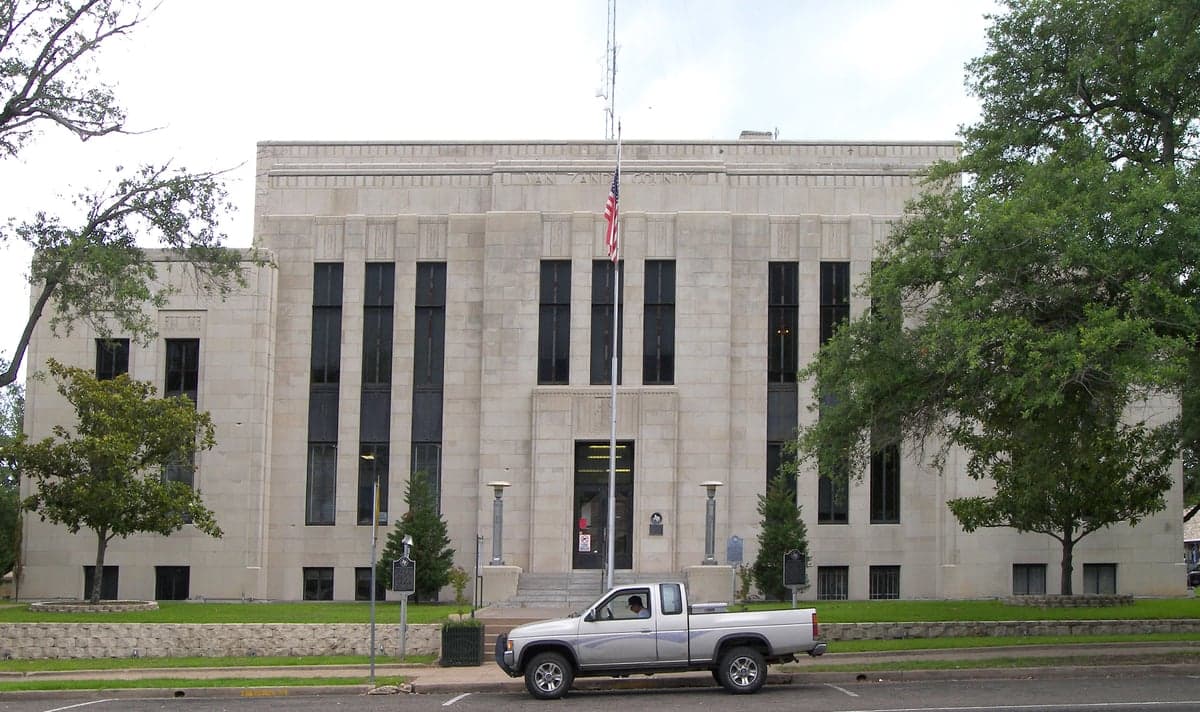
Photo: Wikipedia
Political ClimatePolitical Climate in Van Zandt County
Showing county-level results — no local-only data available.
Lean and PVI are calculated from this county’s 2020 and 2024 presidential results, Cook-style.
Political rankings in Texas
- Most Conservative Cities in Texas
- Most Liberal Cities in Texas
- Best Liberal-Leaning Towns in the South
- Safest Liberal-Leaning Towns in the South
- Safest Conservative-Leaning Towns in the South
- Affordable Small Towns for Conservatives
- Most Affordable Liberal-Leaning Small Towns in the U.S.
- Safest Conservative-Leaning Cities in the U.S.
- Most Conservative Counties in Texas
- Most Liberal Counties in Texas
Local Political AnalysisPolitical Analysis of Van Zandt County
Van Zandt County is one of the most reliably Republican corners of East Texas, and it’s only getting redder. The Cook Partisan Voting Index (PVI) of R+13 means the county votes about 13 points more Republican than the national average, and in 2024, Donald Trump carried it with roughly 80% of the vote. That’s a solid 20 points to the right of Texas as a whole, which itself has a PVI of R+5 (as of 2024). The shift has been steady: back in 2000, George W. Bush won the county by about 35 points; by 2020, Trump’s margin had swelled to nearly 60 points. The driver is simple — the rural, evangelical, and working-class base has hardened, while the small pockets of Democratic voters in the county’s few towns have shrunk or aged out.
How it compares to Texas
Texas is a complicated beast — a Republican state with big blue cities (Houston, Dallas, Austin) that keep it competitive at the statewide level. Van Zandt County has none of that complexity. It’s a deep-red island in a state that’s still red but trending purple in its urban cores. The county’s R+13 PVI is nearly three times as conservative as Texas’s R+5. In practice, that means a statewide Democrat like Beto O’Rourke (who lost Texas by 3 points in 2018) got absolutely crushed in Van Zandt County, losing by over 50 points. The only precincts that ever vote blue are in the county’s two small cities — Canton (home to the famous First Monday Trade Days) and Wills Point — where a handful of precincts near the town squares occasionally hit 40% Democratic. But even those are fading: in 2020, the bluest precinct in Canton still went for Trump by 12 points. The unincorporated areas — Edgewood, Grand Saline, Van — are reliably 80-85% Republican. There are no swing precincts left; the county is a monolith.
What this means for residents
For conservative residents, life is comfortable. The county commission, school boards, and judgeships are all Republican-held, and local policy reflects that — low taxes, minimal regulation, and a strong emphasis on Second Amendment rights and religious liberty. The county’s Republican primary is the real election; the general is a formality. For liberal residents, it’s a different story. They’re a small minority — maybe 15-20% of the electorate — and they have little to no representation on any local body. Socially, it can be isolating; political conversations at the coffee shop or church potluck assume everyone is on the same team. That said, the county is not hostile — most folks are neighborly regardless of party, and the few Democrats I know say they just avoid talking politics. The bigger practical impact is on policy: the county has resisted expanding Medicaid, keeps property taxes low (the county rate is about $0.35 per $100 valuation), and has no public transportation or significant affordable housing programs. If you’re a liberal who wants progressive governance, you’ll find it frustrating. If you’re a conservative who wants a government that stays out of your way, you’ll feel right at home.
Culturally, Van Zandt County is distinct from the state’s urban centers in a few key ways. It’s one of the few counties in Texas that still enforces blue laws — you can’t buy a car or a beer before noon on Sunday in most of the county. The local economy is built on agriculture, small manufacturing (especially in Grand Saline’s salt mines), and tourism from Canton’s First Monday Trade Days, which draws 100,000 visitors each month. There’s no major university, no tech sector, and very little diversity — the county is about 85% non-Hispanic white. The political culture is deeply tied to local churches, especially Southern Baptist and non-denominational evangelical congregations. Looking ahead, the county is likely to stay R+13 or even drift further right as younger, more conservative families move in from the Dallas suburbs (about 45 minutes west) seeking cheaper land and a slower pace. The only wildcard is if the county’s growing Hispanic population (now about 10%) starts voting differently, but so far, that hasn’t shifted the needle. For now, Van Zandt County is what it is: a reliably red place where the politics match the pace of life — steady, predictable, and resistant to change.

State Political ClimatePolitical Climate in Texas
State Political AnalysisPolitical Environment in the State
Texas has been a reliably Republican state for the past three decades, but the margin has been shrinking. In 2024, Donald Trump won the state by roughly 9 points, down from 11 points in 2020 and 16 points in 2012. The dominant coalition remains a mix of rural conservatives, suburban moderates, and business-oriented professionals, but explosive growth in the urban crescent—from Dallas-Fort Worth down through Austin and San Antonio to Houston—is steadily shifting the electorate. The state’s political identity is now a tug-of-war between a deeply entrenched Republican legislature and a rapidly diversifying population that is making once-safe seats competitive.
Urban vs. rural divide
The political map of Texas is a study in contrasts. The major metros—Houston, Dallas, San Antonio, and Austin—are increasingly Democratic strongholds. Harris County (Houston) went for Biden by 13 points in 2020, and Travis County (Austin) by a staggering 51 points. Meanwhile, rural West Texas and the Panhandle—places like Lubbock, Amarillo, and Midland—vote Republican by margins of 60 to 80 points. The real battleground is the suburbs. Counties like Collin (north of Dallas) and Denton, once reliably red, have shifted purple; Collin County voted for Trump by only 9 points in 2024, down from 17 points in 2016. The Rio Grande Valley, historically Democratic, has also moved right, with counties like Zapata flipping to Trump in 2020 and 2024. This urban-rural split means that statewide elections are decided by the suburbs, not the cities or the countryside.
Policy environment
Texas operates under a low-tax, low-service model. There is no state income tax, but property taxes are among the highest in the nation—averaging about 1.6% of home value. The state’s regulatory posture is business-friendly, with minimal zoning in many cities and a right-to-work law that limits union power. Education policy is dominated by a school voucher debate: in 2023, Governor Greg Abbott pushed for education savings accounts, but the bill failed in the House due to rural Republican opposition. Healthcare remains a flashpoint: Texas has the highest uninsured rate in the country (around 17%), having refused Medicaid expansion under the ACA. Election laws were tightened in 2021 with SB 1, which added ID requirements for mail-in ballots and restricted drive-through voting. The state also has a near-total abortion ban (trigger law from 2021) and no exceptions for rape or incest, which has reshaped healthcare access, especially in cities like El Paso and Austin where out-of-state travel for care has surged.
Recent policy direction
The last five years have seen a sharp rightward shift on social and cultural issues, even as the state’s demographics have moved left. In 2023, the legislature passed SB 14, banning gender-affirming care for minors, and HB 900, which restricted what books can be sold in school libraries. On gun rights, Texas enacted permitless carry (HB 1927) in 2021, allowing anyone over 21 to carry a handgun without a license. Property rights were strengthened with the passage of a constitutional amendment in 2023 that prohibits a statewide property tax increase without voter approval. On privacy and surveillance, the state passed a data privacy law (HB 4390) in 2023, giving residents more control over how companies use their personal data. Voting access remains a contested area: while SB 1 tightened rules, the state also expanded early voting hours in some counties. For a relocator, the practical takeaway is that Texas is a state where the government generally stays out of your wallet and your gun safe, but is increasingly active in regulating medical decisions for minors and school curricula.
Civil unrest & political movements
Texas has seen its share of political flashpoints. The 2020 protests in Austin over George Floyd’s death were among the largest in the country, leading to a police budget cut that was later partially restored. Immigration politics are a constant: the state has bused over 100,000 migrants to sanctuary cities like New York and Chicago since 2022, and Governor Abbott’s Operation Lone Star has deployed state troopers and National Guard to the border. Secession rhetoric, while fringe, has a real presence—the Texas Nationalist Movement has pushed for a 2024 ballot referendum on independence, though it has no legal force. Election integrity remains a live issue: the 2020 audit of four counties (including Harris and Dallas) found no widespread fraud, but the effort fueled ongoing distrust among some Republican voters. For a new resident, the most visible sign of political tension is likely the presence of armed border patrol checkpoints near the Rio Grande and the occasional protest at the state capitol in Austin.
Projection
Over the next decade, Texas is likely to become more competitive at the statewide level, but not necessarily blue. The in-migration of roughly 1,000 people per day—many from California and the Northeast—is slowly diluting the Republican base. However, those newcomers are often moderate or conservative-leaning, not progressive. The suburbs of Fort Worth and San Antonio are growing faster than the urban cores, and these areas tend to vote Republican, albeit by smaller margins. The Democratic path to victory depends on turning out the growing Latino population, which has been trending rightward. Realistically, Texas will remain under Republican control for the next 5-10 years, but the margin will continue to narrow. A relocator moving in now should expect a state where the legislature stays conservative on social issues, but where local control in blue cities like Dallas and Houston will continue to create a patchwork of policies—from sanctuary city ordinances to local minimum wage hikes—that clash with state law.
For someone choosing Texas, the bottom line is this: you get low taxes and a business-friendly climate, but you also get a state government that is actively shaping culture-war policy. If you’re conservative, you’ll find a legislature that largely shares your values. If you’re liberal, you’ll find strong communities in the major cities and a growing political movement that is slowly gaining ground. Either way, the state’s sheer size and diversity mean you can find a place that fits your lifestyle—just be prepared for the political climate to keep shifting under your feet.
* Values derived from national, state, county, city and local statistics and may differ in a specific area. Last updated: 2026-10-21T02:54:28.000Z
Narrative content on this page is AI-generated and may contain mistakes. Verify any details that matter before acting on them.
ReloMaps may earn a commission from affiliate links at no extra cost to you.

