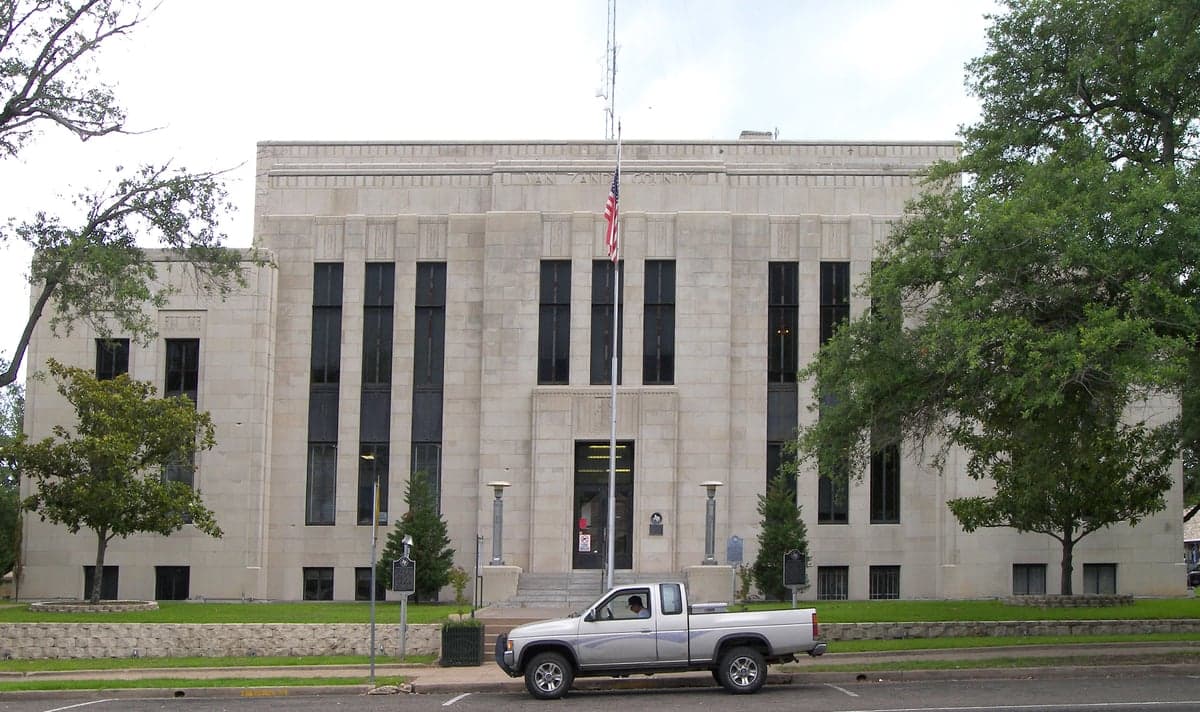
Photo: Wikipedia
Personal Sovereignty in Van Zandt County
Strong independent fundamentals that actively favor personal liberty and low regulation.
What does Personal Sovereignty tell us?
Personal Sovereignty measures your capacity for self-reliance and independence with minimal government friction. Higher scores mean fewer barriers between you and the way you want to live... but it assumes you have the space you need and good neighbors.
What does this tell us?
Personal Sovereignty measures your capacity for self-reliance and independence with minimal government friction. Higher scores mean fewer barriers between you and the way you want to live... but it assumes you have the space you need and good neighbors.
State Policy
Energy independence: Net exporter (195% of energy produced in-state)
Personal Liberty
Homesteading

Personal Liberty Analysis
Van Zandt County, Texas, offers a notably high degree of personal sovereignty, driven by a combination of low regulatory burden, strong property rights, and a deeply embedded culture of self-reliance. Located in the Piney Woods region east of Dallas, the county provides an environment where individual autonomy is the default, not the exception, particularly when compared to the more restrictive urban centers of North Texas. For those prioritizing freedom from government overreach, the area presents a compelling option, though the specific flavor of that autonomy varies between the county’s small towns and unincorporated areas.
Tax burden and regulatory posture: How light is the hand of government?
Van Zandt County operates under Texas’s state-level framework of no personal income tax, which immediately reduces the financial drag on residents. The county’s property tax burden is moderate for the region, with a total effective rate typically hovering around 1.3% to 1.5% of assessed value, depending on the specific city and school district. Towns like Canton, the county seat and home to the famous First Monday Trade Days, and Wills Point have their own municipal property taxes, but these are generally modest. The regulatory posture is decidedly light-touch: there is no county-wide zoning in unincorporated areas, meaning residents in places like Edgewood or Grand Saline can often build structures, park RVs, or keep livestock on their property without navigating a thicket of permits. Building codes are typically only enforced within city limits, and even then, they are less onerous than in Dallas or Houston. This permissive environment is a primary draw for those seeking to escape the bureaucratic friction of more heavily regulated counties.
Self-defense and gun law specifics: What are the actual rules on the ground?
As a Texas county, Van Zandt operates under the state’s strong preemption laws, meaning local governments cannot enact gun control ordinances stricter than state law. This results in a permissive environment where permitless carry (constitutional carry) is legal for anyone 21 or older who can legally possess a firearm. Open carry of handguns in a holster is also lawful. The county’s culture is overwhelmingly pro-Second Amendment, and gun ownership is the norm rather than the exception. There are no local registration requirements, waiting periods, or bans on specific firearm types. The Van Zandt County Sheriff’s Office, under Sheriff Joe Carter, has historically taken a supportive stance toward gun rights. For residents in towns like Van or Fruitvale, the practical reality is that self-defense is treated as a fundamental personal responsibility, with the legal framework providing wide latitude for defensive use of force, including the Castle Doctrine and Stand Your Ground laws that apply statewide. The only notable restriction is the prohibition on carrying firearms in certain posted locations (e.g., schools, bars), which is consistent with state law.
Self-reliance and homesteading viability: Lot sizes, zoning, and off-grid feasibility
Van Zandt County is one of the more viable areas in the Dallas-Fort Worth orbit for serious homesteading and off-grid living. The key factor is the absence of county-wide zoning and relatively lax subdivision regulations. In unincorporated areas, there are no minimum lot size requirements for agricultural use, though standard residential subdivisions often have one-acre minimums. For true self-reliance, rural properties near Ben Wheeler or Martins Mill offer the best conditions, with large tracts of land (5-40+ acres) available at prices significantly lower than in Collin or Denton counties. Off-grid feasibility is high: rainwater catchment is legal and common, composting toilets are permitted, and there are no county-level restrictions on solar panel installation. The main practical hurdles are well-drilling costs (typically $5,000-$15,000) and septic system permitting, which is handled by the county’s environmental health department but is generally straightforward for standard systems. Burning of household trash is permitted in many rural areas with a simple burn permit. The county’s agricultural exemption for property taxes is also accessible for those with qualifying land use (e.g., hay production, livestock), providing a significant financial incentive for larger properties. In contrast, within the city limits of Canton or Wills Point, homesteading is more constrained by municipal codes regarding livestock, structure setbacks, and noise ordinances, so buyers should target unincorporated parcels for maximum freedom.
Personal liberties: Parental rights, medical autonomy, speech, and property
Van Zandt County reflects the broader Texas trend of strong parental rights in education, with school districts like Van ISD and Canton ISD generally deferring to parents on curriculum and health decisions. The county is part of the conservative judicial district, and local courts have been receptive to parental challenges against school policies. Medical autonomy is less explicitly protected at the county level, but the state’s ban on vaccine passports and general resistance to federal health mandates create a permissive atmosphere. Freedom of speech is robust, with no local ordinances restricting public expression beyond standard time, place, and manner rules. Property rights are the crown jewel of personal sovereignty here: the county’s lack of comprehensive zoning and its adherence to Texas’s strong private property laws mean that residents have wide latitude to use their land as they see fit, provided they do not create a public nuisance. The county’s appraisal district is known for being relatively accessible for property tax protests, and the local political culture strongly supports the principle that a person’s home and land are their own domain. There are no county-level mask mandates, business closure orders, or other emergency restrictions that have been common in more urban counties, a pattern that solidified during the COVID-19 pandemic and has persisted.
Overall, Van Zandt County ranks among the more sovereignty-friendly areas within commuting distance of a major metroplex. While it does not offer the extreme libertarian legal framework of some rural New Mexico or Arizona counties, its combination of low taxes, minimal zoning, strong gun rights, and a culture of self-reliance makes it a practical choice for families and individuals who want to live largely unbothered by government. The key trade-off is access to urban amenities, but for those who value personal autonomy above convenience, the county’s small towns and rural stretches provide a solid foundation for an independent life.

* Values derived from national, state, county, city and local statistics and may differ in a specific area. Last updated: 2026-10-21T02:54:28.000Z
Narrative content on this page is AI-generated and may contain mistakes. Verify any details that matter before acting on them.
ReloMaps may earn a commission from affiliate links at no extra cost to you.

