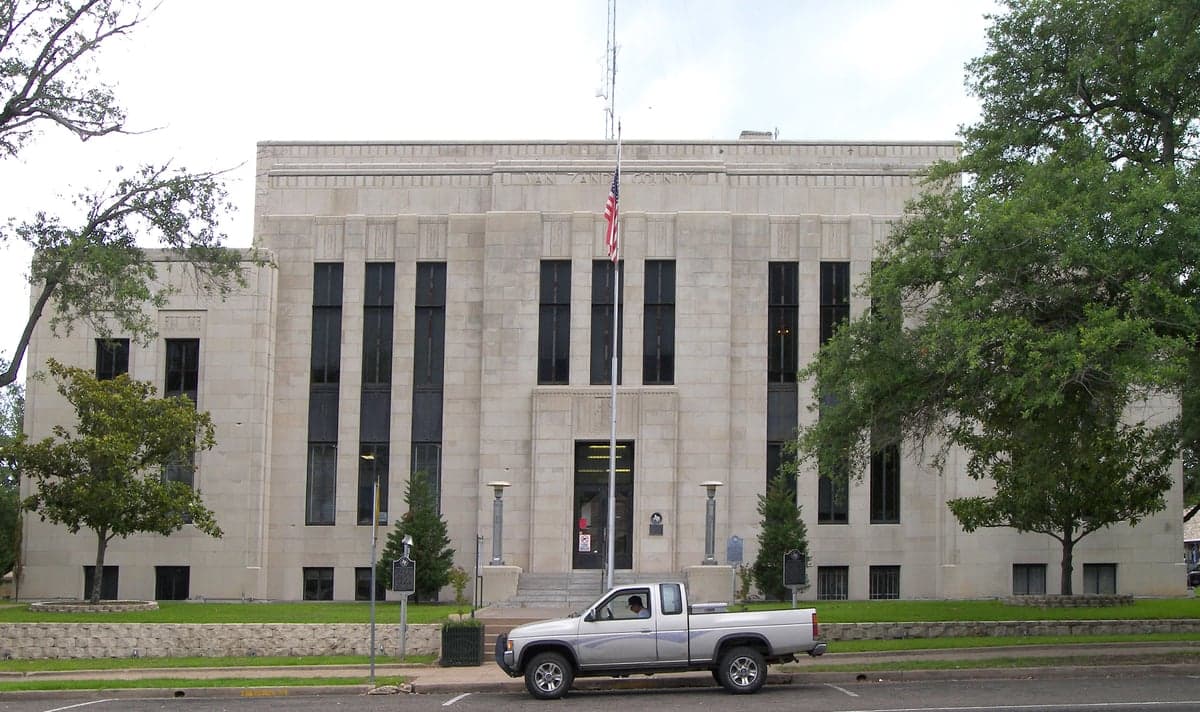
Photo: Wikipedia
Demographics of Van Zandt County
Affluence Level in Van Zandt County
A middle-class area roughly in line with national averages across income, home values, education, and employment.
People of Van Zandt County
Van Zandt County, Texas, is home to 61,323 residents who overwhelmingly identify as white (81.4%) and native-born (97.3% U.S.-born), giving the county a distinctly rural, culturally conservative character that sets it apart from the rapidly diversifying Dallas-Fort Worth metroplex just 60 miles to the west. The county’s population density remains low at roughly 40 people per square mile, and its identity is rooted in deep family ties, evangelical Protestantism, and a strong agricultural and oil-and-gas heritage. With only 18.2% of adults holding a college degree, the workforce leans heavily toward blue-collar and service-sector jobs, and the Hispanic population, at 12.8%, represents the largest and fastest-growing minority group.
Settlement & growth (pre-1960)
Before Anglo-American settlement, the area that became Van Zandt County was part of the traditional hunting grounds of the Caddo Confederacy, particularly the Hasinai and Kadohadacho bands, who lived in settled agricultural villages along the Neches and Sabine river systems. Spanish and French explorers passed through in the 17th and 18th centuries, but no permanent European colonies were established here; the region remained a sparsely populated frontier buffer zone between Spanish Texas and French Louisiana until the early 1800s.
The first permanent Anglo settlers arrived in the 1830s and 1840s, primarily from the Upper South — Tennessee, Kentucky, Arkansas, and Missouri — drawn by the Republic of Texas’s generous land-grant policies. These were overwhelmingly Scots-Irish and English stock, subsistence farmers who brought with them a culture of self-reliance, evangelical Methodism and Baptist faith, and a deep suspicion of centralized authority. They established small farming hamlets like Canton (the county seat, founded 1848), Wills Point (1873), Grand Saline (named for its salt mines, active since the 1840s), and Edgewood (1880s). The salt mines at Grand Saline were a major economic draw, employing both white laborers and enslaved African Americans before the Civil War.
After the Civil War and Reconstruction, the county’s population grew slowly but steadily. The arrival of the Texas and Pacific Railway in the 1870s transformed Wills Point and Grand Saline into shipping hubs for cotton, timber, and salt. A small number of freed slaves — roughly 15% of the county’s population by 1880 — remained in the area, concentrated in rural communities near Ben Wheeler and Martin’s Mill, where they worked as sharecroppers and tenant farmers. The early 20th century brought a wave of white tenant farmers from the Deep South, displaced by the boll weevil and the mechanization of cotton agriculture. The East Texas oil boom of the 1930s, centered on the Van Zandt County portion of the East Texas Oil Field, brought a brief influx of roughnecks and speculators to Van (the town) and Fruitvale, but the county never experienced the explosive growth of nearby Kilgore or Longview. By 1960, the population stood at roughly 19,000, overwhelmingly white, native-born, and rural.
Modern era (post-1965)
The 1965 Hart-Cellar Act had virtually no direct impact on Van Zandt County. The foreign-born population today is just 2.7%, and the county did not receive any of the post-1965 immigrant streams — Vietnamese, Korean, Indian, or Central American — that transformed urban Texas. Instead, the county’s modern demographic story is one of domestic migration: a slow but steady outflow of young adults to Dallas and Houston for jobs, offset by an influx of retirees and second-home buyers from the Dallas-Fort Worth metroplex seeking cheaper land and a slower pace.
The most significant demographic shift since 1965 has been the growth of the Hispanic population, which rose from less than 2% in 1980 to 12.8% today. This growth is driven primarily by Mexican-American families moving from Dallas County and from South Texas, drawn by affordable housing and construction jobs in the expanding exurban corridor along Interstate 20. These new residents have concentrated in and around Canton and Wills Point, where they work in construction, landscaping, poultry processing, and the service industry. The Black population, by contrast, has declined from roughly 10% in 1960 to 2.7% today, as younger African Americans left for urban opportunities and the older rural communities aged out. The East/Southeast Asian population (0.3%) and Indian-subcontinent population (0.1%) are negligible, consisting of a handful of professionals and small business owners in Canton and Grand Saline.
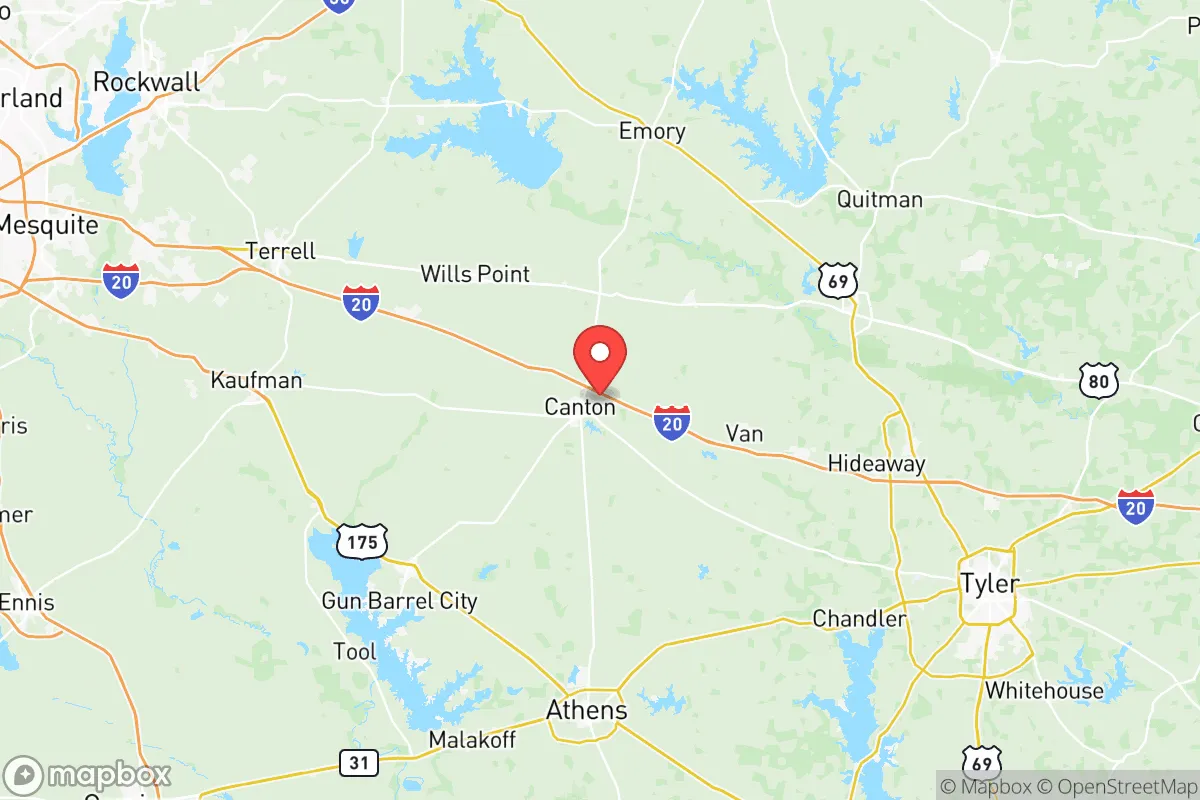
Suburbanization has reshaped the county’s geography since the 1990s. The construction of Interstate 20 in the 1960s made the county accessible to Dallas commuters, and the rise of the Canton First Monday Trade Days — the world’s largest flea market, drawing hundreds of thousands of visitors monthly — turned Canton into a regional retail and tourism hub. New subdivisions have sprouted around Lake Tawakoni (the county’s largest lake, created in 1960), attracting weekenders and retirees from the metroplex. However, the county remains overwhelmingly rural: no town exceeds 5,000 residents, and the largest, Canton, has just over 3,500.
The future
Van Zandt County is projected to grow modestly over the next 10–20 years, reaching roughly 70,000–75,000 residents by 2040, driven almost entirely by domestic migration from the Dallas-Fort Worth metroplex. The Hispanic share of the population will continue to rise, likely reaching 18–20% by 2040, as younger Mexican-American families move in and the older white population ages in place. The county will become slightly more diverse, but it will remain overwhelmingly white and native-born, with no significant influx of Asian, Indian, or African American residents anticipated.
The cultural identity of the county is evolving in subtle ways. The new arrivals from Dallas tend to be more politically moderate and less tied to the county’s traditional agricultural economy, but they are still overwhelmingly conservative and white. The Hispanic community is integrating into existing social structures — attending the same churches, sending children to the same schools — rather than forming distinct enclaves. The county’s political character, already deeply Republican (Donald Trump won 82% of the vote in 2024), is unlikely to shift meaningfully.
For someone moving in now, Van Zandt County offers a stable, slow-growing, culturally homogeneous environment where the pace of life remains rural and the dominant values are family, faith, and self-reliance. The county is not becoming a melting pot; it is becoming a slightly more diverse version of what it has always been — a place where newcomers are expected to adapt to the existing culture rather than transform it. The trade-off is clear: low crime, affordable land, and strong community ties, but limited economic opportunity, low educational attainment, and little racial or cultural diversity.

* Values derived from national, state, county, city and local statistics and may differ in a specific area. Last updated: 2026-10-21T02:54:28.000Z
Narrative content on this page is AI-generated and may contain mistakes. Verify any details that matter before acting on them.
ReloMaps may earn a commission from affiliate links at no extra cost to you.

