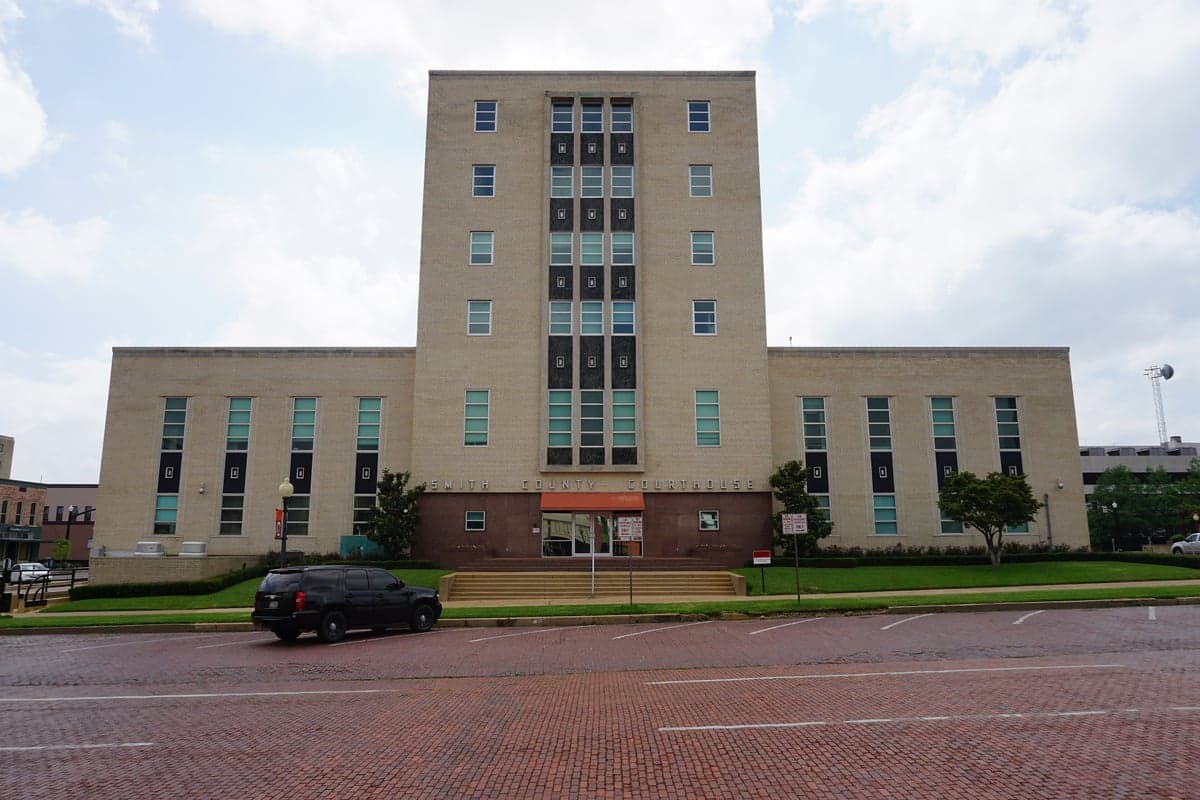
Photo: Wikipedia
Political ClimatePolitical Climate in Smith County
Showing district-level results — no local-only data available.
Local Political AnalysisPolitical Analysis of Smith County
Smith County has been a deeply conservative stronghold for decades, and nothing in recent cycles suggests that’s changing. The Cook Partisan Voting Index (PVI) sits at R+25, meaning the county votes a full 25 points more Republican than the national average. That’s not just red — it’s deep ruby. Tyler, the county seat and the engine of the local economy, consistently delivers 70–75% of its vote to GOP candidates. The smaller, fast-growing suburbs like Whitehouse and Lindale lean even harder to the right, routinely pushing 80% Republican in contested races. A couple of precincts around the University of Texas at Tyler campus and the historic Azalea District have shown slightly more competitive numbers in recent midterms, but those are isolated — maybe a dozen precincts out of a hundred. The trajectory over the last ten years is essentially flat: Smith County was R+25 in 2016 and remains R+25 today. There’s been no suburban drift leftward like you see in parts of Collin or Denton counties — if anything, the rural precincts around Troup and Bullard have become a shade more Republican since 2020.
How it compares
Statewide, Texas is rated R+4 by the Cook PVI, which is broadly competitive in a good year for Democrats — witness Beto O’Rourke’s narrow 2018 Senate race and the party’s narrow wins in Harris and Dallas counties since then. Smith County’s R+25 is a different planet. On a presidential map, while Texas as a whole voted for Trump by about 5.5 points in 2024, Smith County backed him by roughly 44 points. In practical terms, that means a Democratic candidate winning Smith County is almost unheard of. The last Democrat to carry it was Jimmy Carter in 1976, and even then it was a hair-thin margin. For a useful comparison: Smith County is about twice as Republican as nearby Tarrant County (R+13) and roughly on par with the Panhandle’s deep-red bench. But unlike some rural Texas counties, Smith has enough population — just over 230,000 — that its GOP tilt carries real weight in state legislative races. The county anchors Texas House District 6, which has not seen a competitive Democratic challenge in over a decade.
What this means for residents
For conservative residents, it means you rarely have to worry about your political environment. Local elected officials — county commissioners, the sheriff, school board members — are almost always Republican, often unchallenged in primaries. Policy conversations at the county level tend to center on tax rates, road bonds, and Second Amendment issues, with very little debate about social policy because there’s broad consensus. For liberal or moderate residents, the reality is that you’re a clear minority. It’s not hostile — Tyler is a polite, church-going place — but you’ll encounter few like-minded neighbors in casual settings. There’s no organized progressive infrastructure beyond the county Democratic Party, which fields candidates mostly to ensure ballot access. The practical effect is that local campaigns rarely spend money on persuasion; the general election is decided in the GOP primary. Anyone moving here should expect that most political conversations at work, at church, or at the local diner will lean right, and that local news coverage will reflect that mainstream.
The cultural distinctions in Smith County run deeper than just voting patterns. Alcohol sales remain restricted in some parts of the county (Lindale and parts of rural Smith are still dry or partially dry by local option), reflecting a strong evangelical Protestant influence that shapes public policy. The county is also home to a significant number of religious nonprofits and Christian colleges, including Texas College and the University of Texas at Tyler (a secular institution but one that blends into the conservative civic fabric). Gun rights are taken seriously — open carry and permitless carry are the norm, and you’ll see firearms displayed in pickup trucks in grocery store parking lots without anyone batting an eye. There is a palpable sense that the county’s political identity is part of its identity as East Texas, distinct from the more libertarian-leaning suburbs of Dallas or the more diverse Houston area. For better or worse, Smith County is stable in its politics, and that stability is unlikely to waver in the coming decade.

State Political ClimatePolitical Climate in Texas
State Political AnalysisPolitical Environment in the State
Texas has been a Republican stronghold for the past three decades, with a Cook PVI of R+4, meaning the state leans about four points more Republican than the country as a whole. But that headline number hides a state that is genuinely in flux. Over the last ten to twenty years, explosive growth in the major metros—especially Austin, Houston, Dallas, and San Antonio—has gradually shifted the state from deep red to leaning red, while the rural and exurban counties have only gotten redder. The dominant coalition remains the GOP, powered by conservative voters in the suburbs, small towns, and the vast stretches of West Texas and the Panhandle. But Democrats have made steady gains in the urban cores and some inner-ring suburbs, and if current in-migration patterns hold, the long-term trajectory points toward a state that could become genuinely competitive within a decade.
Urban vs. rural divide
The political map of Texas is a study in contrast. The big four metros—Houston, Dallas-Fort Worth, San Antonio, and Austin—are where the state’s Democratic votes are concentrated. Harris County (Houston) flipped to Hillary Clinton in 2016 and has stayed blue since; it cast more votes for Biden than any other county in the state. Travis County (Austin) is an impenetrable Democratic fortress, voting over 70% for Biden. Bexar County (San Antonio) has been reliably blue for decades. Meanwhile, the Dallas-Fort Worth area is more complicated: Dallas County is solidly blue, but Tarrant County (Fort Worth) flipped to Biden by a razor-thin margin in 2020, making it a genuine swing county. Collin County (suburban north of Dallas) is still red but shifting—Frisco, McKinney, and Plano all voted for Trump in 2024 but by smaller margins than in 2016.
Outside the metros, it’s a different world. Drive west of Interstate 35 through the Permian Basin and you hit Midland and Lubbock, where Republicans routinely win 75–80% of the vote. South Texas along the Rio Grande, communities like Brownsville and Laredo are historically Democratic but have drifted right in recent cycles—the so-called “Hispanic shift” that helped Trump win counties he lost in 2020. The Panhandle around Amarillo is as red as any place in the country. So the urban-rural split is stark, and it keeps getting sharper as the metros grow and the countryside shrinks in relative political weight.
Policy environment
Texas’s policy environment reflects its red lean, but with a pragmatic, business-friendly twist. The absence of a state income tax is the marquee feature—the state relies heavily on high property taxes and sales taxes to fund services. That trade-off is a major draw for relocators from high-tax states like California or New York. Regulatory posture is light: no occupational licensing for many professions, minimal environmental permitting delays, and a right-to-work law that weakens unions. Education policy has been especially contentious: the legislature passed a ban on “critical race theory” in schools (HB 3979, later strengthened) and has repeatedly tried to pass school voucher programs, though rural Republicans have blocked them. Healthcare is lean—Texas did not expand Medicaid under the ACA, leading to the nation’s highest uninsured rate. And, of course, the state has some of the strictest abortion laws in the country: a six-week heartbeat ban (SB 8, 2021) and a near-total trigger ban after Dobbs. Election laws were tightened in 2021 with SB 1, which limited mail-in voting, expanded poll watcher access, and banned drive-through voting. Voter ID requirements remain among the nation’s strictest.
Recent policy direction
The last few years have seen Texas double down on conservative priorities. On gun and self-defense law, the state made permitless carry legal in 2021 (HB 1927), meaning adults 21 and older can carry a handgun without a license—one of the most permissive regimes in the country. Parental and education rights have been a flashpoint: in 2023, the legislature passed a law requiring public schools to notify parents if a child requests to use a name or pronoun different from their birth certificate (the “Parental Bill of Rights”). On speech and privacy, Texas passed HB 20 in 2021, a controversial social media law that forbids platforms from banning users based on “viewpoint”—companies challenged it in court, and it’s still winding through litigation. Medical and bodily autonomy is sharply restricted on abortion, but the state also prohibited vaccine mandates by private employers (SB 7, 2023). Property rights were reinforced by recent legislation limiting eminent domain for private development (like pipelines) and capping annual property tax appraisal increases to 10% for homesteads through Proposition 4 (2023). Voting and ballot access remains a battleground: SB 1 made it harder to vote by mail, but early in-person voting is still broadly available and begins weeks before election day. Overall, the direction is toward more individual liberty on guns and parental rights, less on abortion and health care, and a tight leash on local governments that try to go their own way (the state has repeatedly preempted local ordinances on fracking bans, plastic bag bans, and sanctuary policies).
Civil unrest & political movements
Texas is no stranger to political drama. The 2020 George Floyd protests sparked massive demonstrations in Houston (his hometown), Austin, and Dallas, with some turning violent—Austin alone saw over $10 million in property damage. The backlash was swift: the next legislative session produced laws protecting police from defunding and enhancing penalties for protest-related offenses (SB 23, 2021). On immigration, Governor Greg Abbott’s Operation Lone Star has poured billions into border enforcement, busing migrants to sanctuary cities like New York and Chicago—a visible flashpoint that makes national news regularly. Sanctuary policies are illegal at the local level (SB 4, 2017), but some cities like Dallas and Houston continue to resist cooperation with federal immigration enforcement. Secession rhetoric isn’t mainstream, but the Texas Nationalist Movement has a small, vocal following; you’ll see “Texit” bumper stickers occasionally. Election integrity controversies flared after the 2020 election: Texas conducted post-election audits in four counties, found no widespread fraud, but the skepticism persists among a sizable portion of the GOP base. School board meetings across the state have been intense since 2021, with parents arguing over mask mandates, book bans, and curriculum content—especially in purple suburbs like Frisco and Katy. A new resident would notice that political bumper stickers, yard signs, and open political discussion are common in most parts of the state; this is not a place where people hide their leanings.
Projection
Looking five to ten years out, Texas is heading toward a closer partisan balance. In-migration—around 1,000 new residents a day—favors both sides: many come from blue states for economic opportunity and tend to lean right on taxes and regulation, but they also bring moderate social views. The Hispanic population, which is about 40% of
* Values derived from national, state, county, city and local statistics and may differ in a specific area. Last updated: 2026-06-20T14:34:31.000Z
Narrative content on this page is AI-generated and may contain mistakes. Verify any details that matter before acting on them.
ReloMaps may earn a commission from affiliate links at no extra cost to you.

