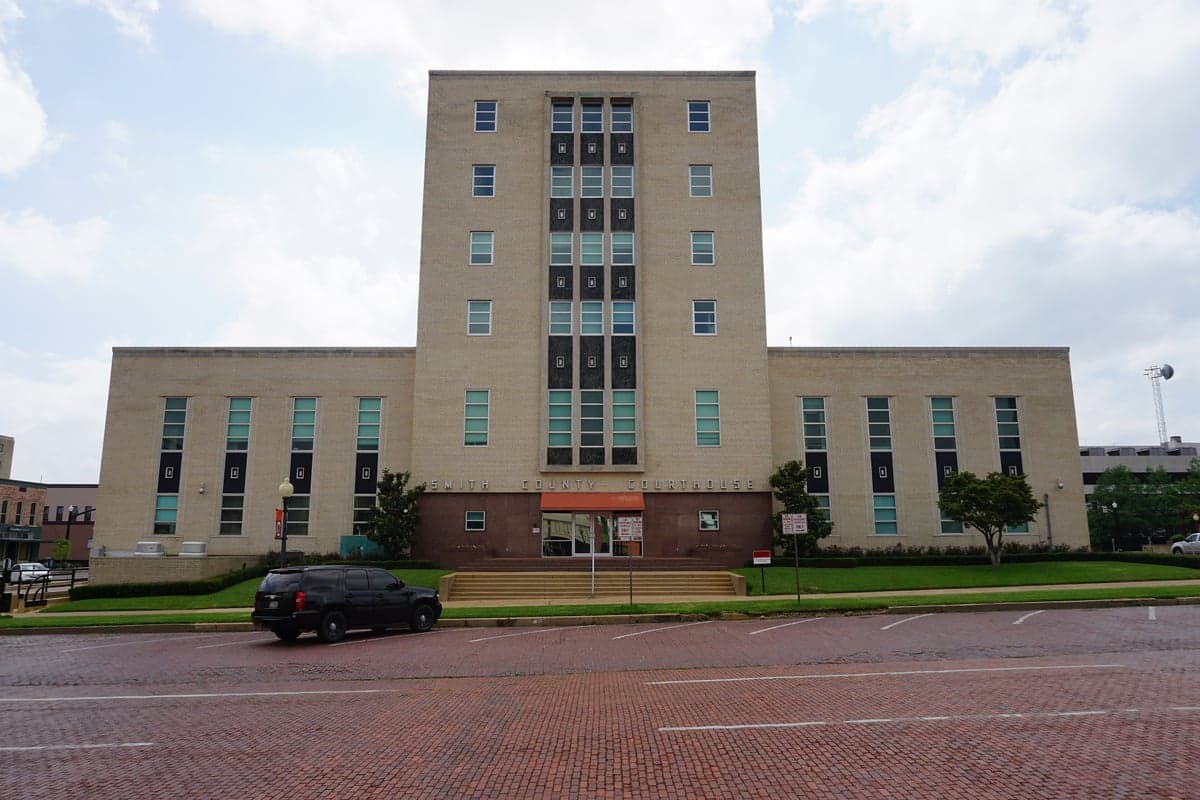
Photo: Wikipedia
Personal Sovereignty in Smith County
Strong independent fundamentals that actively favor personal liberty and low regulation.
What does Personal Sovereignty tell us?
Personal Sovereignty measures your capacity for self-reliance and independence with minimal government friction. Higher scores mean fewer barriers between you and the way you want to live... but it assumes you have the space you need and good neighbors.
What does this tell us?
Personal Sovereignty measures your capacity for self-reliance and independence with minimal government friction. Higher scores mean fewer barriers between you and the way you want to live... but it assumes you have the space you need and good neighbors.
State Policy
Energy independence: Net exporter (220% of energy produced in-state)
Personal Liberty
Homesteading

Personal Liberty Analysis
Smith County, Texas, offers a notably high degree of personal sovereignty, grounded in Texas’s broad preemption laws, low state income tax, and strong property rights, though local municipal ordinances in its larger cities introduce meaningful variation. The county’s regulatory posture is generally light-touch outside of incorporated city limits, making it a viable option for individuals and families seeking autonomy in daily life, self-defense, and land use. However, the specific experience of personal freedom differs significantly between the urban core of Tyler, the suburban ring of Whitehouse and Lindale, and the more rural reaches of Bullard and Troup.
Tax burden and regulatory posture: how local rules compare across Smith County
Texas has no state income tax, which directly benefits residents of Smith County by allowing them to retain more of their earnings. The primary local tax burden falls on property taxes, with Smith County’s combined rate (county, city, school district, and special districts) typically ranging from 2.2% to 2.8% of assessed value, depending on the specific municipality and school zone. Tyler, as the county seat and largest city, imposes the highest combined rates due to city services and Tyler ISD levies. In contrast, unincorporated areas of the county and smaller towns like Bullard or Troup often have lower overall rates, though they still pay county and school taxes. The regulatory environment is similarly tiered: Tyler enforces zoning codes, building permits, and business licensing that can be more restrictive, while rural precincts and towns like Lindale and Whitehouse maintain lighter touch ordinances. For a resident prioritizing minimal government interference, choosing a location outside Tyler’s city limits—or in a smaller municipality—reduces exposure to local regulatory burdens. The county itself does not impose a county-wide zoning code, leaving land-use decisions largely to individual property owners in unincorporated areas, subject only to state-level environmental and health regulations.
Self-defense and gun law specifics: what Smith County residents can and cannot do
Texas law provides strong self-defense protections, including the Castle Doctrine and Stand Your Ground, which apply uniformly across Smith County. No county-specific gun control ordinances exist; state preemption prevents cities like Tyler from enacting their own restrictions on firearm possession, carry, or storage. Residents may carry a handgun openly or concealed without a permit (permitless carry, effective 2021) if they are at least 21 and not prohibited by state or federal law. Smith County’s sheriff’s office is known for a pro-Second Amendment posture, and the county issues License to Carry (LTC) permits for reciprocity with other states. For those seeking training, multiple gun ranges and firearms dealers operate in Tyler, Whitehouse, and Lindale. The practical effect is that a resident living in rural Bullard or Troup can keep firearms in their home or vehicle with minimal legal friction, while even a Tyler apartment dweller enjoys the same state-level protections. The only notable local nuance is that discharging a firearm within city limits is generally prohibited except at approved ranges, so rural property owners have greater freedom to shoot on their own land. Overall, Smith County ranks as a high-autonomy environment for self-defense compared to states with may-issue permitting or local gun control ordinances.
Self-reliance and homesteading viability: lot sizes, zoning, and off-grid feasibility
Homesteading and off-grid living are feasible in Smith County, but viability depends heavily on location. In unincorporated areas, there are no county-wide minimum lot size requirements for single-family homes, though subdivision regulations may apply when splitting land. Rural parcels in Troup and Bullard commonly range from 1 to 10 acres, with some larger tracts available. Off-grid water is legally permissible via private wells, which require a permit from the local groundwater conservation district but are routinely approved. Septic systems are allowed where municipal sewer is unavailable, subject to Texas Commission on Environmental Quality (TCEQ) standards. Solar panels and rainwater collection are unregulated at the county level, though homeowners associations (HOAs) in subdivisions—common in Whitehouse and Lindale—may restrict them. Tyler’s city limits impose stricter rules: minimum lot sizes of 5,000 to 7,500 square feet in most residential zones, mandatory connection to city water and sewer, and building permits for any structure. For a family seeking true self-reliance—raising livestock, growing food, generating power—rural Smith County outside any city limits is the most permissive environment. Lindale and Whitehouse offer a middle ground: they have zoning and permit requirements but are less restrictive than Tyler, and many neighborhoods still allow chickens and small gardens. The county’s agricultural exemption for property taxes further supports homesteading by reducing tax burden on land used for farming or ranching.
Personal liberties: parental rights, medical autonomy, speech, and property
Texas law generally supports parental rights in education and medical decisions, and Smith County reflects this state-level posture. Parents have the right to opt their children out of specific curriculum or assignments, and the county’s school districts—Tyler ISD, Whitehouse ISD, Lindale ISD, Bullard ISD, and Troup ISD—vary in how they accommodate such requests, with rural districts often more responsive to parental input. Medical autonomy is broad: Texas does not require parental consent for minors to receive certain vaccines, but parents can refuse any vaccination for their children. The state has no mask or vaccine mandates as of 2026, and Smith County’s public health authority does not impose local mandates. Free speech is protected under the First Amendment, and Smith County has no local ordinances restricting signage, leafleting, or public assembly beyond standard time-place-manner rules. Property rights are strong: Texas’s private property rights laws limit eminent domain abuse, and Smith County’s appraisal district uses market-value assessments. However, property owners in Tyler must comply with city codes on building setbacks, height, and use, while rural landowners face fewer restrictions. For a resident who values maximum personal liberty, the key decision is whether to live inside a city’s regulatory reach or outside it—the difference is substantial.
Overall, Smith County provides a high-sovereignty environment relative to most of the United States, particularly for those who choose rural or small-town living over Tyler’s urban core. The combination of no state income tax, strong self-defense laws, permissive land-use rules outside city limits, and state-level protections for parental and medical autonomy places it among the more freedom-oriented counties in Texas. For a single individual or family prioritizing personal independence, the most strategic choice is to locate in unincorporated areas near Bullard or Troup, or in the less restrictive towns of Lindale or Whitehouse, rather than within Tyler’s city limits. The county’s overall regulatory posture is light, but the local variation means that the degree of personal sovereignty experienced day-to-day is largely a function of where one chooses to live.

* Values derived from national, state, county, city and local statistics and may differ in a specific area. Last updated: 2026-06-20T14:34:31.000Z
Narrative content on this page is AI-generated and may contain mistakes. Verify any details that matter before acting on them.
ReloMaps may earn a commission from affiliate links at no extra cost to you.

