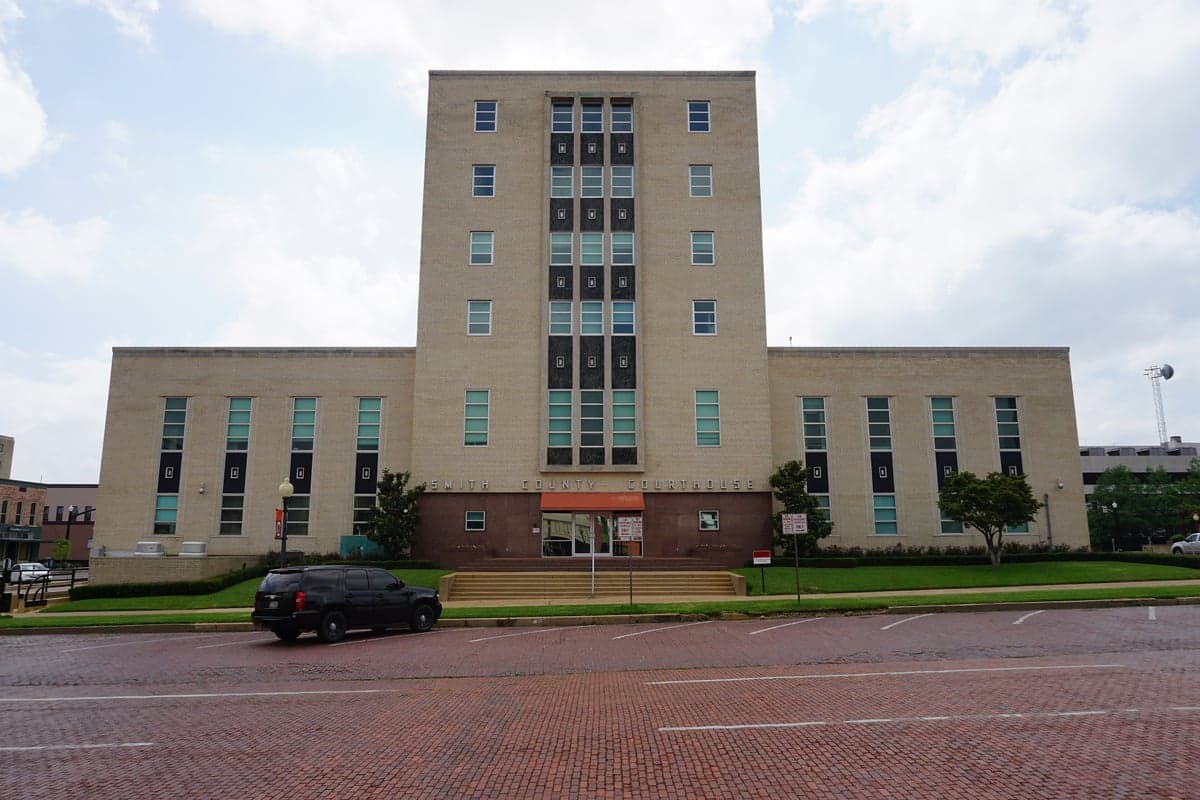
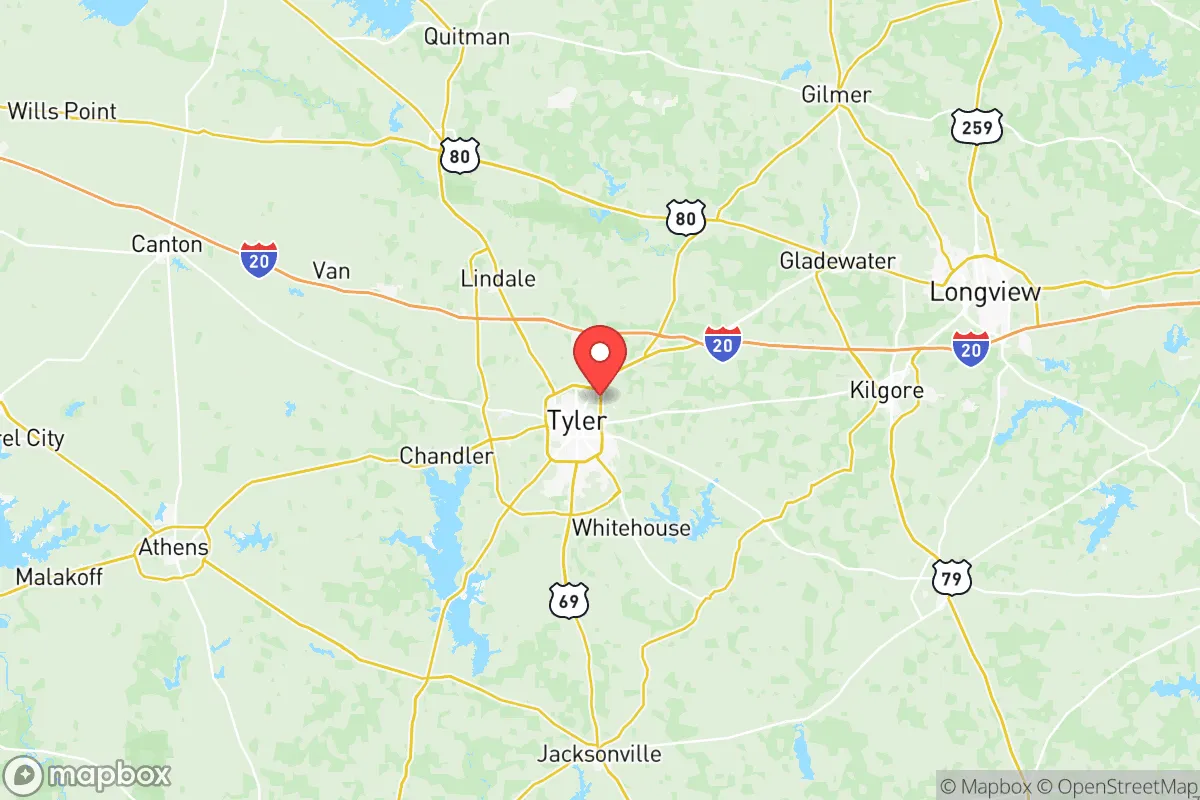
Photo: Wikipedia
Demographics of Smith County
Affluence Level in Smith County
A middle-class area roughly in line with national averages across income, home values, education, and employment.
People of Smith County
Smith County’s 238,014 residents live in a community that is older, more rooted, and more religious than Texas as a whole: nearly 60% claim a Protestant affiliation, the median age of 37.5 is slightly above the state average, and the foreign-born share sits at just 4.9% — well under half the state’s 17% figure. The population is predominantly White (58.0%) with a significant Black minority (16.6%) and a fast-growing Hispanic cohort (20.6%), a mix that reflects the county’s layered history of cotton agriculture, railroad expansion, and modest suburbanization. Its core identity is anchored by Tyler, the county seat and economic hub, but the surrounding towns of Whitehouse, Troup, Lindale, and Bullard each carry distinct settlement legacies that still shape who lives there today.
Settlement & growth (pre-1960)
Before Anglo-American settlement, the region that became Smith County was part of the ancestral territory of the Caddo Confederacy, specifically the Hasinai branch, whose agricultural villages dotted the Sabine and Neches River basins. European contact — first Spanish, then French — brought disease and displacement, and by the time the Republic of Texas was established in 1836, the Caddo had largely been pushed out. The first permanent Anglo settlers arrived in the 1840s and 1850s, mostly from the Upper South: Tennessee, Kentucky, Arkansas, and Missouri. These were small-scale cotton farmers and livestock raisers, drawn by land grants offered under the Texas Preemption Act, and they clustered along the headwaters of the Sabine River, near what is now the southeastern edge of Tyler.
The county was formally organized in 1846, and Tyler was selected as the seat of government the following year. The economy revolved entirely around cotton, and with that came slavery: by 1860, enslaved African Americans made up roughly 35% of the county's almost 14,000 residents, a proportion that would shape racial dynamics for generations. After the Civil War, many freed people remained in the area as sharecroppers and tenant farmers, forming settlements like the community of Flint in the county’s southwest corner and the neighborhood of West Erwin in Tyler. The original Black settlement of Chappel Hill, located just south of Tyler, became a hub for freedmen’s schools and churches, and its descendants still anchor the county’s Black population today.
The next major transformation began in the 1870s with the arrival of the International-Great Northern Railroad, which made Tyler a commercial center for shipping cotton and timber. This ushered in a period of domestic migration from other Southern states, particularly from Mississippi, Alabama, and Louisiana. European immigration was lighter here than in Central Texas: a scattering of German and Swiss families settled in the Lindale area by the 1880s, drawn by the region’s lumber mills, while a small community of Czech farm families put down roots near Troup. The railroad also connected Smith County to wider labor markets, and by 1900 the population had grown to just over 37,000, with roughly equal numbers of White and Black residents.
The 1920s and 1930s brought two profound shifts. First, the discovery of the East Texas Oil Field in 1930 near Overton (just across the county line, but with direct effects in Smith County) sparked an oil-and-gas boom that drew thousands of White laborers from Oklahoma, Arkansas, and the Texas Panhandle to the towns of Arp and Winona. Second, the New Deal’s Agricultural Adjustment Act and mechanization reduced the need for cotton tenant farmers, pushing many Black families toward Tyler and other Southern cities in an early wave of the Great Migration. By 1940 the county’s Black share had dropped from around 35% to just under 25%, a decline that continued as manufacturing grew during and after World War II.
Modern era (post-1965)
The 1965 Hart-Cellar Act had a muted effect on Smith County relative to major urban centers, but it did produce measurable changes. The most visible shift came in the Hispanic population: a combination of migration from South Texas and direct immigration from Mexico expanded the county’s Hispanic share from roughly 5% in 1970 to 20.6% today. These families concentrated initially in Tyler’s south side and in the town of Whitehouse, where jobs in poultry processing and construction offered entry-level employment. The 1990s brought a smaller but distinctive wave of East and Southeast Asian immigrants, primarily from Vietnam and the Philippines, who settled in north Tyler near the University of Texas at Tyler campus. Today the East/Southeast Asian population stands at 1.2%, with a notable Vietnamese-American congregation at the local Buddhist temple on Highway 31.
Indian-subcontinent immigration (0.4%) arrived even later, mostly after 2000, and is almost entirely professional: doctors at Tyler’s hospitals, engineers at the area’s expanding manufacturing plants, and faculty at UT Tyler. This group is geographically dispersed rather than concentrated in an enclave, though a small cluster of Indian families is visible in the Bullard area. The Arab-American population, meanwhile, is very small but growing, centered on a handful of families in west Tyler who run medical practices and gas stations.
The most significant domestic migration since 1970 has been the Rust Belt outflow to the Sun Belt. Smith County attracted retirees and skilled tradespeople from Michigan, Ohio, and Indiana, especially after 1990, drawn by lower housing costs, no state income tax, and the presence of a growing medical sector anchored by the UT Health East Texas system. This influx has been overwhelmingly White, but it has also included a smaller number of Black families from Chicago and Detroit seeking a lower cost of living. Suburbanization reshaped the county’s distribution: the towns of Lindale (in the north) and Bullard (in the south) each grew by roughly 50% between 2000 and 2020, attracting families who work in Tyler but want larger lots and smaller school districts.
The future
Smith County’s demographic future is one of gradual diversification within a still largely traditionalist framework. The Hispanic share, currently 20.6%, is projected to reach 28-30% by 2040, driven by both immigration and higher birth rates, and this will be the main source of population growth: the county is expected to add roughly 25,000 to 30,000 new residents over the next 15 years. New Hispanic settlement is most likely to continue in the southern and eastern corridors — Troup and the rural areas around Arp — where housing remains affordable and agricultural and manufacturing jobs are available.
The Black population share, 16.6%, is stable or slightly declining as older generations age and younger Black adults continue to leave for Houston and Dallas. The White share, while declining in percentage terms, will remain the largest single group, and the county’s cultural identity — socially conservative, churchgoing, politically red (Smith County voted +28 points Republican in 2024) — is not expected to shift dramatically. The East/Southeast Asian and Indian populations will remain small but are likely to double in absolute numbers as the University of Texas at Tyler grows its medical and engineering programs, making the area more attractive for highly skilled immigrants. The key dynamic is that growth will happen in the outer-ring suburbs and small towns — Whitehouse, Lindale, and Bullard — rather than in Tyler itself, where infill development is limited by geography and existing infrastructure.
What all this means for someone moving in now is straightforward: Smith County is becoming modestly more diverse but not fundamentally more cosmopolitan. The pace of change is slow enough that the county retains a distinctly East Texas character — neighborly, cautious, rooted in place. The people who thrive here tend to be those who value stability over novelty, are comfortable in a community where race and ethnicity are present but segregated by neighborhood and school zone, and who want to live in a place where the population is growing but not being transformed overnight.

* Values derived from national, state, county, city and local statistics and may differ in a specific area. Last updated: 2026-06-20T14:34:31.000Z
Narrative content on this page is AI-generated and may contain mistakes. Verify any details that matter before acting on them.
ReloMaps may earn a commission from affiliate links at no extra cost to you.

