Photo: Wikipedia
Political ClimatePolitical Climate in Lampasas County
Showing district-level results — no local-only data available.
Local Political AnalysisPolitical Analysis of Lampasas County
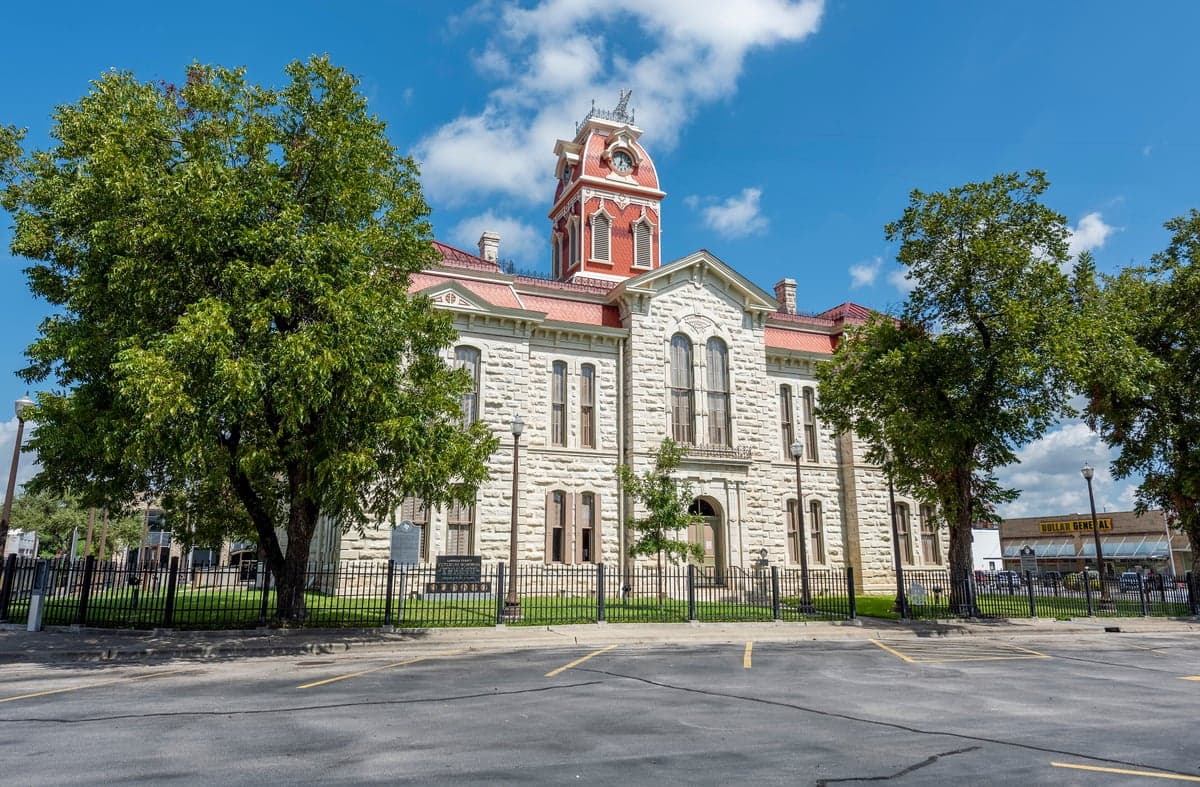
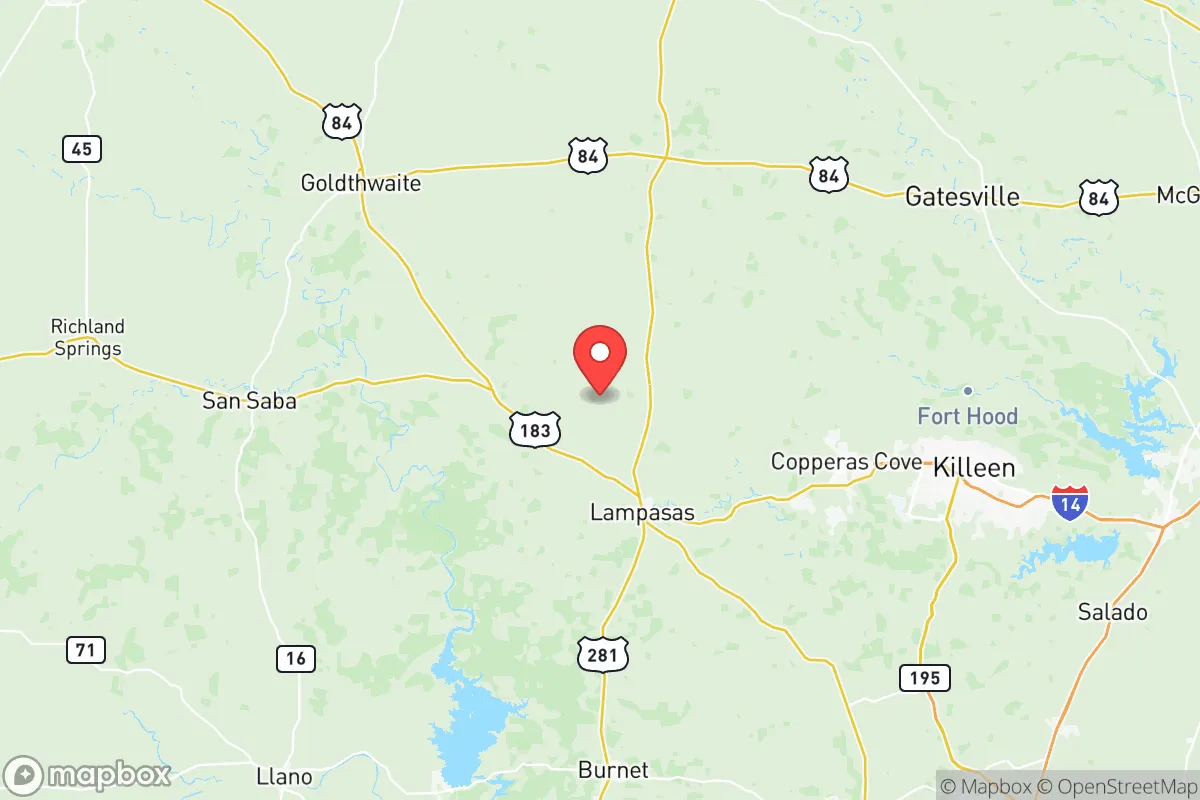
Lampasas County is a deeply conservative stronghold, carrying a Cook Partisan Voting Index of R+22, which makes it one of the most reliably Republican counties in Texas. That R+22 rating means the county votes about 22 points more Republican than the national average, a stark contrast to Texas as a whole, which sits at R+4. This isn't a recent shift; the county has been solidly red for decades, and if anything, the rural precincts have only hardened in their GOP allegiance since the 2020 election. The county seat, Lampasas, is the only real population center, and while it's still overwhelmingly conservative, you'll find a slightly more moderate streak there, especially among the small but growing number of remote workers and retirees moving in from Austin and Dallas. The unincorporated communities like Lometa and Adamsville are where the vote margins get truly lopsided, often exceeding 80% Republican in local races.
How it compares
To understand the scale of the difference, consider that Texas statewide races are often competitive—Republicans typically win by 5-10 points in a good year. In Lampasas County, a Republican candidate can expect to win by 30 to 40 points. The R+22 PVI reflects that reality. The county's politics are much closer to the neighboring rural counties of Burnet and San Saba than to the state's urban centers. There are no swing precincts in the traditional sense; the closest thing to a competitive area is the city of Lampasas itself, where Democratic candidates might pull 30-35% of the vote in a presidential election, largely from the small professional class and a handful of younger transplants. But even that is a far cry from the statewide average. The county's trajectory is actually moving further right, not moderating, as the rural population ages and the small urban liberal influence is diluted by the sheer size of the surrounding ranch and farm country.
What this means for residents
For conservative residents, life is politically comfortable. Local government, school boards, and county commissions are uniformly Republican, and policy debates tend to center on property taxes, water rights, and maintaining rural infrastructure rather than culture war issues. For liberal residents, it means being a clear minority. There is no organized Democratic party presence in the county, and social or political events that lean left are rare. That said, the community is generally live-and-let-live on a day-to-day basis; people are neighborly regardless of party registration. The practical effect is that local elections are often decided in the Republican primary, which is where the real political action happens. Turnout in the general election is high, but the outcome is never in doubt.
Culturally, the county's politics translate into a strong preference for local control and limited regulation. You see this in the relaxed approach to land use, the lack of public transit, and the general skepticism of state or federal mandates. The county has a proud independent streak—it was a center of the "Texas Patriot" movement in the 2010s—but that's tempered by a practical conservatism that values low taxes and minimal government above all else. For anyone moving here, the key takeaway is simple: if you're conservative, you'll find your views reflected in every level of government. If you're not, you'll find a polite but firm majority that doesn't see much need to change. The trajectory suggests this dynamic will only intensify as the county's population grows slowly but remains overwhelmingly rural and Republican.

State Political ClimatePolitical Climate in Texas
State Political AnalysisPolitical Environment in the State
Texas has been a reliably Republican state for the past three decades, with a Cook Partisan Voting Index of R+4, but the political reality on the ground is far more nuanced than that single number suggests. The state’s dominant coalition is a mix of rural conservatives, suburban moderates, and a growing number of business-focused libertarians, but the 10-20 year trajectory shows a slow but steady shift toward competitiveness. In 2024, Donald Trump won Texas by about 9 points, down from 11 points in 2020 and 16 points in 2016, driven largely by explosive growth in the Democratic-leaning suburbs of Houston, Dallas, and San Antonio, while rural and exurban areas have only hardened their Republican margins.
Urban vs. rural divide
The political map of Texas is a study in contrasts. The major metros — Houston, Dallas-Fort Worth, San Antonio, and Austin — are the engines of Democratic growth. Harris County (Houston) and Dallas County have both flipped from red to solid blue over the past decade, while Bexar County (San Antonio) and Travis County (Austin) are deep blue strongholds. Meanwhile, the vast rural stretches of West Texas, the Panhandle, and East Texas remain overwhelmingly Republican. The most interesting battlegrounds are the fast-growing suburban counties that ring these cities: Collin County (north of Dallas), Denton County, and Fort Bend County (southwest of Houston) are shifting from reliably red to purple, with Collin County voting for Trump by only 10 points in 2024 after giving him 18 points in 2016. In contrast, the Rio Grande Valley — historically Democratic — has moved sharply right, with counties like Starr and Zapata flipping to Trump in 2024, driven by conservative Hispanic voters and a backlash against border policy.
Policy environment
Texas’s policy environment is defined by a low-tax, low-regulation posture that appeals to conservative relocators. There is no state income tax, which is a major draw, and property taxes are high (among the top 10 in the nation) to compensate. The state’s regulatory climate is business-friendly, with minimal zoning in many areas and a right-to-work law that limits union power. Education policy is a flashpoint: the state uses a school voucher-like program (the Texas Education Savings Account program, passed in 2023) that allows parents to use public funds for private or homeschool expenses, though it remains capped and controversial. Healthcare is a mixed bag — Texas has the highest uninsured rate in the country (around 17%), as it has not expanded Medicaid under the Affordable Care Act. Election laws have tightened: Senate Bill 1 (2021) restricted mail-in voting, added ID requirements, and banned 24-hour and drive-through voting, while also empowering partisan poll watchers. For a conservative relocator, the tax and regulatory environment is a clear plus; for a liberal one, the lack of a safety net and restrictive voting laws are significant drawbacks.
Recent policy direction
The last five years have seen Texas push aggressively on a range of liberty-related issues. On gun and self-defense law, the state enacted permitless carry (HB 1927) in 2021, allowing most adults to carry a handgun without a license or training — one of the most permissive regimes in the country. Parental and education rights were central to the 2023 legislative session, with the passage of the “Parental Bill of Rights” (SB 1515), which requires schools to notify parents of curriculum changes and medical services, and the “Save Women’s Sports Act” (SB 15), banning transgender athletes from female school sports. On speech and privacy, Texas passed HB 20 in 2021, which restricts social media platforms from moderating content based on viewpoint — a law currently tied up in court. Medical and bodily autonomy saw a dramatic shift: after the 2022 Dobbs decision, Texas triggered a near-total abortion ban (SB 8, the “Heartbeat Act,” and HB 1280), with no exceptions for rape or incest, and a unique private enforcement mechanism that allows anyone to sue violators. Property rights remain strong, with no state-level rent control and limited eminent domain use, though the Texas Railroad Commission’s regulation of oil and gas can affect mineral rights. Taxation remains static — no income tax, but property tax rates are a perennial legislative fight, with a 2023 law (SB 2) compressing school tax rates by using a $12.7 billion surplus. Voting and ballot access have tightened, as noted, with SB 1 making it harder to vote by mail and adding criminal penalties for election officials who send unsolicited mail-in ballot applications.
Civil unrest & political movements
Texas has seen its share of political flashpoints. The 2020 Black Lives Matter protests in Austin, Houston, and Dallas were large and occasionally violent, leading to a state-level crackdown on protest funding (HB 9, 2021, which made it a felony to donate to riot-related activities). Immigration politics are a constant, visible issue: Governor Greg Abbott’s Operation Lone Star (2021-present) deployed state troopers and National Guard to the border, bused migrants to Democratic-led cities like New York and Chicago, and installed razor wire and buoys in the Rio Grande — a policy that has drawn lawsuits from the Biden administration. Secession and nullification rhetoric is more fringe than mainstream, but the Texas Nationalist Movement (TNM) has a vocal presence, and a 2024 GOP primary ballot proposition asking whether Texas should secede from the U.S. passed among Republican voters (though it’s non-binding). Election integrity controversies have been a persistent theme since 2020, with Republican officials pushing for audits and purges of voter rolls, while Democrats argue these efforts suppress turnout. A new resident will notice the heavy law enforcement presence along the border if they live in or travel through the Rio Grande Valley, and the omnipresent political signage in suburban yards — a reflection of a deeply engaged, polarized electorate.
Projection
Over the next 5-10 years, Texas is likely to become more competitive at the statewide level, but not necessarily blue. The key demographic driver is in-migration: roughly 1,000 people move to Texas every day, many from California and the Northeast, and they tend to be younger, more diverse, and more moderate than the existing population. The suburbs of Fort Bend, Collin, and Denton counties will continue to shift toward Democrats, while the Rio Grande Valley’s rightward move could offset some of those gains. The state’s Republican majority in the legislature is safe for now, thanks to gerrymandered maps, but the margin will shrink. A relocator moving in now should expect a decade of political trench warfare — fights over school funding, property taxes, abortion access, and voting laws will intensify. The state’s economic growth will remain a powerful draw, but the political climate will feel increasingly like a battleground, especially in the suburbs where the fight for control of the legislature will be decided.
For a new resident, the bottom line is this: Texas offers a low-tax, high-freedom environment for conservatives, with a government that actively champions gun rights, parental control in education, and limited regulation. For liberals, the state is a frustrating place where their votes are diluted by gerrymandering, their social priorities are blocked, and their rights on issues like abortion and voting are sharply restricted. The practical takeaway is that Texas is not a monolith — your experience will depend heavily on whether you settle in a blue city like Austin, a purple suburb like Frisco, or a red small town like Lubbock. The political climate is real, visible, and likely to get more contentious, but the state’s sheer size and diversity mean you can find a community that fits your values, even if the state government doesn’t.
* Values derived from national, state, county, city and local statistics and may differ in a specific area. Last updated: 2026-06-15T14:30:26.000Z
Narrative content on this page is AI-generated and may contain mistakes. Verify any details that matter before acting on them.
ReloMaps may earn a commission from affiliate links at no extra cost to you.

