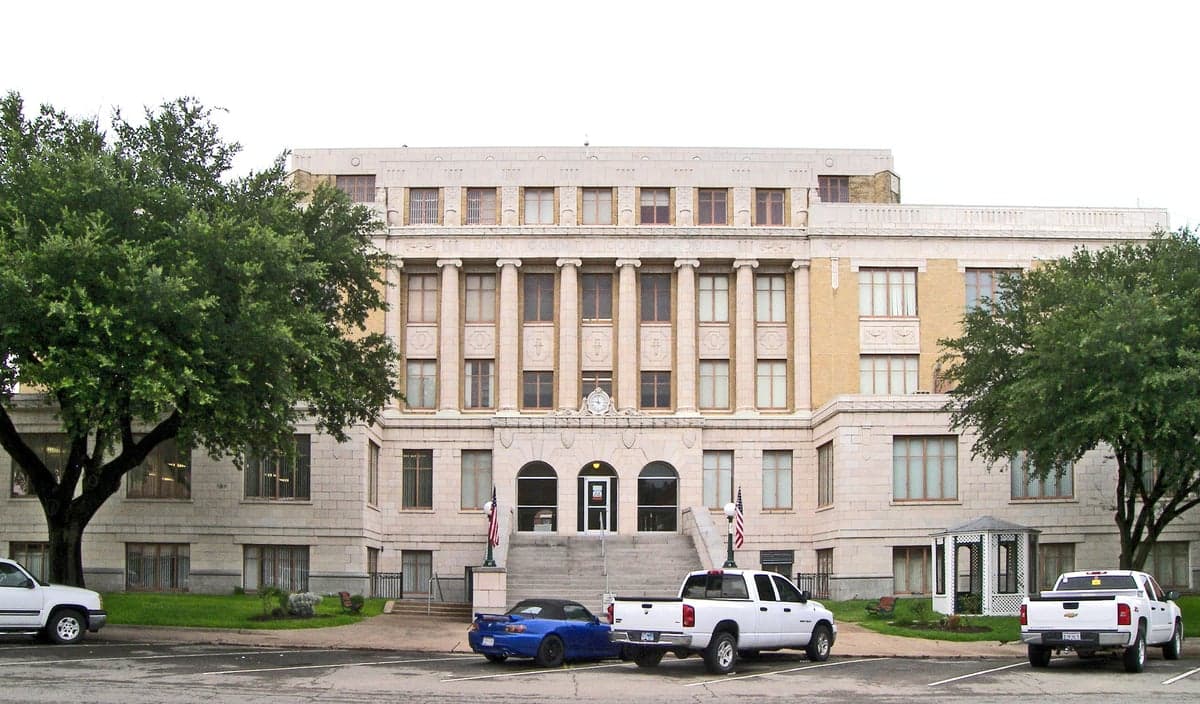
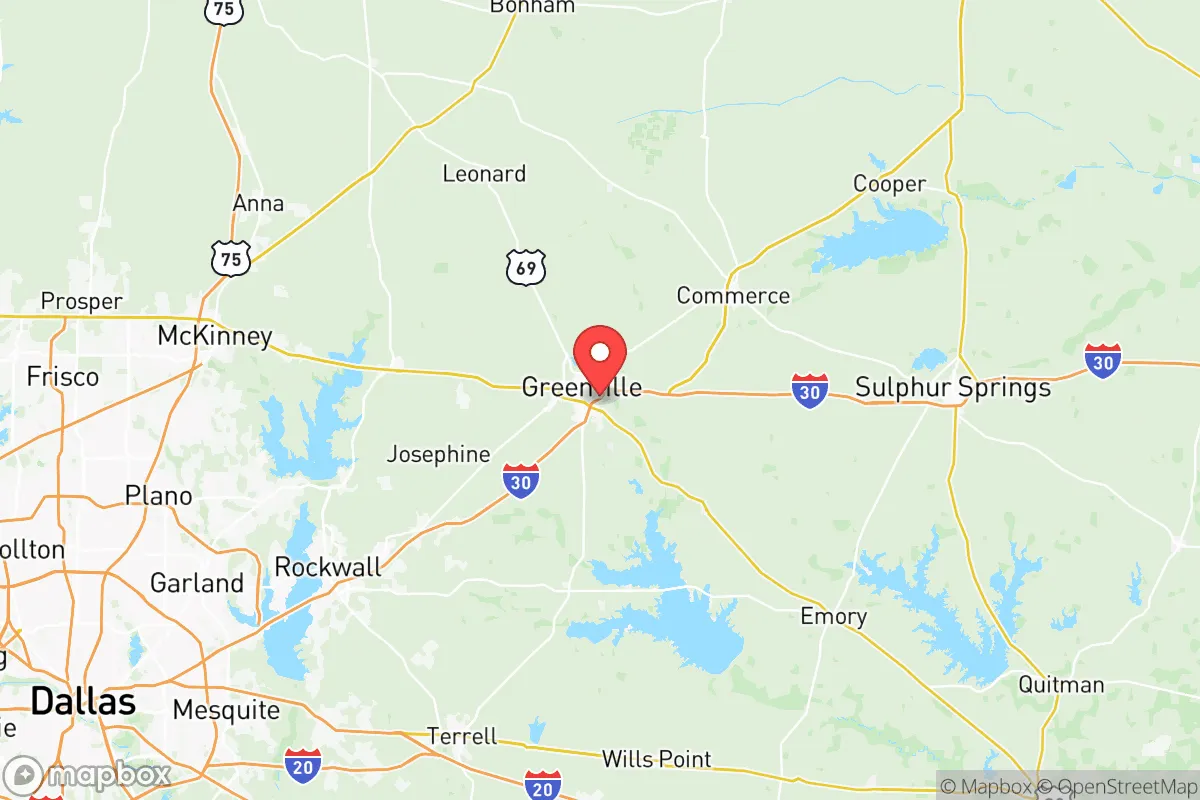
Photo: Wikipedia
Political ClimatePolitical Climate in Hunt County
Showing district-level results — no local-only data available.
Local Political AnalysisPolitical Analysis of Hunt County
Hunt County leans solidly Republican, with a Cook Partisan Voting Index of R+10 — a full six points redder than Texas as a whole (R+4). That margin has widened over the past decade as conservative-leaning suburbanites from the Dallas‑Fort Worth metroplex push east into exurban towns like Caddo Mills, Royse City, and Quinlan, while the county’s own rural character and evangelical base keeps local elections safely in GOP hands. At the same time, a handful of precincts in Greenville’s historic core and around Commerce (home to Texas A&M University–Commerce) consistently vote blue, giving Democrats a visible but small foothold.
How it compares
Relative to Texas’s R+4 statewide PVI, Hunt County is about half again as Republican. In 2024, the county gave Donald Trump roughly 73% of the vote, while the state overall landed near 56%. The gap is most pronounced in the rural precincts southwest of Greenville, where margins can exceed 8-to-1 Republican. By contrast, precincts inside the Greenville city limits — especially near downtown and the west side — can flip within 5–8 points of each other, and the student-heavy wards around Commerce University have delivered Democratic margins of 15–20 points in the last two presidential cycles. Growing exurban subdivisions in Royse City (which abuts Rockwall County) and West Tawakoni are pulling the county even further right, as new arrivals tend to be conservative families priced out of Dallas County. The result is a county that is not just redder than the state, but getting redder faster — a trend that shows no sign of reversing as long as North Texas exurban growth continues.
What this means for residents
For conservative residents, Hunt County politics feel like home. County commissioners, the sheriff, most municipal councils, and school board majorities are reliably Republican. Tax policy is consistently low — the county’s property tax rate is among the lowest in the region — and Second Amendment protections enjoy broad support. Local Republican primaries are the de facto general election, so engaging in precinct meetings and grassroots GOP clubs is where real decisions get made. For liberal residents, the political scene can feel isolating, but it’s not impossible. Greenville and Commerce offer visible Democratic organizations, and the university provides a natural gathering space for progressives. Statewide offices (like the governor or attorney general) are a lost cause locally, but federal races and local city council seats in Greenville’s central precincts are occasionally competitive — one Democrat even won a Greenville city council seat in 2023. The main practical challenge is representation: because the county’s state house and senate districts are solidly R+10 or higher, Democratic voters have little say in those seats.
Culturally, Hunt County stands out from the state’s major metro areas by being visibly more religious and gun-friendly — church-affiliated political groups carry real weight, and open-carry laws are exercised without comment. The county’s small‑town ethos also translates into a distrust of state and federal mandates, whether on COVID restrictions or energy regulations, which makes local politics unusually focused on property rights and personal liberty. At the same time, the steady inflow of DFW exurbanites is slowly diversifying the county’s politics: younger families in McLendon‑Chisholm and Fate (a fast-growing city straddling the Rockwall line) are less reliably Republican than longtime native voters, and a few precincts there have shifted from 80% GOP to around 65% in a single decade. Long‑term, expect Hunt County to remain solidly red, but with a widening suburban fringe where races could become mildly competitive — a shift that will make local primaries even more consequential than they already are.

State Political ClimatePolitical Climate in Texas
State Political AnalysisPolitical Environment in the State
Texas has been a reliably Republican state for the past three decades, with a Cook Partisan Voting Index of R+4, but the reality on the ground is far more nuanced than a single number suggests. The GOP has dominated statewide elections since the 1990s, but the margin of victory has been shrinking: Donald Trump won the state by 9 points in 2016, by 5.6 points in 2020, and by roughly 4.5 points in 2024. The long-term trajectory is a slow but steady shift toward competitiveness, driven by explosive growth in the urban crescent from Dallas-Fort Worth down through Austin to San Antonio and Houston, while rural and exurban areas have hardened their Republican lean.
Urban vs. rural divide
The political map of Texas is a story of three distinct worlds. The major metros — Harris County (Houston), Dallas County, Travis County (Austin), Bexar County (San Antonio), and El Paso County — are solidly Democratic and growing fast. Harris County alone added over 600,000 residents between 2010 and 2020, and it now votes Democratic by double digits. Meanwhile, the vast rural expanse — the Panhandle around Amarillo and Lubbock, East Texas piney woods, and the Hill Country west of I-35 — votes Republican by margins of 60 to 80 percent. The real battleground is the suburban ring counties: Collin, Denton, Tarrant, Fort Bend, Williamson, and Hays. These were once reliably red, but they've been trending purple or even blue in recent cycles. Tarrant County (Fort Worth) flipped to Biden in 2020 after decades of GOP dominance, and Collin County (Plano, Frisco) went from +29 R in 2012 to +11 R in 2024. The political future of Texas hinges on whether these suburbs continue their leftward drift or stabilize as center-right strongholds.
Policy environment
Texas operates with a light regulatory touch and no state income tax, funded instead by high property taxes and a 6.25% state sales tax (local options can push it over 8%). The state's policy posture is aggressively conservative on most fronts: it is a "constitutional carry" state (permitless carry since 2021), has some of the nation's strictest abortion laws (a near-total ban with no exceptions for rape or incest, effective September 2021), and has enacted a series of election integrity measures (SB 1 in 2021 tightened ID requirements, limited drive-through voting, and restricted mail-in ballot access). Education policy has been a flashpoint: the 2023 school voucher bill (SB 2) failed in the House due to rural Republican opposition, but Governor Greg Abbott has made it his top priority for 2025. Healthcare remains a gap: Texas has the highest uninsured rate in the country (around 17%), having refused Medicaid expansion under the ACA. For a relocator, the practical trade-off is clear: lower taxes and fewer regulations on business and property, but less public investment in services and a more restrictive social environment.
Recent policy direction
The last five years have seen Texas double down on conservative governance while also opening new fronts. On gun and self-defense law, the 2021 permitless carry law (HB 1927) means any adult who can legally possess a firearm can carry it openly or concealed without a license. On parental and education rights, the 2023 "Parental Bill of Rights" (HB 900) restricted library content and required parental consent for certain health services, while a 2023 law banned diversity, equity, and inclusion (DEI) offices at public universities. On speech and privacy, the 2021 social media law (HB 20) attempted to prevent platforms from moderating content based on viewpoint, though parts have been blocked by courts. On medical and bodily autonomy, the abortion ban is the headline, but Texas also passed a 2023 law restricting gender-affirming care for minors (SB 14). On property rights, the state has strong eminent domain protections and no state-level rent control, but property taxes remain a perennial complaint — the 2023 session cut school property tax rates by roughly 15 cents per $100 valuation (SB 2). On voting and ballot access, SB 1 (2021) remains the law of the land, with stricter ID rules and a ban on 24-hour and drive-through voting. The overall direction is toward a more assertive state government that preempts local ordinances (on everything from fracking bans to sanctuary city policies) and prioritizes individual liberty in economic and self-defense matters while restricting it on social and medical issues.
Civil unrest & political movements
Texas has seen its share of political flashpoints. The 2021 "Winter Storm Uri" blackouts sparked protests over grid reliability, leading to a political realignment where energy policy became a kitchen-table issue. Immigration politics are a constant: Governor Abbott's Operation Lone Star (launched 2021) deployed state troopers and National Guard to the border, bused migrants to Democratic-led cities, and installed razor wire along the Rio Grande — drawing lawsuits from the Biden administration and creating a visible, ongoing confrontation. The 2023 "sanctuary city" law (SB 4) allows state police to arrest people suspected of illegal entry, though it's been tied up in court. On the left, grassroots movements like the Texas Democratic Party's "Texas Turnout" project and the Working Families Party have organized in the suburbs, while on the right, the Texas Nationalist Movement (Texit) pushes for secession, though it remains a fringe idea with no serious legislative traction. Election integrity remains a live issue: the 2020 and 2022 cycles saw Trump and Abbott both claim fraud without evidence, and the 2024 cycle brought new controversies over voter roll purges. A new resident will notice the political polarization in everyday life — yard signs, bumper stickers, and local news coverage that feels like a national proxy war.
Projection
Over the next 5-10 years, Texas is likely to become a true battleground state. The demographic math is relentless: the state adds roughly 400,000 new residents per year, most of them moving to the urban and suburban counties that lean Democratic or are trending that way. The Hispanic population, which makes up 40% of the state, is growing and has been shifting toward Democrats, though not uniformly — the Rio Grande Valley (Hidalgo County) moved right in 2020 and 2024. The key swing group is college-educated white suburbanites, especially women, who have been moving away from the GOP over social issues like abortion and book bans. If current trends hold, Texas could be competitive at the presidential level by 2032 or sooner. However, the state's political infrastructure — gerrymandered congressional maps, voter ID laws, and a deep bench of conservative activists — means the GOP will retain structural advantages even as the popular vote tightens. For a relocator, the practical implication is that the state's politics will become more contested, more volatile, and more nationalized. The days of Texas as a sleepy one-party state are ending.
For someone moving to Texas, the bottom line is that you're entering a state that is politically divided and growing more so. If you're conservative, you'll find a government that largely shares your values on taxes, guns, and social policy, but you'll also see your political dominance eroding year by year. If you're liberal, you'll find vibrant blue cities and a growing coalition, but you'll live under a state government that is actively hostile to many of your priorities. The practical takeaway is to choose your community carefully: Austin and El Paso are deep blue, Lubbock and Midland are deep red, and the suburbs of Dallas, Houston, and San Antonio are the true battlegrounds where the state's future will be decided. Texas rewards those who pay attention to local politics — your city council and school board elections matter more here than in many states, because the state legislature is constantly preempting local control. Come for the jobs and the low taxes, but understand that the political climate is a feature you'll need to navigate, not just a backdrop.
* Values derived from national, state, county, city and local statistics and may differ in a specific area. Last updated: 2026-06-25T12:09:36.000Z
Narrative content on this page is AI-generated and may contain mistakes. Verify any details that matter before acting on them.
ReloMaps may earn a commission from affiliate links at no extra cost to you.

