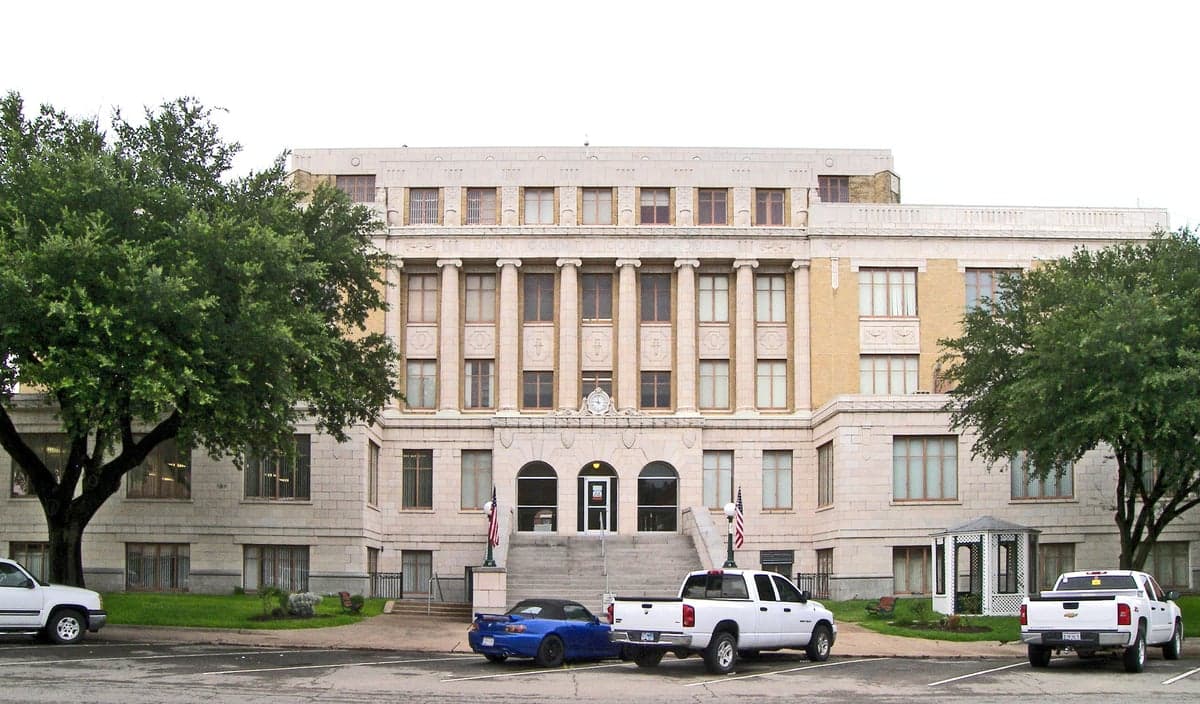
Photo: Wikipedia
Personal Sovereignty in Hunt County
Strong independent fundamentals that actively favor personal liberty and low regulation.
What does Personal Sovereignty tell us?
Personal Sovereignty measures your capacity for self-reliance and independence with minimal government friction. Higher scores mean fewer barriers between you and the way you want to live... but it assumes you have the space you need and good neighbors.
What does this tell us?
Personal Sovereignty measures your capacity for self-reliance and independence with minimal government friction. Higher scores mean fewer barriers between you and the way you want to live... but it assumes you have the space you need and good neighbors.
State Policy
Energy independence: Net exporter (220% of energy produced in-state)
Personal Liberty
Homesteading

Personal Liberty Analysis
Hunt County, Texas, offers a notably high degree of personal sovereignty, grounded in Texas’s broad preemption laws, low state income tax burden, and a deeply ingrained culture of self-reliance. For individuals and families prioritizing autonomy, the county presents a regulatory environment that is generally light-touch compared to urban centers like Dallas or Austin, though specific policies vary between the county’s unincorporated areas and its incorporated cities such as Greenville, Commerce, and Quinlan. The overall atmosphere is one where personal responsibility is expected, and government intervention in daily life is minimal, making it a strong contender for those seeking to maximize personal freedom within a conservative legal framework.
Tax burden and regulatory posture across Hunt County cities
Texas’s lack of a state income tax is a foundational advantage, and Hunt County’s local tax structure reinforces this. The county’s property tax rate is moderate, with the Hunt County tax rate at roughly $0.43 per $100 valuation, but combined city and school district rates push the total effective rate to between 2.0% and 2.5% depending on location. Greenville, the county seat, has a slightly higher combined rate due to its independent school district and city services, while unincorporated areas near Caddo Mills and Lone Oak offer lower overall tax burdens because they lack city property taxes. Regulatory posture is similarly varied: Greenville enforces standard building codes and zoning ordinances, but unincorporated areas have minimal zoning, allowing for greater flexibility in land use. Commerce, home to Texas A&M University-Commerce, has more structured development rules near the campus, but rural tracts in the county’s northern and eastern sections—around Celeste and Campbell—operate under very light county-level regulation. The absence of a county-wide zoning code means that property owners in unincorporated areas can often build, fence, or operate small businesses with fewer bureaucratic hurdles than in incorporated cities.
Self-defense and gun law specifics in Hunt County
Texas’s permitless carry law, effective since 2021, is fully operational in Hunt County, allowing law-abiding adults to carry handguns openly or concealed without a license. Hunt County is a Second Amendment sanctuary county, with a 2021 resolution affirming its commitment to protecting gun rights against state or federal infringement. Local law enforcement, including the Hunt County Sheriff’s Office, is known for a pro-2A stance, and there are no county-level restrictions on magazine capacity, firearm types, or storage requirements beyond state law. In practice, this means that residents in rural areas like Quinlan or West Tawakoni can discharge firearms on private property for target practice or hunting with minimal interference, provided they follow state safety laws. The city of Greenville does have a municipal ordinance prohibiting discharge of firearms within city limits except at approved ranges, but this is standard for urban areas. For those seeking the most permissive environment for self-defense training or firearm use, unincorporated areas near Caddo Mills or Lone Oak offer the greatest latitude, with no local noise or discharge ordinances beyond state statutes.
Self-reliance and homesteading viability: lot sizes, zoning, and off-grid feasibility
Hunt County is highly conducive to homesteading and self-reliant living, particularly in its unincorporated areas. Minimum lot sizes in unincorporated zones are typically 1 to 5 acres, though many rural parcels are sold in 10- to 40-acre tracts, especially near Campbell and Celeste. There is no county-wide zoning that restricts livestock, gardening, or alternative housing such as tiny homes or RVs on owner-occupied land, though individual subdivisions may have deed restrictions. Off-grid feasibility is strong: Texas law does not require connection to municipal water or sewer in unincorporated areas, and private wells and septic systems are standard. Solar panels and rainwater collection are legal and common, with no county-level permitting hurdles beyond standard electrical inspections. The city of Commerce does require connection to city water and sewer within its extraterritorial jurisdiction, but rural properties in Quinlan and West Tawakoni are entirely free from such mandates. For those seeking to minimize reliance on external utilities, the county’s rural eastern and northern sections offer the most flexibility, with abundant land and a regulatory environment that treats self-sufficiency as the default rather than an exception.
Personal liberties: parental rights, medical autonomy, speech, and property
Texas law provides strong protections for parental rights, including the right to direct a child’s education, medical care, and moral upbringing. Hunt County’s school districts—Greenville ISD, Commerce ISD, and Quinlan ISD—generally defer to parental authority on issues like curriculum objections and opt-outs, though specific policies vary. Homeschooling is fully legal and unregulated beyond a simple notice requirement, and the county has a robust homeschooling community, particularly in rural areas. Medical autonomy is supported by Texas’s broad informed consent laws and the absence of state-level vaccine mandates for adults, though employers may set their own requirements. Free speech is protected under the Texas Religious Freedom Restoration Act, and the county has no local ordinances restricting political or religious expression on private property. Property rights are strong: Texas’s private property rights laws limit eminent domain abuse, and Hunt County does not impose rent control or short-term rental bans in unincorporated areas. However, the city of Greenville does regulate short-term rentals through a permitting process, so those seeking maximum property use flexibility should consider rural parcels near Lone Oak or Caddo Mills.
Overall, Hunt County ranks among the more sovereignty-friendly areas in North Texas, offering a balance of low taxes, minimal regulation, and strong legal protections for personal liberties. For context, the county’s regulatory posture is lighter than Collin County to the west, which has more stringent zoning and higher property taxes, but slightly heavier than rural counties further east like Hopkins or Delta. The key differentiator is the choice between incorporated cities—where services come with rules—and unincorporated areas, where personal autonomy is maximized. For a conservative-leaning individual or family seeking a place where self-reliance is respected and government footprint is small, Hunt County’s combination of Texas state law and local culture makes it a compelling option, particularly in its rural townships and unincorporated tracts.

* Values derived from national, state, county, city and local statistics and may differ in a specific area. Last updated: 2026-06-25T12:09:36.000Z
Narrative content on this page is AI-generated and may contain mistakes. Verify any details that matter before acting on them.
ReloMaps may earn a commission from affiliate links at no extra cost to you.

