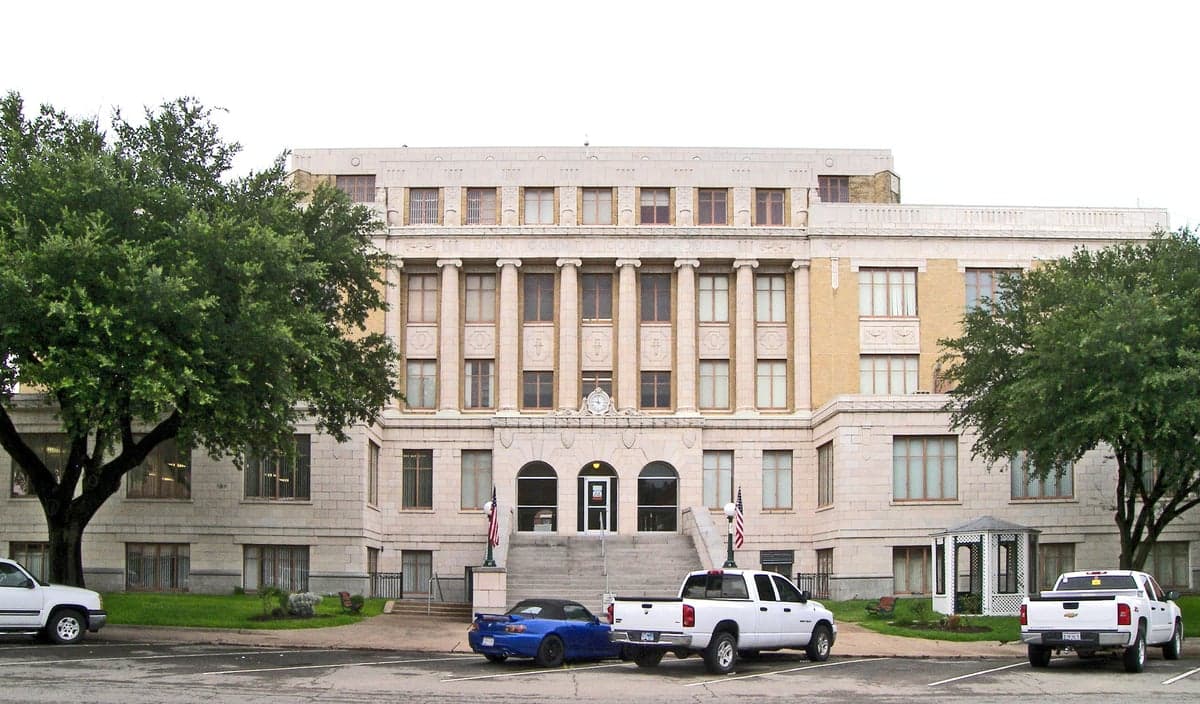
Photo: Wikipedia
Demographics of Hunt County
Affluence Level in Hunt County
A middle-class area roughly in line with national averages across income, home values, education, and employment.
People of Hunt County
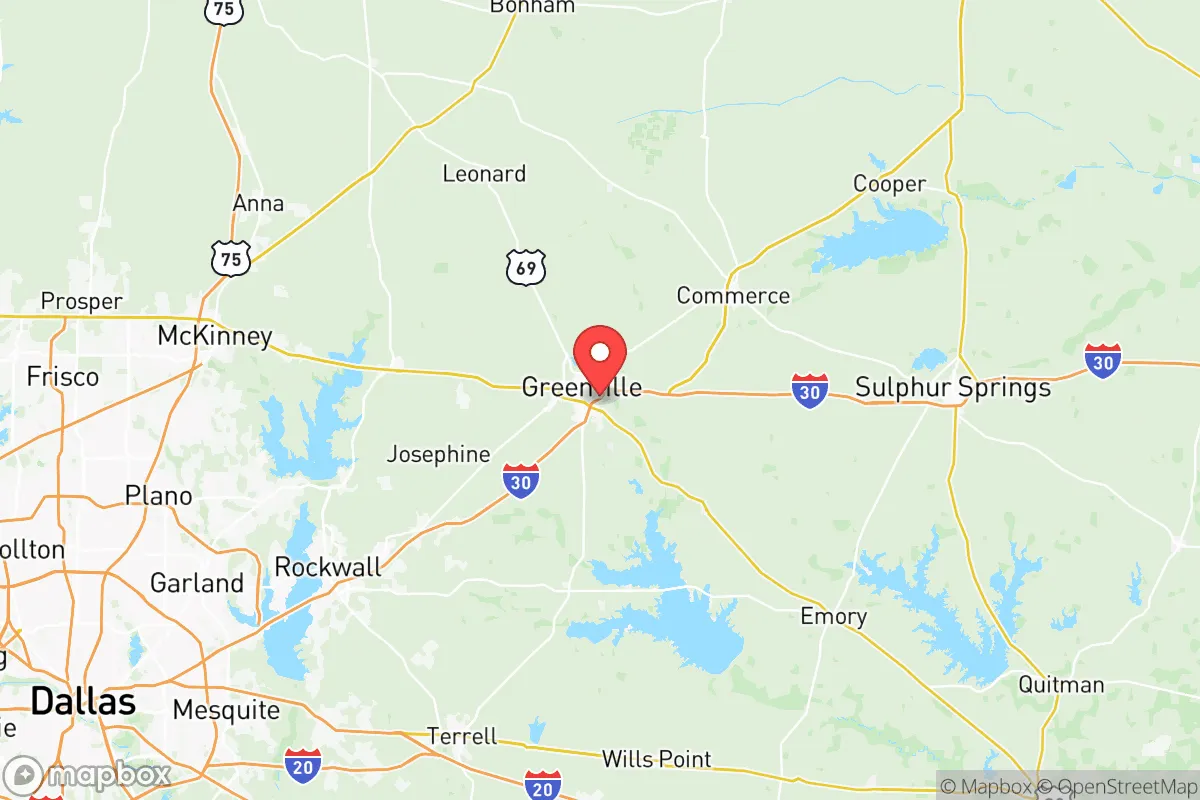
Hunt County, Texas, is home to roughly 105,000 residents, a population that remains predominantly white (66.5%) but is growing more diverse, with a Hispanic community now making up over one in five residents (20.6%) and a Black population of 7.7%. The county’s character is shaped by its rural roots, its role as a bedroom community for the Dallas-Fort Worth metroplex, and a cultural identity that leans conservative, with a strong emphasis on family, faith, and local industry. Unlike the explosive suburban growth seen in neighboring Collin County, Hunt County has experienced a more measured expansion, preserving a small-town feel in its county seat of Greenville and surrounding communities like Commerce and Quinlan.
Settlement & growth (pre-1960)
Before Anglo-American settlement, the area now known as Hunt County was part of the traditional territory of the Caddo Confederacy, particularly the Hasinai and Kichai peoples, who lived in settled agricultural villages along the Sabine River and its tributaries. Spanish and French explorers passed through the region in the 17th and 18th centuries, but no permanent European colonies were established. The land remained sparsely populated by Native groups until the 1830s, when the Republic of Texas began granting land to settlers.
The first major wave of Anglo-American settlers arrived in the 1840s and 1850s, primarily from the Upper South—Tennessee, Kentucky, and Missouri—drawn by cheap land grants under the Texas Pre-emption Act. These were largely Scots-Irish and English yeoman farmers who established small cotton plantations and subsistence farms. The county was formally organized in 1846, and Greenville was platted as the county seat in 1848, quickly becoming the commercial and political hub. The settlers’ descendants still form a significant portion of the county’s white population, particularly in rural areas around Campbell and Caddo Mills.
After the Civil War, the population shifted as freed slaves established their own communities. By 1870, Black residents made up roughly 25% of Hunt County’s population, many working as sharecroppers or tenant farmers on former plantations. The town of Neylandville, founded in the 1870s just south of Greenville, became a thriving all-Black community with its own schools, churches, and businesses. This legacy persists today, with Neylandville remaining a predominantly Black community and a cultural anchor for the county’s African American population.
The arrival of the railroads in the 1880s—the Missouri-Kansas-Texas (Katy) line and the Texas Midland Railroad—spurred a second wave of settlement. Small towns sprang up along the tracks: Commerce (founded 1886) grew around a cotton gin and later East Texas Normal College (now Texas A&M University-Commerce); Lone Oak (1880s) became a shipping point for cotton and timber; and Wolfe City (1880s) attracted a mix of Anglo and German merchants. The cotton boom brought seasonal Mexican migrant workers by the 1910s, but few settled permanently until later decades.
The Dust Bowl and Great Depression of the 1930s sent a wave of displaced farmers—often called “Okies” regardless of their state of origin—into Hunt County, seeking work in cotton fields and the region’s growing timber industry. Many settled in unincorporated areas around Quinlan and West Tawakoni, where land was cheap. World War II brought a military training base to Camp Maxey, just north of Paris, but Hunt County itself saw limited direct impact. The post-war period saw a slow decline in farming as mechanization reduced the need for labor, and many young people left for Dallas and other cities.
Modern era (post-1965)
The 1965 Hart-Cellar Act had a modest effect on Hunt County compared to major urban centers. The county’s foreign-born population remains low at just 4.8%, well below the national average. However, the Hispanic population has grown steadily since the 1970s, driven by domestic migration from South Texas and Mexico, as well as by natural increase. Today, Greenville is home to the largest Hispanic concentration, with a vibrant community centered around Catholic parishes like St. William Catholic Church and a growing number of Mexican grocery stores and restaurants. Smaller Hispanic enclaves have formed in Commerce and Quinlan, where many work in construction, poultry processing, and landscaping.
The Black population, which declined from its post-Reconstruction peak to around 10% by 1970, has stabilized at 7.7% today. The historic community of Neylandville remains a stronghold, but many Black residents have also moved into Greenville and Commerce, drawn by employment at the county’s largest employers—L3Harris Technologies (aerospace) and the Texas A&M University-Commerce campus. The Asian population is very small (0.8% East/Southeast Asian, 0.2% Indian subcontinent), concentrated almost entirely in Greenville, where a handful of Indian and Vietnamese families have settled, often as professionals in engineering or healthcare.
The most significant demographic shift since 1965 has been suburbanization from the Dallas-Fort Worth metroplex. Starting in the 1990s, families seeking cheaper housing and larger lots began moving east along Interstate 30 and Highway 380. Royse City, on the western edge of Hunt County, has seen explosive growth, its population jumping from under 3,000 in 2000 to over 13,000 by 2020. This influx is overwhelmingly white and Hispanic, with a smaller number of Black and Asian families. The newcomers tend to be younger, more educated, and more politically moderate than the county’s long-term residents, creating a cultural tension between rural traditionalists and suburban commuters.
The future
Hunt County is projected to become more diverse over the next 10-20 years, driven primarily by Hispanic population growth and continued suburban spillover from the Dallas-Fort Worth area. The Hispanic share is likely to rise from 20.6% to 25-30% by 2040, as younger families have more children and new arrivals from Texas’s Rio Grande Valley and Mexico settle in Greenville and Royse City. The Black population is expected to remain stable or grow slightly, while the Asian population may increase modestly as professionals are drawn to the expanding healthcare and education sectors.
The county’s cultural identity is evolving. The old rural Anglo-Protestant majority is shrinking, but the conservative political character remains strong, as many Hispanic and Black residents also hold socially conservative views. The biggest change is geographic: growth is concentrating in the western half of the county, particularly along the I-30 corridor from Royse City to Greenville, while the eastern towns like Wolfe City and Celeste are likely to remain small and predominantly white. The county is becoming less isolated and more integrated into the Dallas-Fort Worth economy, but it is not becoming a liberal enclave—rather, a more diverse version of its conservative self.
For someone moving in now, Hunt County offers a lower-cost, slower-paced alternative to the booming suburbs of Collin and Denton counties, with a population that is increasingly varied in background but still united by a shared emphasis on family, community, and traditional values. The key question for newcomers is whether they are comfortable with a place that is changing—becoming more suburban and more diverse—while still holding onto its rural, conservative roots.

* Values derived from national, state, county, city and local statistics and may differ in a specific area. Last updated: 2026-06-25T12:09:36.000Z
Narrative content on this page is AI-generated and may contain mistakes. Verify any details that matter before acting on them.
ReloMaps may earn a commission from affiliate links at no extra cost to you.

