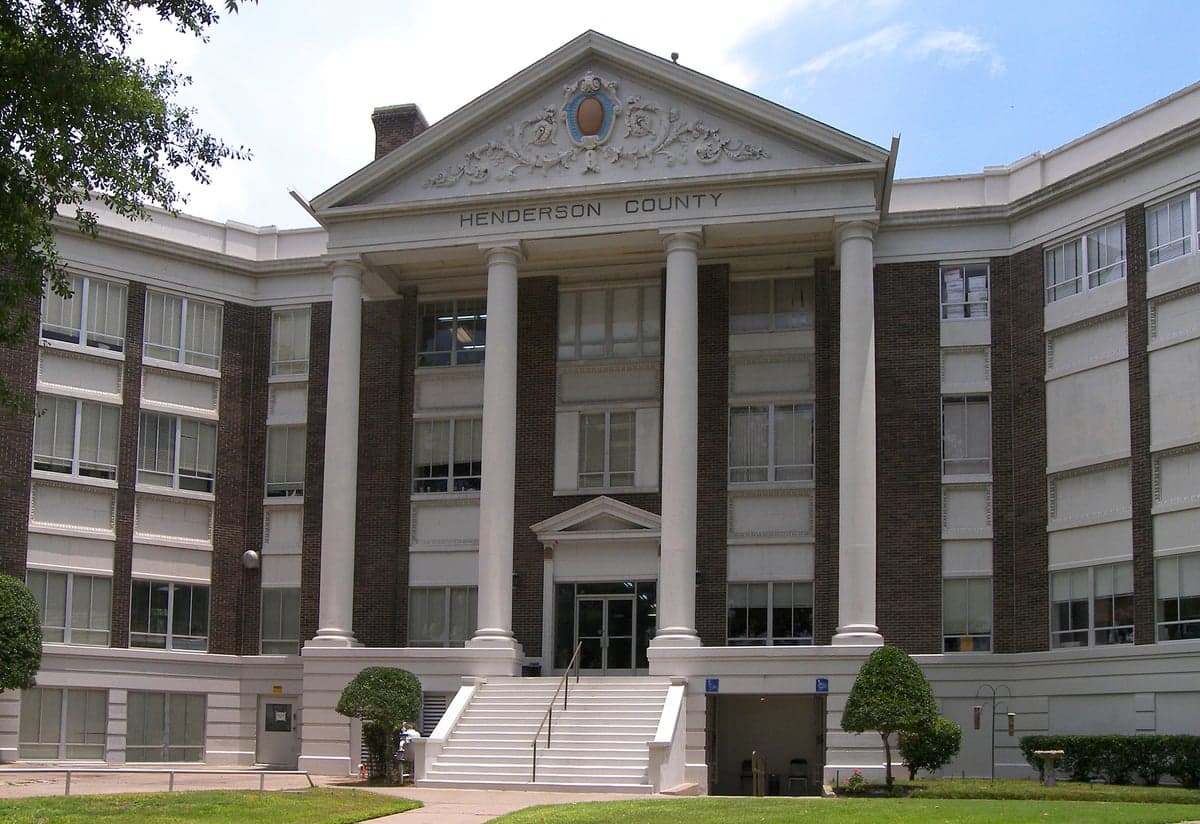
Photo: Wikipedia
Political ClimatePolitical Climate in Henderson County
Showing county-level results — no local-only data available.
Lean and PVI are calculated from this county’s 2020 and 2024 presidential results, Cook-style.
Political rankings in Texas
- Most Conservative Cities in Texas
- Most Liberal Cities in Texas
- Best Liberal-Leaning Towns in the South
- Safest Liberal-Leaning Towns in the South
- Safest Conservative-Leaning Towns in the South
- Affordable Small Towns for Conservatives
- Most Affordable Liberal-Leaning Small Towns in the U.S.
- Safest Conservative-Leaning Cities in the U.S.
- Most Conservative Counties in Texas
- Most Liberal Counties in Texas
Local Political AnalysisPolitical Analysis of Henderson County
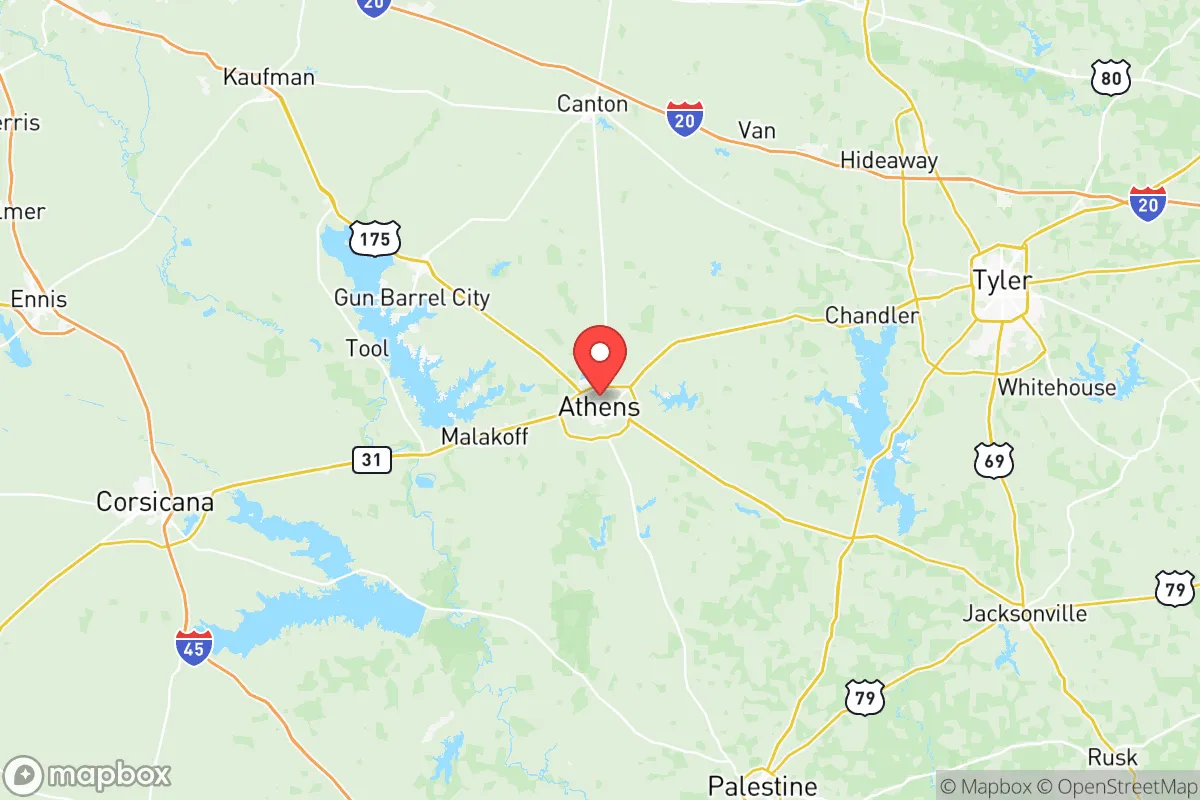
Henderson County, Texas, is a reliably Republican stronghold with a Cook Partisan Voting Index (PVI) of R+13, meaning it votes about 13 points more Republican than the national average. This isn't a recent shift; the county has been solidly red for decades, though the margin has tightened slightly in presidential races since 2016 as suburban precincts around Athens and Gun Barrel City have become more competitive. The county's political center of gravity remains firmly conservative, but the growing exurban population from the Dallas-Fort Worth metroplex is slowly introducing more moderate and even a few blue-leaning pockets, particularly in the western parts near Tool and Seven Points.
How it compares
Compared to Texas as a whole, Henderson County is noticeably more conservative. While statewide Texas has a Cook PVI that is also Republican-leaning (estimated around R+5 to R+6 in recent cycles), Henderson County's R+13 places it in the top 20% of the state's most Republican counties. The biggest difference is in the suburbs: in the 2024 election, Athens (the county seat) voted about 68% Republican, while Gun Barrel City and Seven Points were closer to 60-62% Republican — still red, but with a noticeable 6-8 point gap from the rural precincts. The deep-red rural areas, like Malakoff and Eustace, routinely hit 75-80% Republican. The swing precincts are almost entirely in the western lake communities (Tool, Payne Springs) where new arrivals from Dallas and Tarrant counties have brought more independent and Democratic-leaning voters. Statewide, Texas has large urban Democratic strongholds (Harris, Dallas, Travis counties) that Henderson County simply lacks.
What this means for residents
For conservative residents, the political climate is comfortable and familiar. Local offices — county commissioners, sheriff, school boards — are almost entirely held by Republicans, and policy debates tend to focus on property taxes, rural infrastructure, and Second Amendment rights. Conservative voters here rarely feel their views are out of step with the community. For liberal or moderate residents, the reality is more nuanced. You won't find a Democratic club or a progressive advocacy group with much visibility, but you also won't face open hostility in most settings — the culture is more "live and let live" than confrontational. The practical impact is that liberal residents often drive to Tyler or Dallas for political events or community organizing, and local elections are effectively decided in the Republican primary. The county's trajectory suggests this dynamic will persist for the next decade, though the western lake precincts may continue to shift toward purple as more metro-area commuters settle in.
Culturally, Henderson County's politics are shaped by its rural identity and strong ties to the oil-and-gas and agriculture sectors. There's a palpable skepticism of state and federal mandates, especially around environmental regulations and land use. The county has resisted some state-level housing density proposals, and local zoning debates in Athens and Gun Barrel City often split along "property rights" versus "managed growth" lines — a microcosm of the broader Texas political tension. For anyone moving here, the key takeaway is that the county's R+13 lean is baked into daily life: expect conservative values in local governance, but don't expect a monolithic experience — the lake communities offer a slightly more diverse political mix than the rural interior.

State Political ClimatePolitical Climate in Texas
State Political AnalysisPolitical Environment in the State
Texas has been a reliably Republican state for over two decades, but the margin has been shrinking. In 2024, Donald Trump won Texas by roughly 9 points, down from 11 points in 2020 and 16 points in 2012. The dominant coalition remains a mix of rural conservatives, suburban moderates, and business-oriented fiscal conservatives, but explosive growth in the urban crescent from Dallas-Fort Worth down to San Antonio and Houston is slowly shifting the ground. The state is not flipping blue anytime soon, but it is becoming more competitive, especially in the suburbs that once voted straight-ticket Republican.
Urban vs. rural divide
The political map of Texas is a story of three distinct regions. The big metros — Houston, Dallas, Austin, San Antonio, and El Paso — are the Democratic strongholds. Harris County (Houston) alone delivered over 1 million votes for Biden in 2020, and Travis County (Austin) gave him 71% of the vote. Meanwhile, the rural Panhandle, East Texas, and most of West Texas are deeply Republican. Lubbock and the surrounding South Plains vote Republican by 40-point margins. The real battleground is the suburbs: Collin County (north of Dallas) and Denton County were once reliably red but have shifted purple. In 2024, Collin County voted for Trump by only 8 points, down from 15 points in 2016. Fort Bend County (southwest of Houston) flipped to Biden in 2020 and has stayed competitive. The Rio Grande Valley, historically Democratic, has been trending right — Hidalgo County went from +40 for Clinton in 2016 to +15 for Biden in 2020, and Trump improved his margin there again in 2024. This urban-rural split means that state-level politics are still dominated by rural and exurban voices, but the cities are growing faster.
Policy environment
Texas has no state income tax, which is the single biggest policy draw for relocators. Property taxes are high to compensate — the average effective rate is about 1.6%, among the highest in the nation. The regulatory posture is light-touch: no state-level zoning in most areas, fast permitting for development, and a right-to-work law that keeps union influence low. Education policy is a flashpoint: the state funds schools largely through local property taxes, leading to wide disparities between wealthy suburbs and poorer rural districts. The school voucher debate is ongoing — in 2023, Governor Greg Abbott pushed a universal education savings account program that failed in the House due to rural Republican opposition. Healthcare policy is notably limited: Texas has not expanded Medicaid under the ACA, leaving roughly 1.5 million uninsured adults in the coverage gap. Election laws have tightened: SB 1 (2021) restricted mail-in voting, added ID requirements, and banned 24-hour and drive-through voting. The state also has a permitless carry law (HB 1927, 2021) and a near-total abortion ban (SB 8, 2021, and the trigger law that took effect in 2022).
Recent policy direction
The last five years have seen a sharp rightward shift on social and cultural issues, even as the state's demographics diversify. On gun and self-defense law, Texas now allows permitless carry for anyone 21 or older who can legally possess a firearm, and "stand your ground" protections are broad. On parental and education rights, the 2023 law HB 900 (the "READER Act") required book vendors to rate materials for sexual content, though it was partially blocked by a federal judge. The state also banned diversity, equity, and inclusion (DEI) offices at public universities (SB 17, 2023). On speech and privacy, Texas passed a law (HB 20, 2021) that restricts social media platforms from moderating content based on viewpoint, though it has been tied up in court. On medical and bodily autonomy, the abortion ban is total with no exceptions for rape or incest, and the state has aggressively pursued out-of-state providers who prescribe abortion pills to Texas residents. On property rights, Texas has strong eminent domain protections for landowners, but no statewide rent control (and a preemption law banning local rent control). On taxation, the state has periodically cut property tax rates through compression of school district tax rates, most recently in 2023 with a $12.7 billion package. On voting and ballot access, the trend is toward restriction: SB 1 made it harder to vote by mail and gave partisan poll watchers more access.
Civil unrest & political movements
Texas has seen significant protest activity on both sides. The 2020 George Floyd protests in Austin and Houston were large and occasionally violent, leading to property damage and a police reform debate that ultimately stalled. The "Defund the Police" movement gained traction in Austin briefly, but the city council reversed course after a spike in violent crime. On the right, the "constitutional sheriff" movement is active in rural counties, with sheriffs in places like Montgomery County publicly refusing to enforce certain state or federal gun laws. Immigration politics are a constant flashpoint: Governor Abbott's Operation Lone Star (2021-present) has deployed state troopers and National Guard to the border, bused migrants to northern cities, and installed razor wire and buoys in the Rio Grande. This has led to legal fights with the Biden administration and a humanitarian crisis in border towns like El Paso and Eagle Pass. Secession rhetoric — "Texit" — is a fringe but vocal movement, with the Texas Nationalist Movement pushing for a 2024 primary ballot referendum, though it has no real political traction. Election integrity remains a live issue: the 2020 election saw Trump's legal challenges fail in Texas courts, but the state GOP continues to push for stricter laws, and some counties have seen partisan fights over voting machine security.
Projection
Over the next 5-10 years, Texas will likely remain Republican-controlled at the state level, but the margin will continue to narrow. The key demographic driver is in-migration: roughly 1,000 people move to Texas every day, and they are disproportionately young, diverse, and from blue states. However, many of these newcomers are also fiscally conservative and may not vote as reliably Democratic as the urban cores. The suburbs of Dallas-Fort Worth and Houston will be the decisive battlegrounds. If the state GOP continues to push culturally conservative legislation on abortion, guns, and education, it risks alienating suburban moderates. If the Democratic Party can turn out the growing Latino population in the Rio Grande Valley and the suburbs, the state could become competitive for statewide office by 2030. For now, expect continued Republican control of the legislature and governor's office, with occasional high-profile fights over school funding, property taxes, and border policy. A new resident moving in today should expect a state that is politically stable but increasingly polarized, with the cities getting bluer and the rural areas getting redder.
For a new resident, the bottom line is that Texas offers a low-tax, low-regulation environment that appeals to conservatives and libertarians, but the social policies — especially on abortion and education — are among the most restrictive in the country. If you lean conservative, you will find a state government that largely reflects your values. If you lean liberal, you will find strong communities in the cities and a growing political movement, but you will also face state-level policies that may feel hostile. The practical takeaway: choose your county carefully. A family moving to Collin County will have a very different experience than one moving to Travis County, even though both are part of the same state. The political climate is not monolithic, and the best fit depends on where you land.
* Values derived from national, state, county, city and local statistics and may differ in a specific area. Last updated: 2026-10-28T10:29:14.000Z
Narrative content on this page is AI-generated and may contain mistakes. Verify any details that matter before acting on them.
ReloMaps may earn a commission from affiliate links at no extra cost to you.

