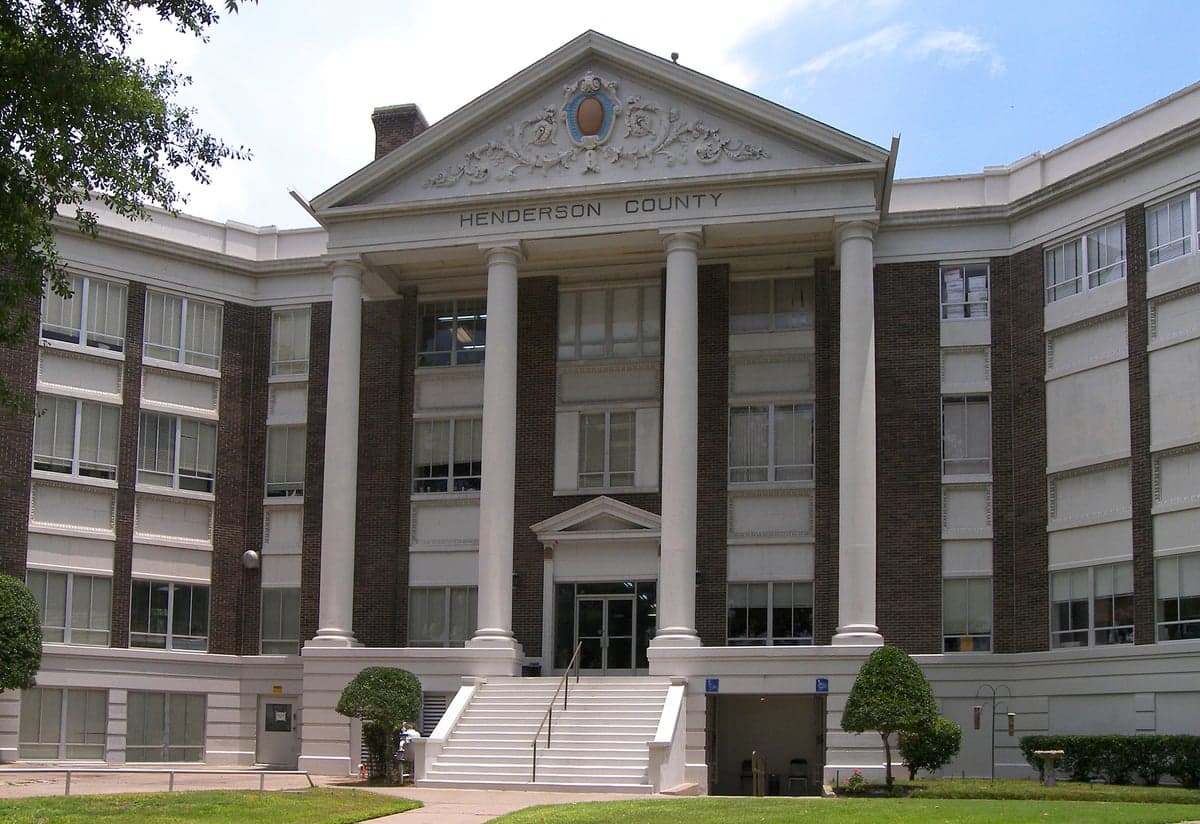
Photo: Wikipedia
Personal Sovereignty in Henderson County
Strong independent fundamentals that actively favor personal liberty and low regulation.
What does Personal Sovereignty tell us?
Personal Sovereignty measures your capacity for self-reliance and independence with minimal government friction. Higher scores mean fewer barriers between you and the way you want to live... but it assumes you have the space you need and good neighbors.
What does this tell us?
Personal Sovereignty measures your capacity for self-reliance and independence with minimal government friction. Higher scores mean fewer barriers between you and the way you want to live... but it assumes you have the space you need and good neighbors.
State Policy
Energy independence: Net exporter (195% of energy produced in-state)
Personal Liberty
Homesteading

Personal Liberty Analysis
Henderson County, Texas, offers a notably high degree of personal sovereignty, grounded in Texas’s strong state-level protections for individual rights and a local culture that favors minimal government intrusion. The county’s regulatory environment is light, its tax burden is among the lowest in the state, and its gun laws are permissive, creating a setting where self-reliance is not just possible but expected. For single individuals and families who prioritize autonomy over convenience, the area presents a compelling alternative to the more restrictive policies found in urban centers like Dallas or Austin, though the degree of freedom varies across its towns and unincorporated areas.
Tax burden and regulatory posture: How Henderson County compares to surrounding areas
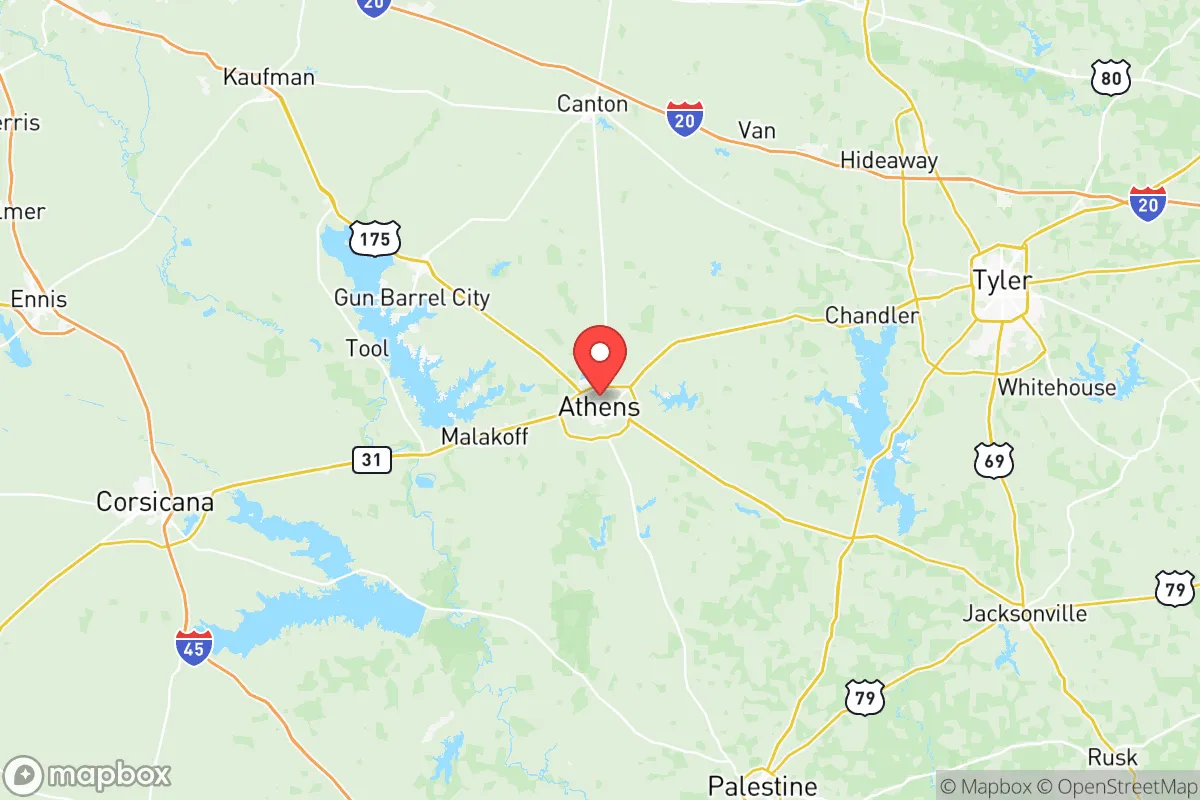
Henderson County’s tax burden is a major draw for those seeking financial autonomy. The county’s property tax rate is approximately 0.65% of assessed value, well below the Texas average of 1.0% and significantly lower than counties in the Dallas-Fort Worth metroplex, where rates often exceed 1.5%. There is no county-level income tax, and sales tax is capped at the state’s 6.25% plus local options, totaling around 8.25% in most areas. The regulatory posture is equally light: there is no countywide zoning in unincorporated areas, meaning property use is largely unrestricted. Towns like Athens (the county seat) and Malakoff have basic building codes and subdivision regulations, but these are minimal compared to cities like Dallas. In contrast, Eustace and Trinidad have almost no local ordinances, allowing residents to operate home businesses, keep livestock, or build structures without extensive permitting. This hands-off approach extends to environmental regulations—the county does not enforce stormwater or tree preservation rules that are common in more urbanized areas—making it easier for property owners to develop land as they see fit.
Self-defense and gun law specifics: What the Castle Doctrine and permitless carry mean locally
Texas’s firearm laws are among the most protective of individual rights in the nation, and Henderson County fully embraces this framework. The state’s Castle Doctrine and Stand Your Ground law apply without local modification, meaning residents have no duty to retreat before using deadly force in self-defense at home, in a vehicle, or anywhere they are lawfully present. Since 2021, permitless carry (also known as constitutional carry) allows any law-abiding adult 21 or older to carry a handgun openly or concealed without a license. Local law enforcement in Athens and Gun Barrel City (whose name reflects the area’s gun-friendly culture) generally do not enforce additional restrictions, and there are no county-level firearm registration or storage mandates. The sheriff’s office in Henderson County is known for issuing licenses to carry (LTCs) efficiently, with a typical turnaround of under 30 days. For those who want to carry in other states, an LTC is still recommended for reciprocity, but within the county, the legal environment is as permissive as it gets in Texas. The only notable restriction is that firearms are prohibited in certain government buildings and schools, per state law, but these are clearly posted and rarely an issue for responsible gun owners.
Self-reliance and homesteading viability: Lot sizes, zoning, and off-grid feasibility
Henderson County is a strong candidate for homesteading and off-grid living, particularly in its rural stretches. Minimum lot sizes in unincorporated areas are typically 1 to 5 acres for residential use, though many parcels are sold in 10- to 40-acre tracts, especially near Poynor and Murchison. There is no countywide zoning, so raising chickens, goats, or even larger livestock is generally unrestricted, provided the property is outside city limits. Off-grid feasibility is high: the county does not require connection to municipal water or sewer systems, and private wells and septic systems are standard. Solar panels and rainwater collection are legal and common, with no permitting hurdles beyond standard electrical work. However, towns like Athens and Chandler have stricter rules—Athens requires a building permit for any structure over 120 square feet, and Chandler enforces a minimum lot size of 0.5 acres within city limits. For those seeking maximum self-reliance, the unincorporated areas around Tool and Seven Points offer the most freedom, with no building codes, no zoning, and minimal county oversight. The main limitation is that the county does enforce Texas’s health and safety codes for septic systems, but these are straightforward and inexpensive to meet.
Personal liberties: Parental rights, medical autonomy, speech, and property
Personal liberties in Henderson County are strongly aligned with conservative values. Parental rights are protected under Texas law, which gives parents broad authority over their children’s education, medical decisions, and religious upbringing. The county has several private and religious schools, and homeschooling is common, with no state registration or curriculum requirements beyond basic subjects. Medical autonomy is similarly robust: Texas does not mandate COVID-19 or other vaccines for adults, and there are no county-level health mandates. The state’s ban on vaccine passports and mask mandates applies locally, and healthcare providers in Athens and Malakoff generally respect patient choice. Free speech is protected by the Texas Religious Freedom Restoration Act and the state’s strong anti-SLAPP laws, which shield residents from frivolous lawsuits over public commentary. Property rights are a cornerstone of the local culture: the county has no rent control, no inclusionary zoning, and no historic preservation ordinances that restrict what owners can do with their land. Eminent domain is rarely used, and when it is, the county follows Texas’s requirement for full market-value compensation. The only notable limitation is that the Texas Open Beaches Act does not apply here (Henderson County is inland), so property rights are as absolute as state law allows.
Overall, Henderson County ranks among the top Texas counties for personal sovereignty, offering a regulatory environment that is lighter than most of the state and far lighter than urban areas. The combination of low taxes, permissive gun laws, off-grid feasibility, and strong protections for parental and property rights creates a setting where individuals and families can live with minimal government interference. While towns like Athens and Chandler impose modest restrictions, the unincorporated areas—particularly around Eustace, Poynor, and Tool—provide near-total autonomy. For those who value self-reliance and are willing to handle their own infrastructure, Henderson County is a strong contender in the broader Texas landscape of freedom-oriented relocation destinations.

* Values derived from national, state, county, city and local statistics and may differ in a specific area. Last updated: 2026-10-28T10:29:14.000Z
Narrative content on this page is AI-generated and may contain mistakes. Verify any details that matter before acting on them.
ReloMaps may earn a commission from affiliate links at no extra cost to you.

