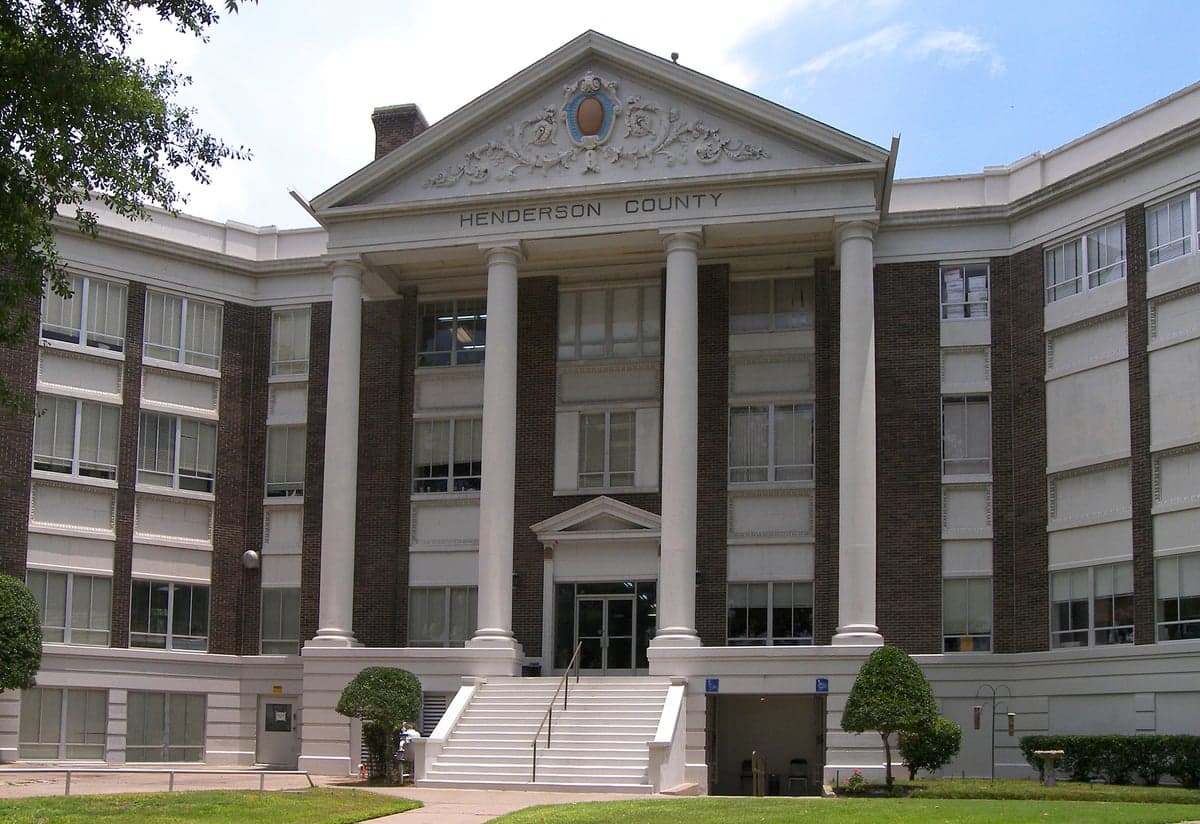
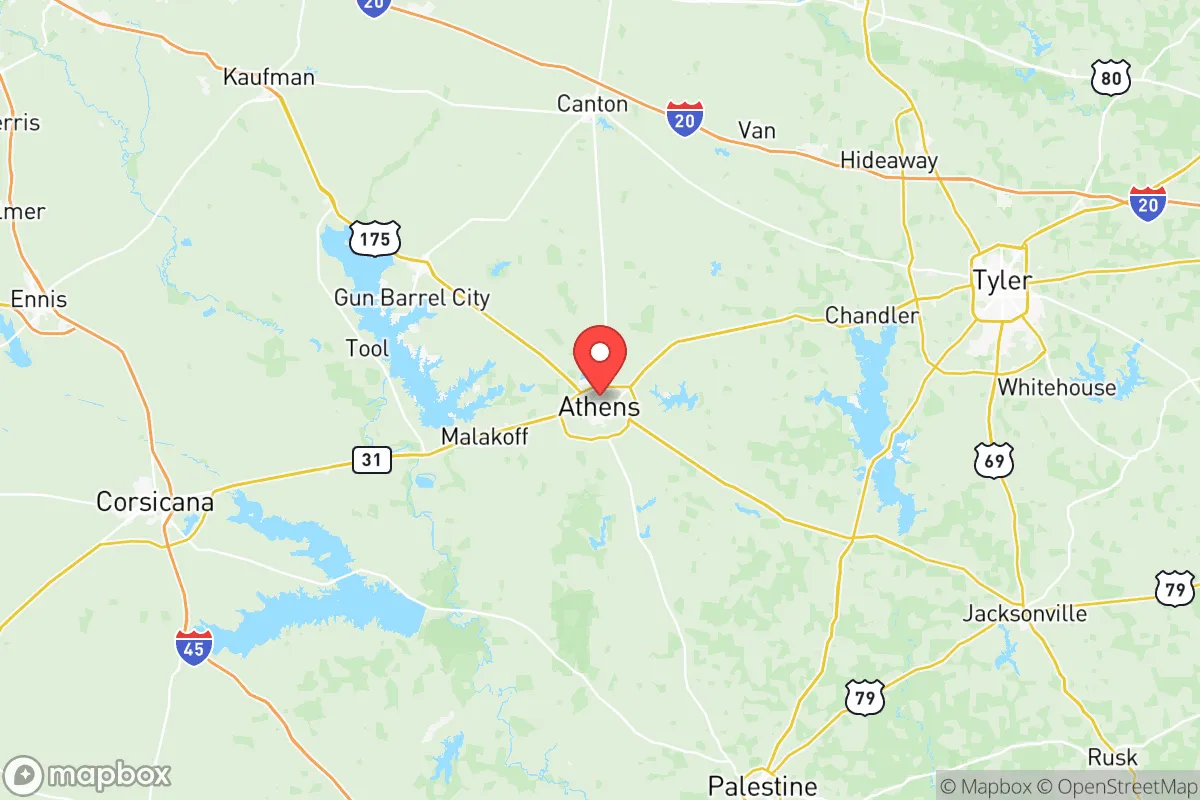
Photo: Wikipedia
Demographics of Henderson County
Affluence Level in Henderson County
A middle-class area roughly in line with national averages across income, home values, education, and employment.
People of Henderson County
Henderson County, Texas, is home to 83,658 residents who overwhelmingly identify as White (75.2%), with a significant Hispanic minority (14.3%) and a smaller Black population (5.3%). The county remains one of the least diverse in the Dallas-Fort Worth metroplex, with a foreign-born share of just 3.0% — far below the state average — and a college attainment rate of only 20.2%. Its people are predominantly native-born, rural-to-suburban in character, and culturally anchored in the Piney Woods traditions of East Texas, with a growing commuter population drawn to the lakes and lower cost of living near Athens, Gun Barrel City, and Mabank.
Settlement & growth (pre-1960)
Before Anglo-American settlement, the area now comprising Henderson County was inhabited by the Caddo Confederacy, particularly the Hasinai and Kadohadacho divisions, who lived in settled agricultural villages along the Neches and Trinity River watersheds. Spanish and French explorers passed through in the 17th and 18th centuries, but no permanent European colonies were established. The region remained a sparsely populated frontier until the Republic of Texas era.
The first major wave of settlers arrived in the 1840s and 1850s, primarily Scots-Irish and English yeoman farmers from the Upper South — Tennessee, Kentucky, Arkansas, and Missouri. They were drawn by headright land grants under the Republic of Texas and later state land policies, which offered cheap acreage for cotton and subsistence farming. These families established the county seat of Athens (founded 1850) and the smaller communities of Murchison, Poynor, and Brownsboro. The county was formally organized in 1846, named after James Pinckney Henderson, the first governor of Texas.
After the Civil War, the population grew slowly but steadily. Freed slaves — roughly 30% of the county’s antebellum population — remained in the area, forming rural settlements and small enclaves in Athens and Malakoff. They worked as sharecroppers and tenant farmers, and their descendants still constitute the core of the county’s Black population today. No significant European immigrant groups (Germans, Czechs, Poles) settled in Henderson County in the 19th century, unlike the Texas Hill Country; the population remained almost entirely native-born White and Black.
The early 20th century brought two transformative economic shifts. First, the discovery of oil in the East Texas Oil Field in 1930 triggered a boom that drew workers from across the South and Midwest. Towns like Malakoff and Eustace saw rapid, chaotic growth as roughnecks and speculators flooded in. Second, the construction of the Trinity River reservoirs — Cedar Creek Reservoir (1965) and Lake Palestine (1962) — created a recreational economy that began attracting retirees and second-home buyers from Dallas, 70 miles to the northwest. By 1960, the county’s population had reached roughly 21,000, still overwhelmingly rural and agricultural in character.
Modern era (post-1965)
The 1965 Hart-Cellar Act had minimal direct impact on Henderson County. Unlike the booming suburbs of Dallas or Houston, the county did not receive significant numbers of post-1965 immigrants. The foreign-born share remains at 3.0%, and the Asian population — East and Southeast Asian communities — is just 0.5%, with an even smaller Indian-subcontinent population of 0.2%. The county’s demographic story since 1965 is not one of international immigration but of domestic migration from the Rust Belt and from within Texas itself.
Beginning in the 1970s and accelerating through the 1990s, retirees and suburban refugees from the Dallas-Fort Worth metroplex moved into lakefront communities on Cedar Creek Reservoir and Lake Palestine. Towns like Gun Barrel City (incorporated 1969), Seven Points, and Tool were essentially created by this wave — built for boating, fishing, and affordable lake living. These newcomers were predominantly White, middle-class, and politically conservative, reinforcing the county’s existing cultural and political character.
Since 2000, the Hispanic population has grown from roughly 8% to 14.3%, driven by both natural increase and migration from South Texas and Mexico. This growth is concentrated in the southern and western parts of the county, particularly around Athens and Mabank, where construction, landscaping, and service-industry jobs have drawn Hispanic workers. The Black population has remained stable at 5.3%, with the largest concentrations in Athens and Malakoff. The county’s overall population has grown by roughly 25% since 2000, but the growth has been slower than in neighboring Kaufman or Van Zandt counties, which are closer to Dallas’s suburban fringe.
The future
Henderson County is projected to become slightly more diverse over the next 10-20 years, but it will remain overwhelmingly White and native-born. The Hispanic share is expected to rise to 18-20% by 2040, driven by higher birth rates and continued migration from the Rio Grande Valley and Mexico. The Asian and Indian populations will likely remain below 2% combined, as the county lacks the high-skilled job base and urban amenities that attract these groups to the Dallas suburbs.
The most significant demographic trend is the continued spillover from the Dallas-Fort Worth metroplex. As housing prices in Collin, Denton, and Rockwall counties push families and retirees outward, Henderson County’s lake communities — especially Gun Barrel City, Mabank, and Seven Points — are absorbing a steady stream of new residents. These newcomers are predominantly White, middle-class, and politically conservative, which will reinforce the county’s existing cultural identity. The county’s population could reach 95,000-100,000 by 2040, but the growth will be dispersed rather than concentrated in a single urban core.
Culturally, Henderson County is likely to remain a conservative, rural-suburban hybrid — more traditional than the fast-growing exurbs to its west, but increasingly connected to the Dallas economy through commuting and second-home ownership. The county’s low college attainment rate (20.2%) and low foreign-born share suggest it will not experience the rapid diversification seen in the DFW core. For a newcomer, this means a community where English is the dominant language, church attendance is high, and the pace of life is slower than in the metroplex — but where amenities like ethnic restaurants, international grocery stores, and cultural diversity are limited.
Henderson County is becoming a quieter, more affordable alternative to the booming Dallas exurbs — a place where the population is slowly diversifying but remains deeply rooted in the Piney Woods traditions of East Texas. For someone moving in now, the county offers a stable, low-crime, family-oriented environment with strong conservative values, but little of the cosmopolitan energy or rapid change found closer to Dallas.

* Values derived from national, state, county, city and local statistics and may differ in a specific area. Last updated: 2026-10-28T10:29:14.000Z
Narrative content on this page is AI-generated and may contain mistakes. Verify any details that matter before acting on them.
ReloMaps may earn a commission from affiliate links at no extra cost to you.

