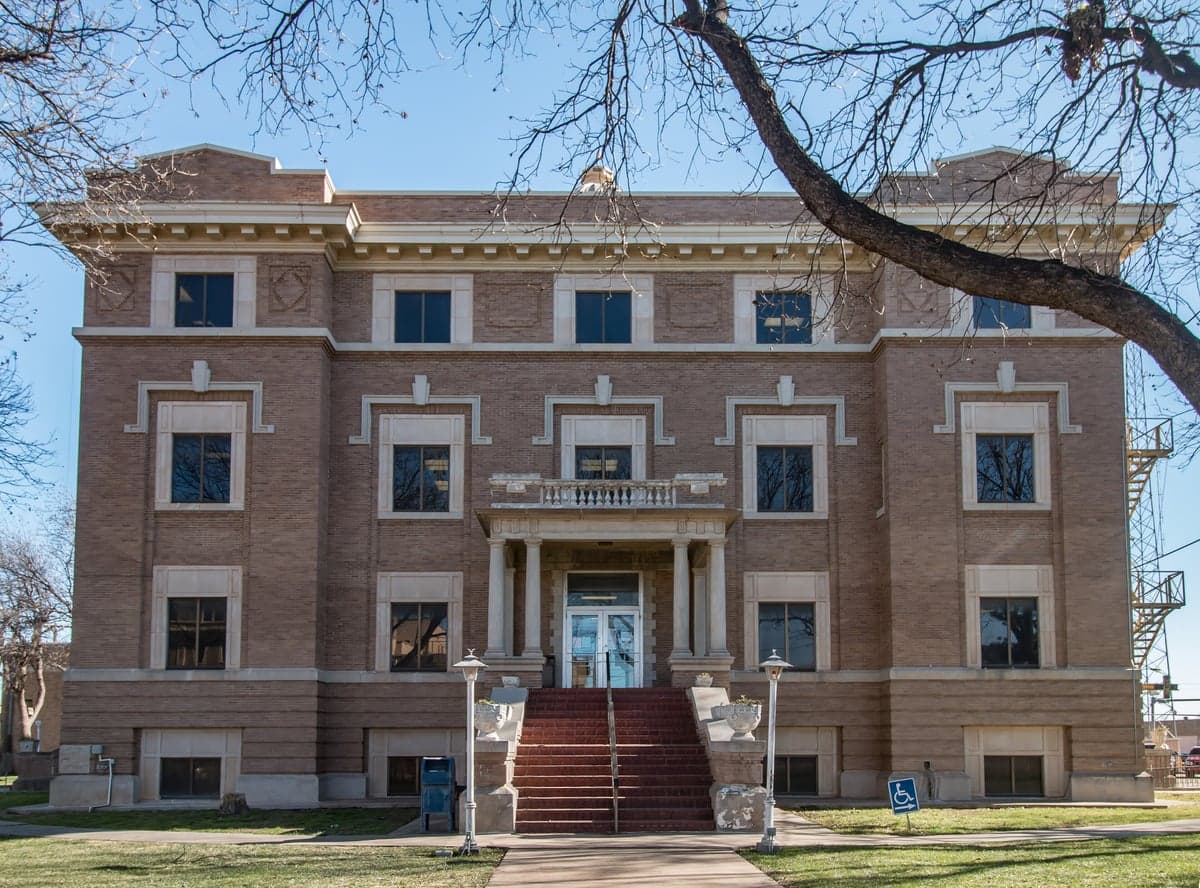
Photo: Wikipedia
Political ClimatePolitical Climate in Hale County
Showing district-level results — no local-only data available.
Local Political AnalysisPolitical Analysis of Hale County
Hale County is one of the most reliably Republican counties in Texas, with a Cook Partisan Voting Index (PVI) of R+25, meaning it votes about 25 points more Republican than the national average. This is a stark contrast to Texas as a whole, which sits at R+4, and the gap has actually widened over the past decade as rural, agricultural communities like Hale County have shifted rightward while the state’s urban centers have become more competitive. The county hasn’t voted for a Democratic presidential candidate since 1964, and in 2024, Donald Trump carried it by a margin of roughly 40 points, a reflection of how deeply entrenched the conservative lean has become.
How it compares
Compared to Texas at R+4, Hale County is in a completely different political universe. The state’s R+4 rating reflects a balance of deep-blue urban cores (Harris, Dallas, Travis counties) and red rural and suburban areas, but Hale County is pure rural red. Within the county itself, there are subtle variations: the city of Plainview, the county seat and largest town, is the most moderate area, with a significant Hispanic population (over 60%) that occasionally produces Democratic-leaning precincts in local races, especially in the southern and eastern parts of town. However, even Plainview’s city council is majority Republican, and the city voted for Trump by about 15 points in 2024. In contrast, the smaller towns of Hale Center, Petersburg, and Kress are overwhelmingly conservative, often voting 80% or more Republican. The swing precincts in the county are almost nonexistent; the only real variation is between shades of red, not between red and blue. The county’s R+25 PVI is a full 21 points more conservative than the state’s overall rating, placing it in the top 10% of the most Republican counties in Texas.
What this means for residents
For conservative residents, the political climate is deeply affirming. Local government, school boards, and law enforcement are reliably aligned with their values, and there is little friction in daily life over political issues. For liberal residents, the reality is more isolating. There is no organized Democratic Party presence in the county, and progressive viewpoints are rarely voiced in public forums like city council meetings or school board hearings. That said, the community is generally polite and non-confrontational; political disagreements are usually avoided in social settings rather than debated. The practical effect is that policy leans heavily toward low taxes (the county’s property tax rate is among the lowest in the state), limited regulation on agriculture and energy, and a strong emphasis on Second Amendment rights. Social issues like abortion and LGBTQ+ rights are rarely discussed publicly, but the prevailing sentiment is culturally conservative.
One cultural distinction worth noting is the role of the Hispanic community, which makes up about 55% of the county’s population. While many Hispanic voters in Hale County are conservative, especially on economic and religious issues, there is a small but persistent Democratic-leaning bloc in Plainview that keeps local elections from being completely one-sided. This creates a unique dynamic where the county’s overall politics are deeply red, but the conversation around immigration and labor is more nuanced than in whiter rural counties. In practice, this means that while the county votes overwhelmingly Republican, there is a pragmatic acceptance of the agricultural workforce’s reliance on immigrant labor, a topic that occasionally creates tension between national party rhetoric and local economic reality. Looking ahead, the county’s political trajectory seems locked in: as long as agriculture and small-town life dominate, Hale County will remain a R+25 stronghold, with Plainview providing the only faint hint of political diversity.

State Political ClimatePolitical Climate in Texas
State Political AnalysisPolitical Environment in the State
Texas has been a reliably Republican state for over three decades, with a Cook Partisan Voting Index of R+4, but the political reality on the ground is far more complex than a single lean suggests. The state’s dominant coalition has historically been built on rural and suburban conservatives, evangelical Christians, and business interests, but explosive population growth—especially in the metroplexes of Dallas-Fort Worth, Houston, San Antonio, and Austin—has been steadily shifting the ground beneath that coalition. Over the last 10-20 years, the GOP’s grip has tightened in rural areas and the Panhandle while loosening in the suburbs and major cities, creating a state that is both more polarized and more competitive than it was in the 2000s.
Urban vs. rural divide
The political map of Texas is a study in stark contrasts. The state’s biggest metros—Houston, Dallas, San Antonio, and Austin—are Democratic strongholds, with Harris County (Houston) and Dallas County delivering margins of 55-60% for Democrats in recent presidential cycles. Austin’s Travis County is the bluest large county in the state, often voting over 70% Democratic. Meanwhile, the vast rural expanse—from the Piney Woods of East Texas to the South Plains around Lubbock—votes overwhelmingly Republican, often by 70-80% margins. The real battleground has been the fast-growing suburbs: Collin County (north of Dallas), Denton County, and Fort Bend County (southwest of Houston) have all shifted leftward as young families and professionals move in, though they still lean Republican overall. In 2020, Bexar County (San Antonio) and Tarrant County (Fort Worth) both flipped to Biden, signaling that the urban-suburban coalition is growing. The Rio Grande Valley, once a Democratic stronghold, has seen a notable rightward shift, with counties like Zapata and Starr moving toward Trump in 2020 and 2024, driven by cultural conservatism and economic concerns.
Policy environment
Texas’s policy environment is defined by a low-tax, low-regulation posture that appeals strongly to conservative relocators. There is no state income tax, and property taxes are among the highest in the nation (averaging around 1.6-1.8% of home value), funded largely by local school districts. The state’s regulatory posture is business-friendly, with minimal zoning in many areas and a right-to-work law that limits union power. Education policy is dominated by school choice debates: the state has a robust charter school system and a voucher-like program (the Texas Education Savings Account) passed in 2023, though it remains limited. Healthcare policy is marked by the state’s refusal to expand Medicaid under the ACA, leaving roughly 18% of residents uninsured—the highest rate in the country. Election laws have tightened: Senate Bill 1 (2021) restricted mail-in voting, added ID requirements, and banned 24-hour and drive-through voting. Abortion is effectively banned after a fetal heartbeat is detected (about six weeks) under the Texas Heartbeat Act (SB 8, 2021), with no exceptions for rape or incest, and a near-total ban (trigger law) now in effect. Gun laws are permissive: permitless carry was enacted in 2021 (HB 1927), and the state has strong castle doctrine and stand-your-ground laws.
Recent policy direction
The last five years have seen Texas push aggressively on several fronts that matter to relocators weighing personal liberty. On gun and self-defense law, the 2021 permitless carry law (HB 1927) allows most adults to carry a handgun without a license or training, though federal restrictions still apply. On parental and education rights, the state passed a Parents’ Bill of Rights (HB 547, 2023) and restricted how race and gender can be taught in public schools (HB 3979, 2021; SB 3, 2023). On speech and privacy, a 2023 law (HB 20) requires social media platforms to disclose content moderation policies and prohibits them from banning users based on viewpoint—a direct challenge to Big Tech’s moderation practices. On medical and bodily autonomy, the abortion bans are the most restrictive in the nation, but the state has also expanded access to telemedicine for mental health and primary care. On property rights, eminent domain reform (SB 421, 2023) gave landowners more leverage against pipeline companies. On taxation, the 2023 property tax cut package (SB 2 and SB 3) provided roughly $18 billion in relief, compressing school tax rates and raising the homestead exemption. On voting and ballot access, SB 1 (2021) made it harder to vote by mail and added new ID requirements, but early voting hours remain generous and same-day registration is still not allowed.
Civil unrest & political movements
Texas has seen its share of political flashpoints. The 2020 Black Lives Matter protests in Austin, Houston, and Dallas were large and occasionally violent, leading to property damage and a heavy police response. The state’s immigration politics are a constant source of tension: Governor Abbott’s Operation Lone Star (2021-present) deployed state troopers and National Guard to the border, bused migrants to Democratic-led cities, and installed razor wire and buoys in the Rio Grande—actions that have been challenged in court. Sanctuary city policies are banned statewide (SB 4, 2017), but some cities like Austin and Houston have declared themselves “welcoming” and limit cooperation with federal immigration enforcement. Secession rhetoric, often called “Texit,” flares up periodically among a vocal minority of Republicans, but it remains a fringe position with no serious legislative traction. Election integrity controversies have been persistent: the 2020 and 2022 cycles saw lawsuits over mail-in ballot drop boxes, voter roll purges, and allegations of fraud (largely unsubstantiated). A new resident would notice the omnipresence of political signage, especially in rural areas, and the occasional protest at the state capitol in Austin on hot-button issues like abortion and gun rights.
Projection
Over the next 5-10 years, Texas is likely to become more competitive at the statewide level, but not necessarily more liberal. The demographic drivers—rapid growth among Hispanic and young voters, plus an influx of out-of-state transplants from California and the Northeast—are pushing the state leftward in the suburbs and cities. However, those same transplants often bring their own conservative values (especially on taxes and regulation), and the rural vote is becoming more Republican as the population there ages and shrinks. The state’s political future will likely be decided in the suburban ring counties around Dallas, Houston, and San Antonio, where the electorate is becoming more diverse and more moderate. A Democratic presidential candidate could plausibly win Texas by 2032 if trends hold, but the state legislature will remain Republican-controlled for the foreseeable future due to gerrymandering and the concentration of Democratic votes in urban districts. A relocator moving in now should expect a state that remains culturally conservative at the policy level—low taxes, gun-friendly, abortion-restricted—but with a growing, vocal liberal minority that will keep the political temperature high.
For a new resident, the bottom line is that Texas offers a policy environment that strongly favors conservative priorities—low taxes, gun rights, school choice, and limited regulation—while also providing a high degree of personal freedom in daily life. Liberal residents will find their values reflected in the major cities and some inner suburbs, but they will face a state government that is actively hostile to their policy goals on abortion, voting, and immigration. The political climate is intense and polarized, but it rarely disrupts daily life for most people. If you’re moving here, expect to pay high property taxes, enjoy no state income tax, and live in a place where your neighbors’ political signs will tell you exactly where they stand. The state is changing fast, but for now, it remains a solidly conservative place with a growing blue undercurrent.
* Values derived from national, state, county, city and local statistics and may differ in a specific area. Last updated: 2026-09-08T17:24:20.000Z
Narrative content on this page is AI-generated and may contain mistakes. Verify any details that matter before acting on them.
ReloMaps may earn a commission from affiliate links at no extra cost to you.

