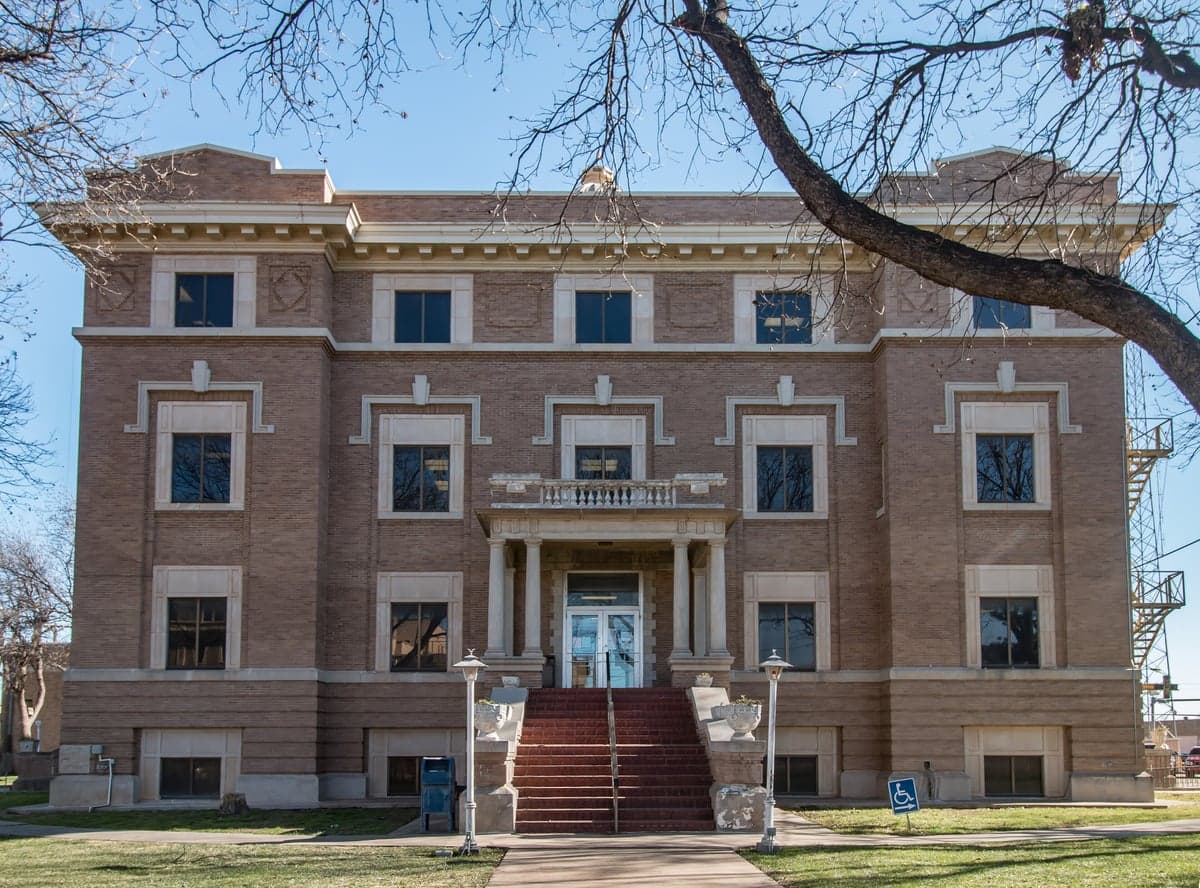
Photo: Wikipedia
Personal Sovereignty in Hale County
Viable for self-reliance. Generally workable, though some barriers may limit total independence.
What does Personal Sovereignty tell us?
Personal Sovereignty measures your capacity for self-reliance and independence with minimal government friction. Higher scores mean fewer barriers between you and the way you want to live... but it assumes you have the space you need and good neighbors.
What does this tell us?
Personal Sovereignty measures your capacity for self-reliance and independence with minimal government friction. Higher scores mean fewer barriers between you and the way you want to live... but it assumes you have the space you need and good neighbors.
State Policy
Energy independence: Net exporter (220% of energy produced in-state)
Personal Liberty
Homesteading

Personal Liberty Analysis
Hale County, Texas, offers a personal sovereignty environment that is distinctly shaped by its rural West Texas character and the state’s strong preemption laws, creating a landscape where individual autonomy is the default rather than the exception. The county seat, Plainview, anchors a region where local governance is minimal, property rights are robust, and the culture of self-reliance is deeply embedded. For those prioritizing personal freedom—whether in tax burden, self-defense, or homesteading—Hale County presents a markedly different proposition than urbanized areas like Lubbock or Dallas, with specific variations across towns like Abernathy, Hale Center, and Petersburg.
Tax burden and regulatory posture in Hale County
Hale County’s tax burden is low by national standards, with no city or county income tax and a property tax rate that typically falls below the Texas state average. The effective property tax rate in Plainview hovers around 1.2% of assessed value, while smaller communities like Edmonson and Cotton Center often see rates slightly lower due to minimal municipal services. The county’s regulatory posture is light-touch: there is no county-wide zoning code, and most unincorporated areas operate under minimal land-use restrictions. This means a resident in rural Hale County can build a workshop, keep livestock, or install a wind turbine without navigating a thicket of permits. However, incorporated towns like Abernathy and Hale Center do maintain basic zoning for commercial districts, but residential and agricultural uses are largely unencumbered. The state’s lack of a personal income tax and its relatively low sales tax (6.25% state, plus local options that push it to 8.25% in Plainview) further reduce the fiscal drag on individuals and families.
Self-defense and gun law specifics in Hale County
Texas is a permitless carry state, and Hale County fully reflects that posture. Residents 21 and older can carry a handgun openly or concealed without a license, and the county sheriff’s office in Plainview does not impose additional local restrictions. The county’s gun culture is robust: shooting ranges are common on private land, and hunting is a staple activity, particularly in the southern parts of the county near Petersburg and Kress. There are no local ordinances banning firearms in parks or public buildings beyond what state law requires, and the county courthouse in Plainview is the only facility with a metal detector. For those concerned with self-defense, the legal environment is permissive: Texas’s Castle Doctrine and Stand Your Ground laws apply fully, meaning no duty to retreat exists in any place where a person has a legal right to be. The sheriff’s department in Hale County is known for a pro-Second Amendment stance, and local gun shops in Plainview report steady business without the regulatory friction seen in more urban counties.
Self-reliance and homesteading viability in Hale County
Homesteading and off-grid living are highly viable in Hale County, thanks to large lot sizes, minimal zoning, and a forgiving regulatory climate. Unincorporated areas allow for parcels as small as one acre without subdivision restrictions, while rural tracts near Seth Ward and Halfway routinely offer 5- to 40-acre plots ideal for self-sufficient living. There are no county-level bans on rainwater harvesting, composting toilets, or solar panels, though well permits are required from the Texas Commission on Environmental Quality—a straightforward process. Off-grid electricity is legal, but most residents connect to the grid via South Plains Electric Cooperative, which offers net metering for solar. The county’s agricultural heritage means that keeping chickens, goats, or even a few head of cattle is common and unregulated in unincorporated areas. In contrast, Plainview’s city limits impose some restrictions on livestock within residential zones, but these are lenient compared to suburban HOA-dominated areas. For those seeking true self-reliance, the rural stretches between Petersburg and Kress offer the most freedom, with no building codes beyond basic septic system requirements.
Personal liberties in Hale County: parental rights, medical autonomy, speech, and property
Parental rights are strongly protected in Hale County, reflecting Texas’s broader legal framework. The state’s parental bill of rights gives parents authority over medical decisions, education, and religious upbringing, and local school districts—including Plainview ISD and Hale Center ISD—do not impose vaccine mandates or curriculum opt-out restrictions beyond state minimums. Medical autonomy is similarly robust: Texas law prohibits local health orders that would override individual choice, and Hale County has no county-level mask or vaccine mandates. Free speech is protected under the First Amendment, and the county’s conservative culture means that political expression—whether on vehicles, lawns, or social media—faces no local censorship. Property rights are a cornerstone: Texas’s private property rights laws limit eminent domain abuse, and Hale County’s appraisal district is known for reasonable valuations. The county’s lack of a local income tax and its minimal business licensing requirements further reinforce personal economic freedom. For families, the absence of HOA-dominated subdivisions in most of the county means fewer restrictions on home-based businesses, vehicle storage, or exterior modifications.
Overall, Hale County ranks among the more sovereignty-friendly areas in Texas, particularly for those who value low taxes, permissive gun laws, and the ability to live off-grid without bureaucratic interference. Compared to the Austin metro area or even Lubbock, the regulatory burden is significantly lighter, and the culture of self-reliance is more ingrained. For a single individual or family prioritizing personal autonomy, the county’s combination of state-level protections and local minimalism creates an environment where freedom is not just a legal right but a daily reality. The trade-off is limited urban amenities and a slower pace of life, but for those who see that as a feature rather than a bug, Hale County delivers a sovereignty profile that is hard to beat in the Texas Panhandle.

* Values derived from national, state, county, city and local statistics and may differ in a specific area. Last updated: 2026-09-08T17:24:20.000Z
Narrative content on this page is AI-generated and may contain mistakes. Verify any details that matter before acting on them.
ReloMaps may earn a commission from affiliate links at no extra cost to you.

