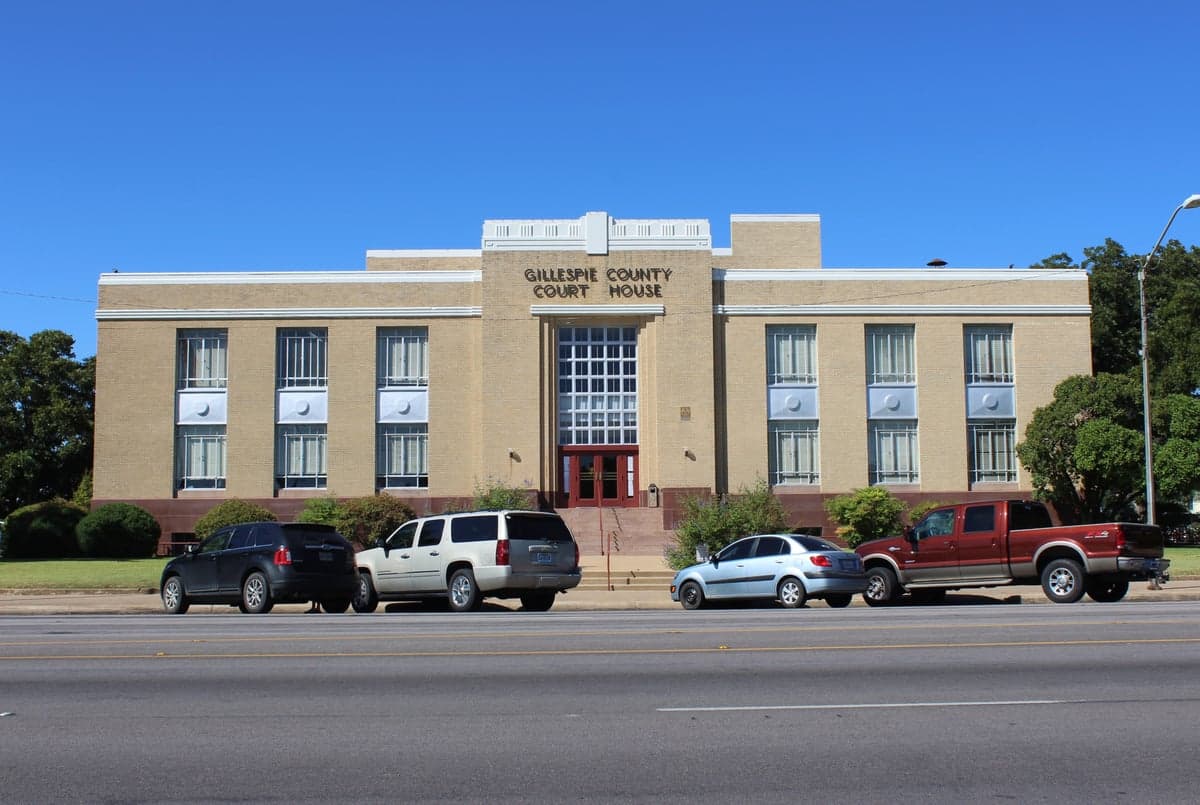
Photo: Wikipedia
Political ClimatePolitical Climate in Gillespie County
Showing district-level results — no local-only data available.
Local Political AnalysisPolitical Analysis of Gillespie County
Gillespie County is one of the most reliably Republican counties in Texas, with a Cook Partisan Voting Index (PVI) of R+11, a full seven points more conservative than the state's already solid R+4 rating. The county hasn't voted for a Democratic presidential candidate since 1952, and in 2024, Donald Trump carried it by a margin of roughly 78% to 21%. That said, the political landscape isn't a monolith—Fredericksburg, the county seat and largest town, shows subtle signs of moderation, while the rural precincts around Harper, Doss, and Willow City remain deeply conservative. The trajectory is toward a slight softening in the city limits as new residents arrive from Austin and San Antonio, but the county's rural character and strong German-heritage cultural conservatism keep the overall lean firmly red.
How it compares to Texas as a whole
Gillespie County's R+11 PVI makes it significantly more Republican than Texas's R+4 rating, placing it in the top 15% of the state's most conservative counties. To put that in perspective, while Texas statewide races are competitive enough that Democrats occasionally win statewide office (like the 2018 Senate race), Gillespie County is a lock for Republicans at every level. In the 2022 gubernatorial election, Greg Abbott won 79% of the county vote versus 59% statewide. The county's Republican primary is often the de facto general election, especially for county commissioner and school board seats. The biggest contrast with the state is cultural: Gillespie County lacks the large urban centers (Houston, Dallas, San Antonio) that drive Texas's Democratic vote, and it has a much smaller Hispanic population (about 18% versus 40% statewide), which tends to moderate the county's politics relative to the state's more diverse electorate.
What this means for residents
For conservative residents, Gillespie County offers a rare experience of near-total political alignment with local government. The county commissioners court, school board, and city council in Fredericksburg are all Republican-dominated, meaning conservative priorities on taxes, property rights, and Second Amendment issues face little organized opposition. For liberal or moderate residents, the reality is more isolating. There is no organized Democratic party presence in the county; the local party chair position often goes unfilled. Socially liberal views on issues like abortion or LGBTQ+ rights are rarely voiced in public forums. That said, the county's small size and neighborly culture mean political disagreements rarely escalate into personal conflict—most people just avoid the topic at the feed store or the Sunday brunch line at the Fredericksburg Bakery. Newcomers from blue areas often report feeling politically invisible but not actively harassed.
Culturally, Gillespie County stands apart from much of Texas due to its deep German heritage, which shapes everything from local holidays (Easter Fires, Oktoberfest) to a pragmatic, live-and-let-live attitude that tempers the hard-edge national politics. The county's strong tradition of volunteerism and community self-reliance means that even as national polarization intensifies, local governance remains focused on practical issues like water rights, wildfire mitigation, and maintaining the historic Main Street district. The biggest policy distinction from the state is the county's aggressive approach to property tax relief—Gillespie County has one of the lowest effective property tax rates in the Hill Country, a direct result of its conservative fiscal culture. For anyone moving here, the key takeaway is simple: if you're conservative, you'll feel at home; if you're not, you'll find a polite, functional community that just happens to vote differently than you do.

State Political ClimatePolitical Climate in Texas
State Political AnalysisPolitical Environment in the State
Texas has been a reliably Republican state for decades, with a Cook Partisan Voting Index of R+4, but the political reality on the ground is far more complex than that single number suggests. The state’s dominant coalition has historically been built on a mix of socially conservative voters in rural areas and suburbs, combined with a business-friendly, low-tax ethos that appeals to transplants and native Texans alike. Over the last 10 to 20 years, however, the political trajectory has shifted noticeably: the GOP’s margins have shrunk from double-digit wins in the 2000s to closer races in the 2020s, driven by explosive growth in the Democratic-leaning urban corridors of Houston, Dallas-Fort Worth, San Antonio, and especially Austin, while the rest of the state has held firm or moved rightward.
Urban vs. rural divide
The political map of Texas is a study in stark contrasts. The major metropolitan areas — Harris County (Houston), Dallas County, Bexar County (San Antonio), and Travis County (Austin) — have become Democratic strongholds, with Travis County delivering margins of over 70% for Democratic presidential candidates in recent cycles. These urban cores are powered by a diverse coalition of young professionals, minority communities, and college-educated voters, many of whom have moved from out of state. Meanwhile, the vast rural and exurban expanse of West Texas, the Panhandle, and East Texas remains deeply Republican. Lubbock, for example, is a conservative anchor in the South Plains, while El Paso stands out as a Democratic-leaning outlier in far West Texas, driven by its large Hispanic population and union history. The suburbs that once reliably voted Republican are now the primary battlegrounds: Collin County (north of Dallas) and Fort Bend County (southwest of Houston) have both seen their GOP margins erode significantly as new residents arrive, though they still lean right overall. This urban-rural split means that statewide elections are increasingly decided by turnout in the suburbs and the ability of each party to mobilize their respective bases.
Policy environment
Texas’s policy environment is defined by a deeply conservative approach to governance that has remained consistent even as the state’s demographics shift. There is no state income tax, which is a major draw for relocators, and property taxes are high to compensate — averaging around 1.6% of assessed value, among the highest in the nation. The regulatory posture is famously business-friendly, with minimal zoning in many cities and a right-to-work law that limits union power. On education, the state has expanded school choice through charter schools and a voucher-like program for special needs students, though a broader school choice bill remains a perennial fight in the legislature. Healthcare policy is marked by the state’s refusal to expand Medicaid under the Affordable Care Act, leaving roughly 18% of Texans uninsured, the highest rate in the country. Election laws have been tightened in recent years, including stricter voter ID requirements and limits on drive-through and 24-hour voting, passed in 2021’s Senate Bill 1. For a conservative relocator, this environment offers low taxes and light regulation; for a liberal one, it means navigating a system with fewer public services and a higher burden of proof for voting.
Recent policy direction
The last few legislative sessions have pushed Texas further into a specific vision of liberty that prioritizes gun rights, parental control, and property rights while restricting abortion and certain local ordinances. In 2021, the state passed permitless carry (HB 1927), allowing most adults to carry a handgun without a license. The same year, the Heartbeat Act (SB 8) banned abortion after roughly six weeks and created a private enforcement mechanism that has withstood early court challenges. On education, 2023 saw the creation of a school safety program (HB 3) requiring armed officers on every campus, alongside a push for curriculum transparency that lets parents review instructional materials. Property rights were strengthened by the passage of a law limiting the ability of homeowners’ associations to ban certain energy-efficient improvements, and the state has continued to resist federal surveillance programs, with a 2023 law (HB 2789) restricting the use of facial recognition by police without a warrant. Voting access remains a flashpoint: the 2021 election law (SB 1) banned 24-hour and drive-through voting, added new ID requirements for mail ballots, and gave poll watchers more latitude, which critics say suppresses turnout and supporters say ensures integrity. For a relocator weighing these issues, Texas offers a clear tilt toward gun rights, parental authority, and local property control, but at the cost of limited abortion access and a voting system that some find restrictive.
Civil unrest & political movements
Texas has seen its share of political flashpoints in recent years, many of them centered on immigration and election integrity. The border city of El Paso has been a focal point for both migrant arrivals and political rhetoric, with Governor Greg Abbott’s Operation Lone Star deploying state troopers and National Guard to the border since 2021, leading to legal battles with the Biden administration over federal authority. In 2022, a busing program sent migrants to Democratic-led cities like New York and Chicago, drawing national attention. On the left, grassroots movements like the Texas Democratic Party’s “Turnout Texas” and the progressive group Indivisible have organized around voting rights and abortion access, while on the right, the Texas GOP’s 2022 platform included a call for a referendum on secession, though this remains fringe rhetoric with little legislative traction. Election integrity controversies have been persistent: after the 2020 election, some Republican officials in counties like Harris and Tarrant pushed for audits, though no widespread fraud was found. A new resident would notice the intensity of these debates in local news and social media, but daily life in most of the state is calm, with the political heat concentrated in legislative sessions and campaign seasons.
Projection
Over the next 5 to 10 years, Texas is likely to remain a Republican-leaning state, but the margin will continue to narrow as the population grows and diversifies. The state is adding roughly 1,000 new residents a day, many from California and other blue states, and these newcomers tend to be more moderate or liberal, especially in the suburbs of Dallas, Houston, and Austin. The rural and exurban areas that anchor the GOP’s base are growing more slowly, meaning the political center of gravity will shift toward the suburbs. This could lead to more competitive statewide races — the 2022 gubernatorial election saw Abbott win by 11 points, down from 13 in 2018 — and a legislature that is still Republican but with a narrower majority. For a relocator moving in now, the expectation should be that Texas will become a true battleground state within a decade, with policy fights over school choice, abortion, and voting access intensifying as the electorate changes. The low-tax, low-regulation core is unlikely to change, but the social and cultural battles will become more heated.
For a new resident, the bottom line is that Texas offers a political environment that is reliably conservative on taxes, guns, and regulation, but increasingly contested on social issues and voting laws. A conservative family will find a state that largely aligns with their values, with strong gun rights, school choice options, and a business-friendly climate. A liberal individual will face a state government that is often hostile to their priorities, but will find like-minded communities in the major cities and a growing political movement that is slowly shifting the state’s trajectory. The practical takeaway is to choose your location carefully — the political experience of living in Austin is radically different from living in Lubbock, and the state’s diversity means you can find a community that fits your worldview, even if the state government as a whole does not.
* Values derived from national, state, county, city and local statistics and may differ in a specific area. Last updated: 2026-06-17T19:57:55.000Z
Narrative content on this page is AI-generated and may contain mistakes. Verify any details that matter before acting on them.
ReloMaps may earn a commission from affiliate links at no extra cost to you.

