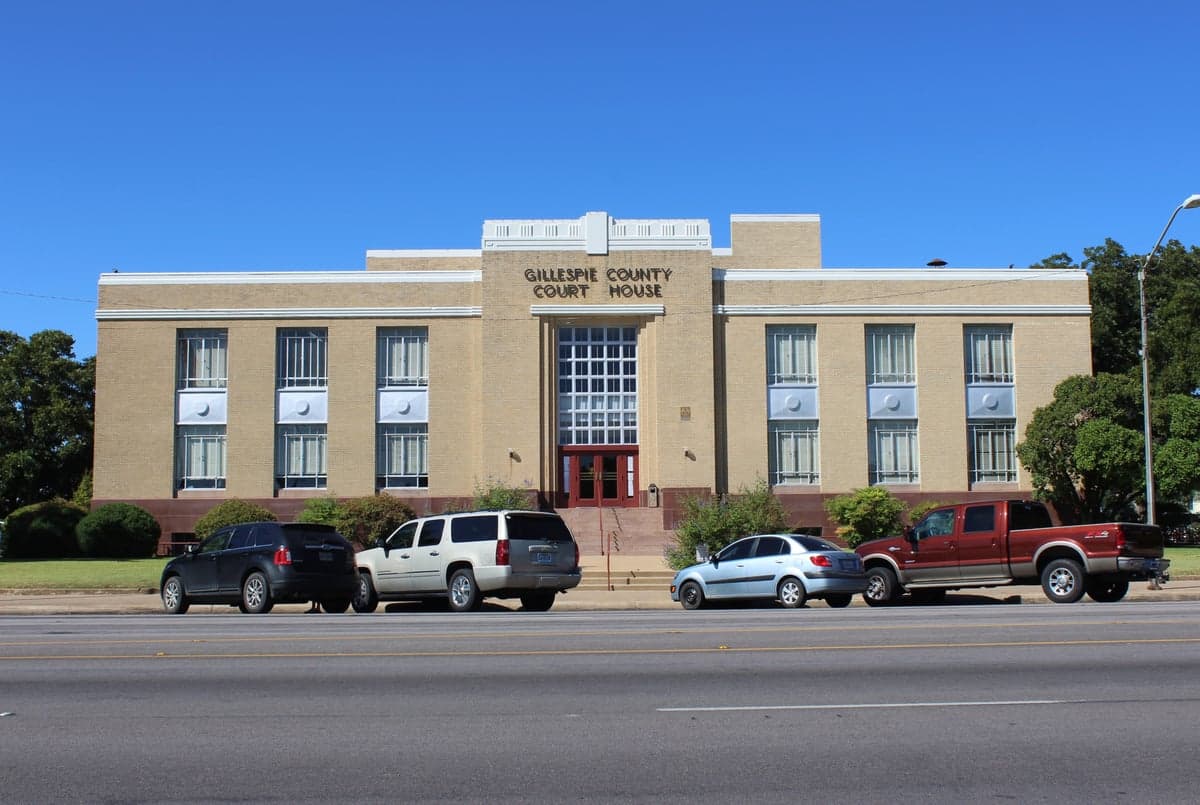
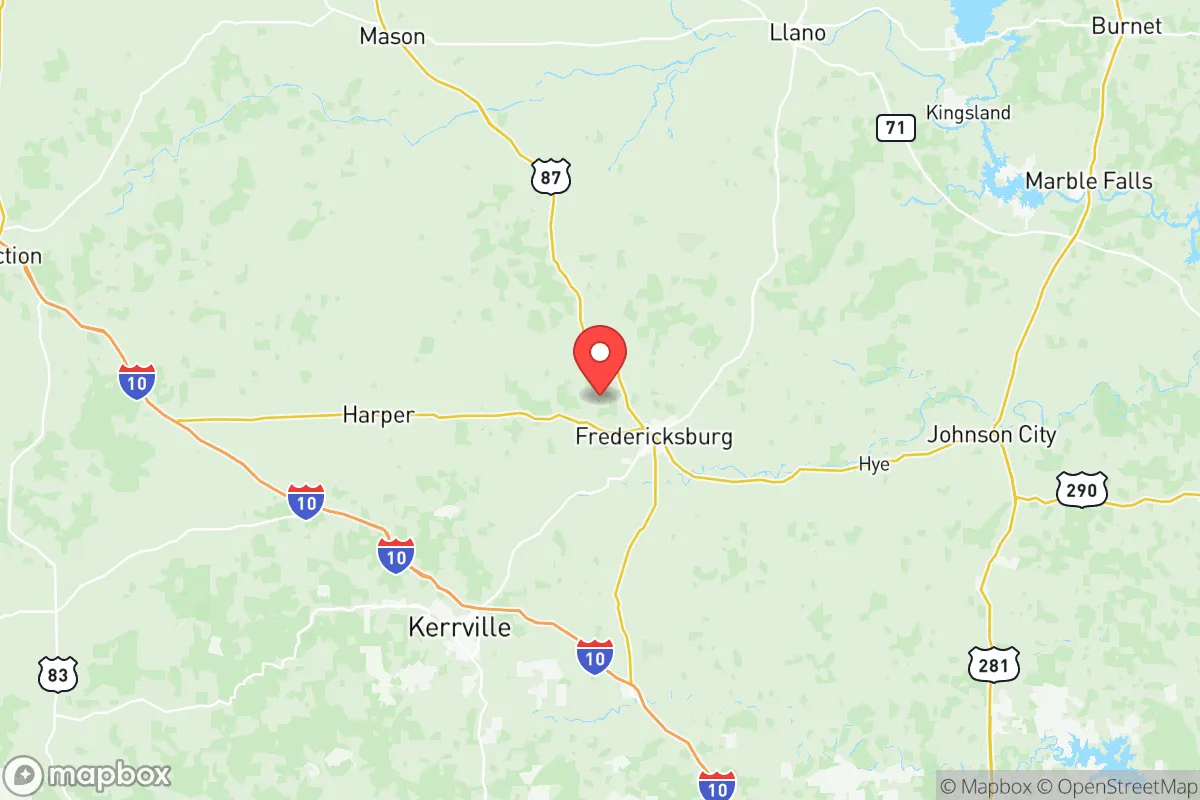
Photo: Wikipedia
Demographics of Gillespie County
Affluence Level in Gillespie County
A middle-class area roughly in line with national averages across income, home values, education, and employment.
People of Gillespie County
Gillespie County, Texas, is home to 27,202 residents who overwhelmingly trace their roots to German immigrants who settled the region in the mid-19th century, creating a distinctive cultural enclave that persists today. The county is 74.2% White, with a significant Hispanic minority of 22.4%, and remains one of the most culturally homogeneous areas in Central Texas. Its identity is anchored by the town of Fredericksburg, the county seat, which still bears the architectural and culinary marks of its German heritage, while the surrounding rural areas and smaller communities like Stonewall and Harper retain a strong ranching and agricultural character. The foreign-born population is just 4.2%, and the county has a college-educated rate of 35.3%, reflecting a mix of long-established families and newer retirees drawn to the Hill Country lifestyle.
Settlement & growth (pre-1960)
Before European settlement, the area now known as Gillespie County was home to the Lipan Apache and Comanche nations, who used the region’s hills and springs for hunting and seasonal camps. Spanish expeditions passed through as early as the 17th century, but no permanent Spanish or Mexican settlements were established here due to the threat of Comanche raids. The land remained largely uncolonized until the Republic of Texas began actively encouraging immigration in the 1840s.
The defining wave of settlement came in 1846, when German immigrants, organized by the Adelsverein (the Society for the Protection of German Immigrants in Texas), founded Fredericksburg as a planned colony. These settlers were primarily farmers, craftsmen, and tradesmen from the Rhineland, Hesse, and other German states, fleeing economic hardship and political unrest. They were granted land by the Texas government and established a tight-knit agricultural community that grew wheat, corn, and later cotton. The German language and customs dominated daily life well into the 20th century, with many residents speaking German at home and in church. Smaller settlements like Stonewall (founded 1870) and Harper (founded 1880s) emerged as farming and ranching hubs, with German families spreading across the county’s limestone hills.
Unlike many Texas counties, Gillespie saw almost no African American settlement after the Civil War; the 0.2% Black population today reflects this history. The county’s economy remained rooted in ranching, peach orchards, and wool production through the early 1900s. The arrival of the Fredericksburg and Northern Railway in 1913 connected the county to larger markets but did not spark major immigration. The Dust Bowl and Great Depression of the 1930s caused some out-migration, but the German-descended population largely stayed put, maintaining a stable, insular community through World War II.
Modern era (post-1965)
The 1965 Hart-Cellar Act had minimal direct impact on Gillespie County, as the region did not attract the large-scale immigrant flows seen in Houston or Dallas. Instead, the county’s modern demographic shift has been driven by domestic migration. Beginning in the 1970s, the scenic Hill Country began drawing retirees, second-home buyers, and entrepreneurs from larger Texas cities and out of state. This influx has been predominantly White and relatively affluent, raising the county’s median income and home values, particularly in Fredericksburg and along the U.S. 290 corridor.
The Hispanic population, which now stands at 22.4%, grew steadily from the 1980s onward, primarily through migration from Mexico and South Texas. These residents are concentrated in Fredericksburg’s service and hospitality sectors—restaurants, landscaping, and construction—and have established a visible presence in the town’s workforce and schools. Unlike the German-descended population, which is spread across the county, the Hispanic community is more urbanized, with many families living in Fredericksburg’s newer subdivisions and mobile home parks. Smaller towns like Doss and Cherry Spring remain overwhelmingly White and German-descended.
The East/Southeast Asian population (0.3%) and Indian subcontinent population (0.0%) are negligible, reflecting the county’s lack of high-tech or professional job centers that attract these groups. The county has not experienced the suburbanization boom seen in nearby Comal or Hays counties; instead, growth has been steady but modest, with the population increasing from about 17,000 in 1990 to 27,202 today. The post-1965 era has thus been one of gradual diversification through Hispanic migration and White domestic in-migration, rather than through international immigration.
The future
Gillespie County is projected to become slightly more diverse over the next 10-20 years, driven primarily by continued Hispanic population growth. The Hispanic share, currently 22.4%, could reach 30-35% by 2040, as younger Hispanic families have higher birth rates and as service-sector jobs continue to attract new arrivals. The White population, while still the majority, will likely shrink as a percentage due to an aging demographic and lower birth rates among long-established German-descended families.
New communities are concentrating in Fredericksburg’s expanding subdivisions and along the U.S. 290 corridor toward Johnson City, where land is cheaper and development pressure is rising. The county’s cultural identity is evolving from a purely German-American enclave to a more layered Hill Country identity that incorporates Hispanic traditions, evident in bilingual school programs and the growing popularity of Tex-Mex cuisine alongside traditional German fare. The county is unlikely to see significant Asian or Indian immigration, as it lacks the tech or university sectors that attract those groups. The future Gillespie County will likely be a place where German heritage remains a strong cultural touchstone, but where everyday life becomes increasingly bilingual and bicultural.
For someone moving in now, Gillespie County offers a stable, family-oriented community with a strong sense of place, low crime, and good schools—but also a population that is slowly becoming more diverse. The county’s character is shifting from a historically insular German settlement to a broader Hill Country destination that balances tradition with gradual change. New residents, whether retirees or young families, will find a welcoming but culturally distinct environment where the past remains visible in every limestone building and peach orchard.

* Values derived from national, state, county, city and local statistics and may differ in a specific area. Last updated: 2026-06-17T19:57:55.000Z
Narrative content on this page is AI-generated and may contain mistakes. Verify any details that matter before acting on them.
ReloMaps may earn a commission from affiliate links at no extra cost to you.

