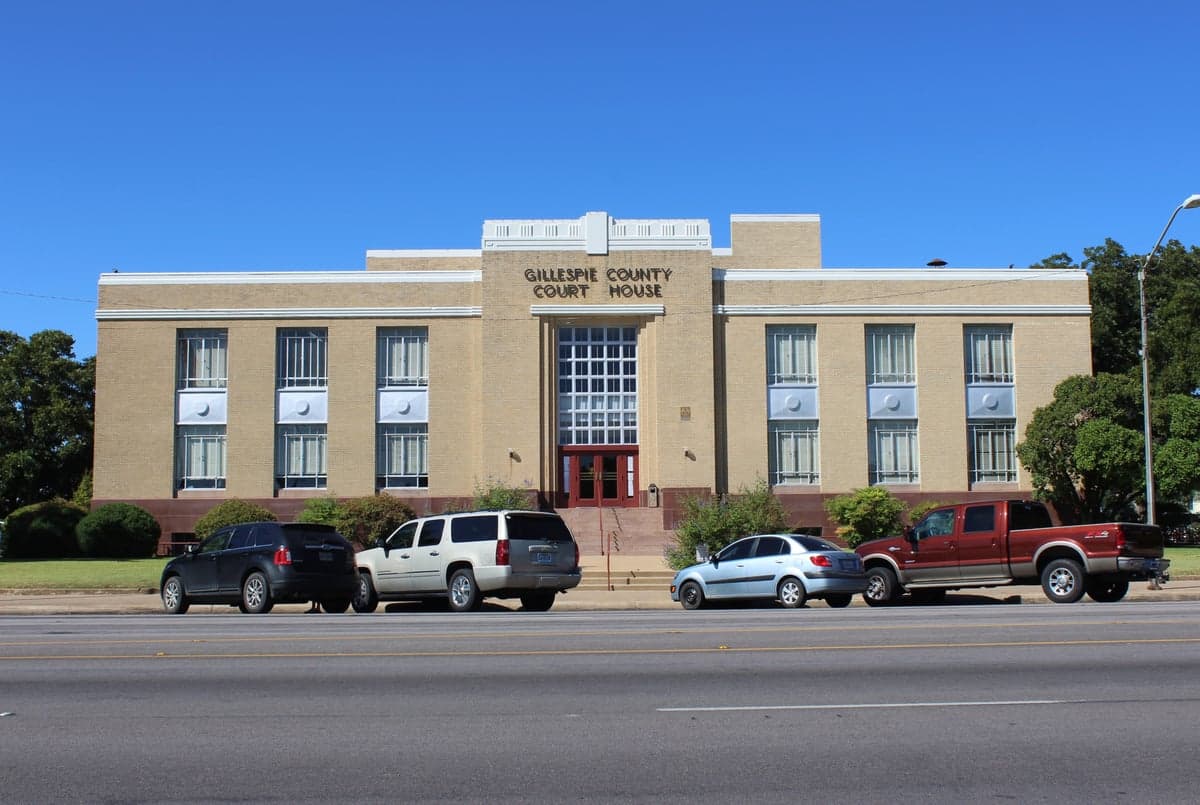
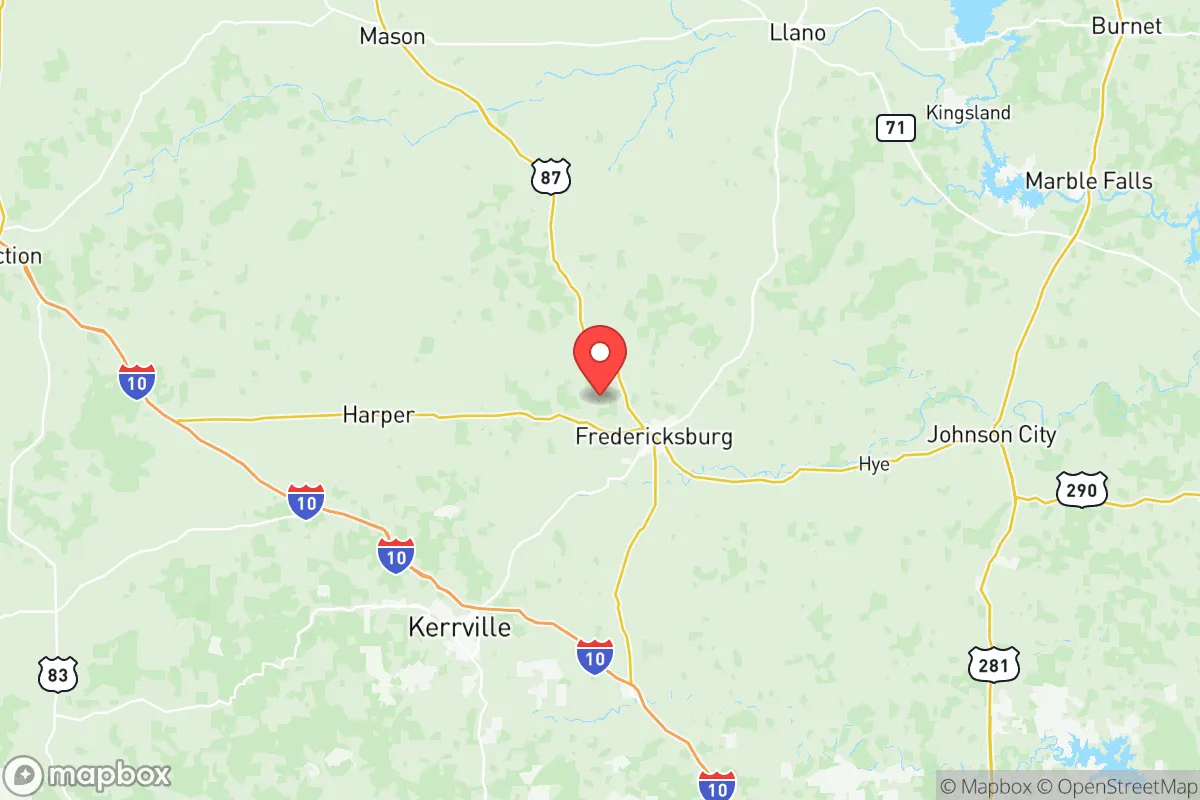
Photo: Wikipedia
Personal Sovereignty in Gillespie County
Strong independent fundamentals that actively favor personal liberty and low regulation.
What does Personal Sovereignty tell us?
Personal Sovereignty measures your capacity for self-reliance and independence with minimal government friction. Higher scores mean fewer barriers between you and the way you want to live... but it assumes you have the space you need and good neighbors.
What does this tell us?
Personal Sovereignty measures your capacity for self-reliance and independence with minimal government friction. Higher scores mean fewer barriers between you and the way you want to live... but it assumes you have the space you need and good neighbors.
State Policy
Energy independence: Net exporter (220% of energy produced in-state)
Personal Liberty
Homesteading

Personal Liberty Analysis
Gillespie County, anchored by the city of Fredericksburg, offers one of the strongest personal sovereignty environments in the Texas Hill Country, characterized by a deeply ingrained culture of self-reliance and a local government that consistently prioritizes minimal interference in private life. The county’s regulatory posture is notably light-touch compared to neighboring areas like Travis or Bexar counties, and its political leadership has actively resisted state and federal overreach on issues ranging from property rights to public health mandates. For individuals and families who value autonomy over convenience, Gillespie County presents a compelling balance of rural independence and functional local governance, though the specific level of freedom varies between the incorporated city limits of Fredericksburg and the unincorporated areas like Stonewall, Doss, and Harper.
Tax burden and regulatory posture in Gillespie County
Gillespie County operates under Texas’s no-state-income-tax framework, but its local tax burden is moderate relative to other rural Texas counties. The county’s property tax rate hovers around 0.65% to 0.75% of assessed value, which is competitive but not the lowest in the state. Fredericksburg’s city tax adds roughly 0.35%, making the combined rate slightly higher inside city limits than in unincorporated areas like Harper or Doss. The county has not adopted overly restrictive building codes for rural properties; outside the Fredericksburg city limits, there are no county-wide zoning ordinances, which means landowners in areas like Stonewall and Willow City can build, fence, and use their property with minimal bureaucratic hurdles. The regulatory environment is best described as permissive — the county issues permits for septic systems and well drilling as required by state law, but does not impose additional local restrictions on accessory dwellings, home-based businesses, or agricultural structures. This stands in stark contrast to the regulatory density found in Austin’s extraterritorial jurisdiction or even in nearby Kerrville.
Self-defense rights and gun law specifics in the Hill Country
Gillespie County is one of the most gun-friendly jurisdictions in Texas, reflecting both state law and local enforcement philosophy. Texas is a permitless carry state, and Gillespie County Sheriff’s Office has publicly stated it will not enforce any federal firearm regulations it deems unconstitutional, including potential future restrictions on certain rifle configurations or magazine capacities. The county is a designated Second Amendment Sanctuary, a resolution passed by the Commissioners Court in 2021 that remains in effect. Open carry of handguns is common in Fredericksburg and throughout the county, and concealed carry is virtually unrestricted. The sheriff’s office processes license-to-carry applications efficiently, with wait times typically under two weeks. For those who prioritize self-defense, the practical reality is that law enforcement response times in rural areas like Doss or Crabapple can exceed 20 minutes, making personal firearm proficiency a practical necessity rather than a political statement. There are no local ordinances restricting where firearms can be carried, beyond the state-mandated prohibitions on government buildings and schools.
Self-reliance and homesteading viability across the county
Gillespie County is highly viable for homesteading and off-grid living, though the feasibility varies significantly by location. Minimum lot sizes in unincorporated areas are governed by the subdivision regulations of the Hill Country Underground Water Conservation District, which generally require one-acre minimums for new subdivisions where no public water is available. However, existing parcels in areas like Harper, Doss, and Willow City can be as small as one to five acres and still support a well and septic system. The county does not require building permits for agricultural structures or single-family dwellings outside the Fredericksburg city limits, though a septic permit from the county environmental health office is mandatory. Off-grid solar is legal and common; the county does not mandate grid connection, and the local electric cooperative, Pedernales Electric Cooperative, allows net metering for solar installations. Rainwater collection is legal and encouraged, and the county offers a property tax exemption for rainwater harvesting systems. The primary constraint is water availability: the Trinity Aquifer is reliable in the southern and eastern parts of the county, but wells in the northern areas near Doss and Crabapple may need to be drilled deeper, with costs ranging from $15,000 to $30,000. The county’s agricultural exemption for property tax is generous — landowners with as few as 10 acres can qualify if they engage in livestock grazing, hay production, or beekeeping, which significantly reduces the tax burden for homesteaders.
Personal liberties: parental rights, medical autonomy, and property
Gillespie County has a strong record of protecting parental rights and medical autonomy, consistent with the broader Texas political environment but amplified by local governance. The county’s school districts — Fredericksburg Independent School District and Harper Independent School District — have adopted policies that require parental notification for any medical or mental health services provided to students, and both districts have resisted implementing state-mandated curriculum changes that parents found objectionable. The county’s public health department did not mandate mask or vaccine requirements during the COVID-19 pandemic, and the Commissioners Court passed a resolution in 2021 affirming that no county resources would be used to enforce federal vaccine mandates. Property rights are robust: the county has no rent control, no short-term rental moratoriums (though Fredericksburg city limits have some restrictions on STRs), and no local ordinances restricting the use of land for agricultural or residential purposes. The county’s approach to property rights is best described as "you can do what you want with your land as long as it doesn’t create a nuisance for your neighbor" — a standard that is enforced primarily through the court system rather than through proactive code enforcement. Speech and assembly are fully protected; the county has not attempted to regulate political signage, public gatherings, or religious expression, and the Fredericksburg city council has consistently voted down any proposals to restrict First Amendment activities in public spaces.
Overall, Gillespie County ranks among the top 10% of Texas counties for personal sovereignty, offering a regulatory environment that is substantially lighter than the Austin metro area and more consistently freedom-oriented than even neighboring Kendall or Kerr counties. The combination of no county zoning, permissive gun culture, strong parental rights protections, and viable off-grid homesteading makes it a standout choice for individuals and families who prioritize autonomy. The trade-off is that this freedom comes with limited services — law enforcement response times are long in rural areas, there is no public transportation, and the county’s health care infrastructure is concentrated in Fredericksburg. For those willing to accept those trade-offs, Gillespie County delivers a level of personal sovereignty that is increasingly rare in Texas’s growing urban corridors.

* Values derived from national, state, county, city and local statistics and may differ in a specific area. Last updated: 2026-06-17T19:57:55.000Z
Narrative content on this page is AI-generated and may contain mistakes. Verify any details that matter before acting on them.
ReloMaps may earn a commission from affiliate links at no extra cost to you.

